Get Full Government Meeting Transcripts, Videos, & Alerts Forever!
Get email alerts on the Sb707 Remote Participation topic
No spam. Unsubscribe anytime.
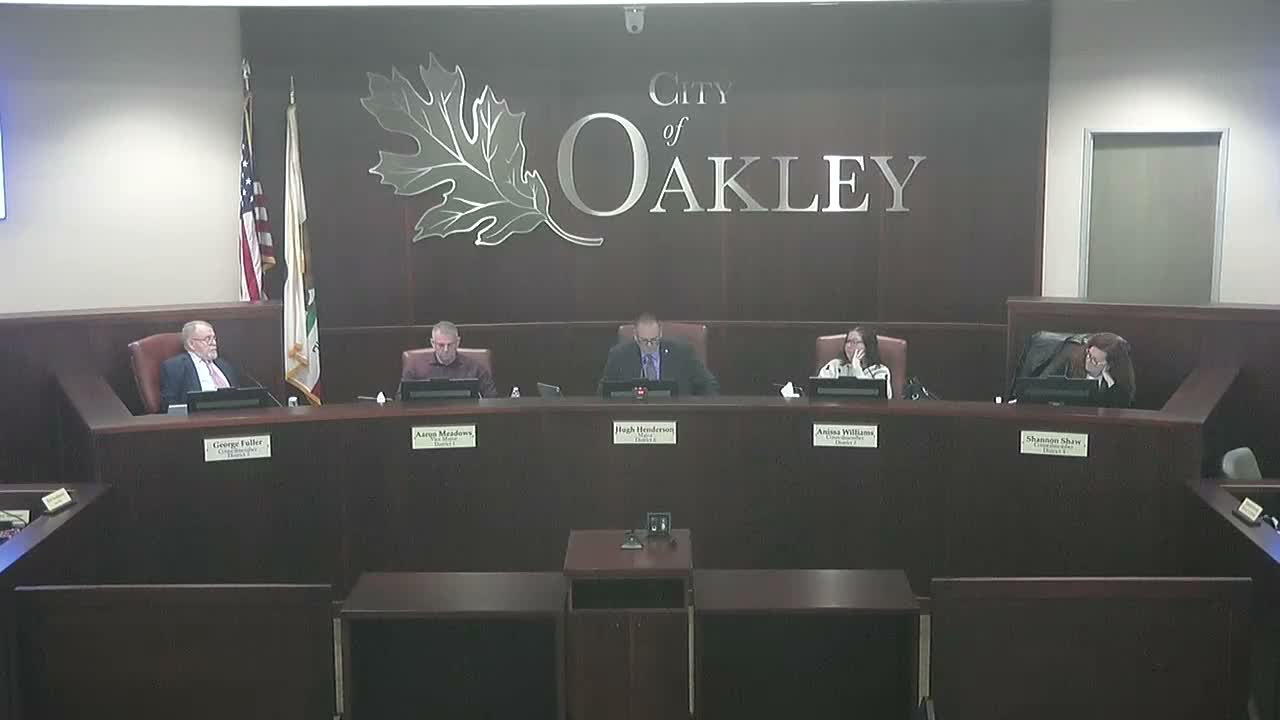
Oakley council reviews SB 707 changes to Brown Act, seeks direction on two‑way public access
Summary
City attorney Derek Cole briefed the Oakley City Council on SB 707, describing immediate Brown Act updates and July 1 requirements for two‑way audiovisual public access, remote participation limits, accessibility standards and outage procedures; councilmembers debated audio-only vs. video, camera policies and accommodations.
City Attorney Derek Cole told the Oakley City Council that SB 707 represents ‘‘the biggest change in the Brown Act in years,’’ and walked the council through immediate compliance steps and decisions it must make before the law’s Phase 2 effective date on July 1.
Cole said Phase 1 changes already in effect require the city to distribute Brown Act materials, clarify social‑media limits for council members, and expand oral compensation reporting for executives beyond the city manager to department heads. He described new disorderly‑conduct rules that require warnings and allow removal of disruptive participants, including online disruptions.
The bulk of the presentation focused on Phase 2: a statutory mandate that eligible legislative bodies (cities above 30,000 population) provide two‑way audiovisual access so remote members and remote members of the public can see and be seen by the dais. Cole said the city must provide accessible links and dial‑ins and prepare a disruption policy to address outages. In the event of a prolonged outage, the law requires a one‑hour pause; after that threshold the body may continue in person following a public‑interest finding recorded in the minutes.
Councilmembers pressed staff for operational details. Shaw asked how the city will identify a council member’s ‘‘just cause’’ for a remote appearance and who would enforce social‑media violations; Cole said the law generally relies on an honor system for just‑cause statements from members and that enforcement can come from a district attorney complaint or civil suit. Fuller raised repeated questions about qualifications for disability accommodations and HIPAA implications; Cole said accommodation decisions will be handled confidentially by management and the city will follow applicable ADA law.
Councilmembers expressed differing preferences about whether the council should implement full audiovisual access — allowing remote participants and members to use video — or an audio‑only option. Vice Mayor Meadows said she favored camera off for members of the public; Councilmember Williams argued that cameras can ‘‘humanize’’ remote participation. Cole said staff will present technology options (audio vs. audiovisual and whether cameras are allowed) and an RFP is already in the field for AV modernization.
Cole also identified operational requirements the council must adopt: a public meetings web page with clear instructions, accessibility compliance for dial‑ins and video, and a mechanism for tracking the five allowable remote ‘‘just cause’’ appearances per calendar year for members. He noted an exception: members with qualifying disabilities who need remote attendance for accommodations do not count toward the five‑appearance limit.
City staff told the council $150,000 was budgeted in the FY 2025–26 capital budget for AV modernization; managers said they expect proposals this week and will return with recommended contracts and a draft disruption policy well before July 1. Cole said the council will have to record any formal public‑interest finding in the minutes if the AV service outage forces a pause.
The work session ended with councilmembers broadly supportive of implementing two‑way access while reserving judgment on whether audience cameras should be permitted. Staff will return with technical options, draft policies on outages and ADA accommodations, and an implementation schedule ahead of the July 1 deadline.