Get Full Government Meeting Transcripts, Videos, & Alerts Forever!
Get email alerts on the Land Use Development topic
No spam. Unsubscribe anytime.
Oakley council approves Bridgehead project after applicant drops data‑center option; vote 4‑1
Summary
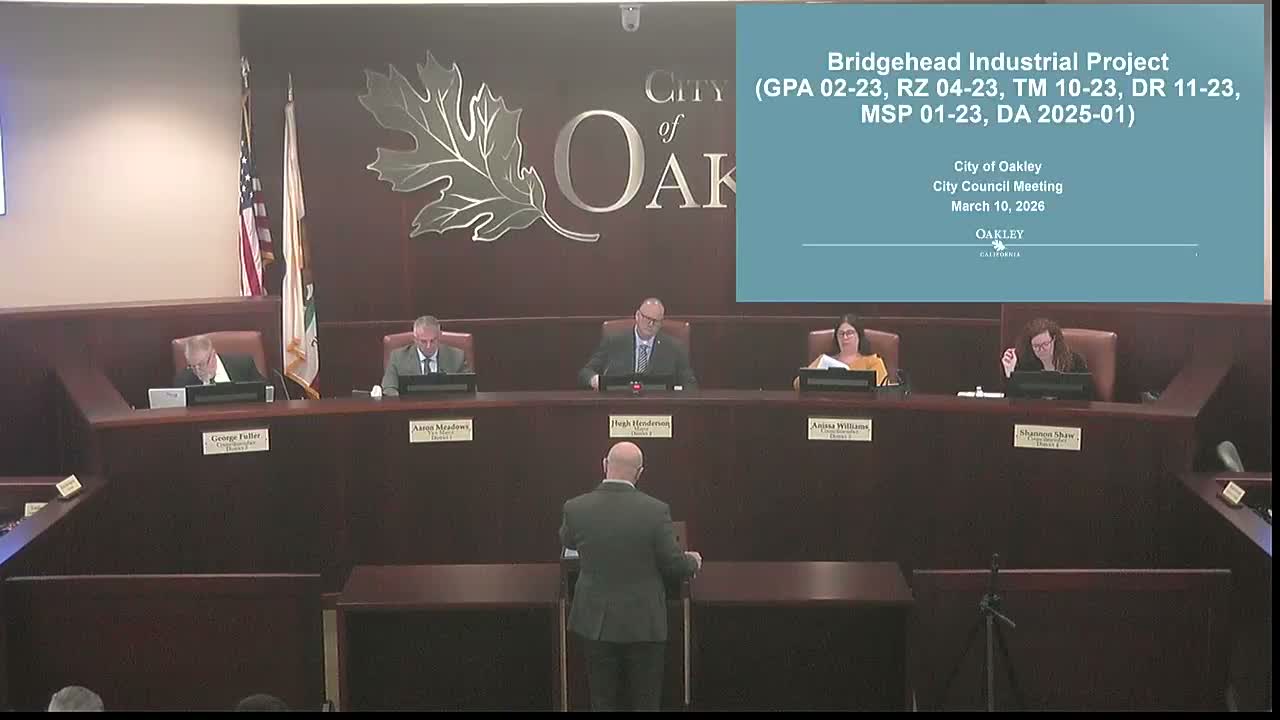
After hours of public testimony for and against a proposed 164‑acre Bridgehead Industrial Project, the Oakley City Council certified the EIR and approved related entitlements 4‑1 on March 10, 2026; the developer agreed to remove data centers from the PUD and staff added a Diablo Water District utility coordination condition.
Oakley City Council voted 4‑1 on March 10 to certify the environmental impact report for the Bridgehead Industrial Project and to approve the package of entitlements for the 164‑acre development in Northwest Oakley, after the project's developer agreed at the hearing to remove data centers from the planned unit development.
The council's votes covered certification of the final EIR, approval of a general plan amendment, introduction of the rezone ordinance to create a PUD, adoption of a tentative map, and introduction of an ordinance to authorize a 20‑year development agreement. Vice Mayor Aaron Meadows moved the package with the applicant's data‑center removal and a Diablo Water District condition added; Councilmember Shaw seconded. The tally was: Fuller no; Shaw yes; Williams yes; Meadows yes; Mayor Henderson yes.
The project applicant, Jason Bennett of JB2 Partners, told the council that data centers were never the primary objective and offered a formal change during the hearing: “I respectfully request to modify our application to remove data center from the PUD and from the application in its entirety.” Bennett said the team would continue to market the site for light industrial, warehouse and logistics uses designed to be compatible with the nearby Oakley Logistics Center.
Staff and consultants described the project and the CEQA analysis. Ken Streelow, the city's Community Development Director, summarized the entitlements, design review, phasing and the developer's $250,000 contribution toward a future railroad overcrossing. He also explained the EIR process and its findings, saying, “And these are the three areas where there are significant unavoidable impacts identified in the EIR,” naming conversion of prime farmland and regional air‑quality criteria pollutant impacts among them.
Rod Stinson, the EIR consultant, told the council the EIR found that project emissions for reactive organic gases (ROG) and nitrogen oxides (NOx) would exceed regional thresholds even after feasible mitigation, making some air‑quality impacts "significant and unavoidable," though the EIR's health‑risk assessment indicated toxic‑air cancer risks at the nearest sensitive receptors would remain below air‑district thresholds.
Residents who live near the proposed southern parcels and users of the adjacent Big Break Regional Shoreline urged the council to reject or to tighten the project, raising concerns about water use, noise, light, traffic and long‑term property values. Several speakers requested that the council ban data centers outright rather than leaving them as a conditional use; others urged approval to secure jobs and local union construction opportunities. Tracy Boyum, a Vintage Parkway resident, asked for building height limits and larger setbacks along Big Bridal Road.
Union representatives and labor leaders gave sustained support for the project's job prospects. Chris Palomo, a senior organizer with the North Coast States Carpenters Union, described union agreement commitments and estimated thousands of construction work hours and local economic output during build‑out.
Council deliberations focused on three topics: the EIR's unavoidable impacts, required public‑benefit improvements to the city's road and trail network, and protections the PUD could provide for residents (including photometric shielding, landscaping, and timing triggers so frontage improvements occur before occupancy). Staff told the council that Big Bridal Road, Bridgehead Road and Main Street frontages would require curb, gutter, sidewalk and bicycle lanes as part of the improvement plans and that some improvements would be triggered by specific building permits or occupancy.
The approved motion included two explicit changes from the packet: removing "data center" as a permitted use in the PUD and adding a condition, as requested by Diablo Water District, that any use requiring utility capacity beyond the project's analyzed amounts must secure upgraded service capacity and coordinate with the respective provider before occupancy.
The development agreement being introduced calls for a 20‑year term tying certain entitlement durations (such as design‑review life) to the agreement and locks in the developer's obligation for the stated public benefits; the council directed staff to insert (and the motion included) the Diablo Water District language to address capacity concerns.
What happens next: the council waived first readings and introduced ordinances tonight and took the required roll‑call votes to move the entitlements forward. Because the developer removed the data‑center potential and the council added the water‑coordination condition, the approvals the council adopted apply to light‑industrial/logistics uses as now defined in the revised PUD. The project will still require building permits, improvement plans, and any subsequent discretionary approvals for future conditional uses. Opponents may pursue judicial review or referendum challenges; several speakers referenced their willingness to pursue legal options.
The council also scheduled a future work session to examine whether and where the city should allow data centers in its zoning rules, after community members and multiple councilmembers requested clearer policy guidance.
Votes at a glance: The consolidated motion to certify the final EIR and approve the related general plan amendment, rezone introduction, tentative map and development agreement (with data‑center removal and Diablo Water District condition) passed 4‑1 (Aye: Shaw, Williams, Meadows, Henderson; No: Fuller).