Get Full Government Meeting Transcripts, Videos, & Alerts Forever!
Get email alerts on the Transportation Safety topic
No spam. Unsubscribe anytime.
Martinez unveils data-driven roadmap to reduce pedestrian and cyclist collisions
Summary
Consultant Advanced Mobility Group presented a draft Vulnerable Road User Safety Action Plan that ranks the city’s top 25 collision locations, proposes countermeasures (leading pedestrian intervals, HAWK beacons, bike lanes) and plans two public workshops in spring to narrow priority sites to 10 for conceptual design.
The Martinez City Council reviewed a data-driven Vulnerable Road User Safety Action Plan on Jan. 21 that aims to reduce pedestrian and bicyclist collisions citywide by identifying prioritized intersections and corridors and proposing targeted engineering and operational countermeasures.
Consultant Christopher (Advanced Mobility Group) told the council the team analyzed about six years of collision data and identified roughly 61 collisions involving pedestrians and bicyclists; he said the methodology gives extra weight to pedestrian and bicycle crashes and to incidents with severe outcomes to elevate locations that disproportionately risk vulnerable users. The draft list includes 25 intersections and several corridors—Alhambra Avenue appears repeatedly on the draft priority list.
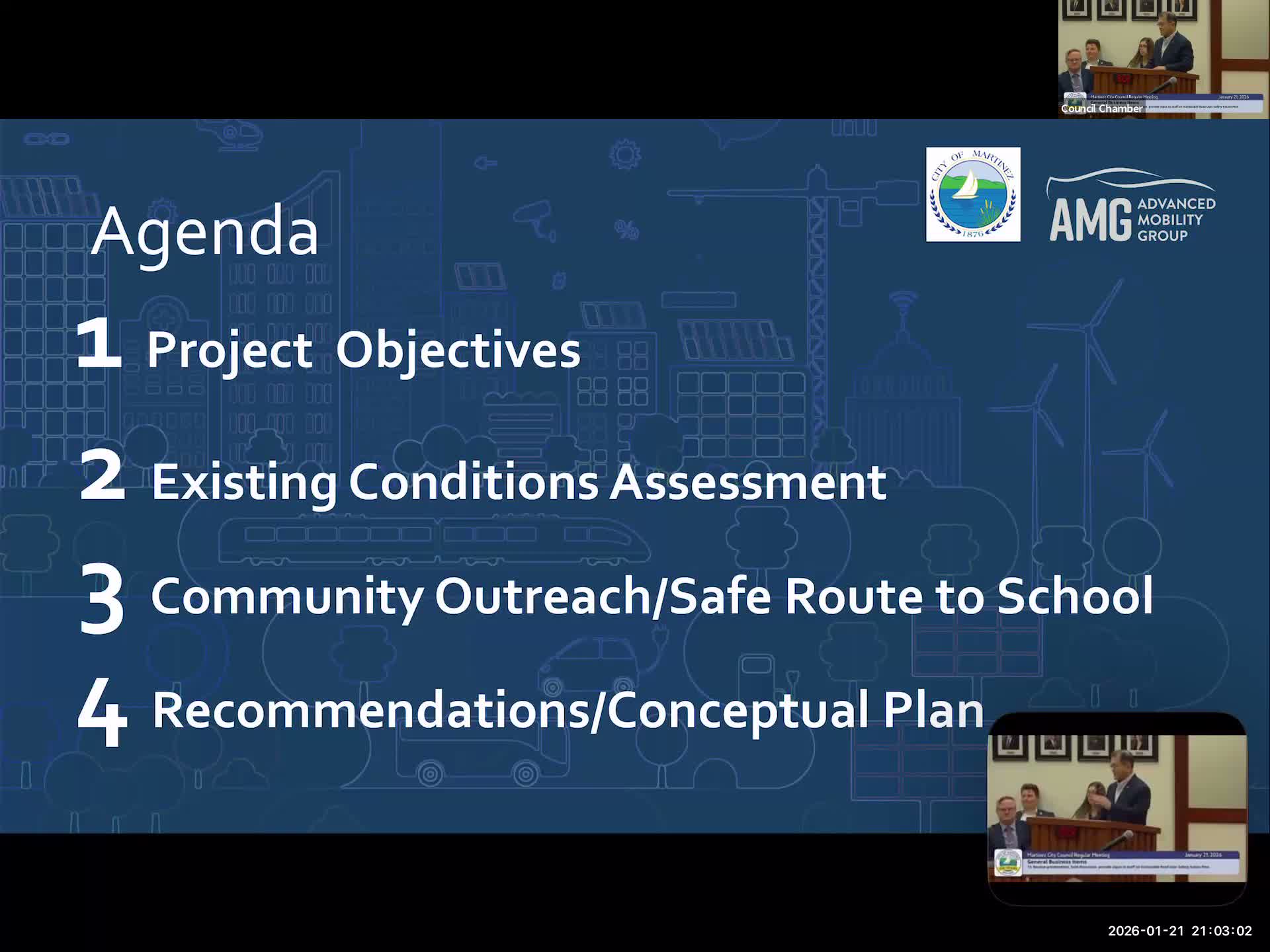
Recommendations range from lower-cost treatments such as rectangular rapid-flashing beacons and high-visibility markings to more substantial engineering work—HAWK (pedestrian hybrid) beacons, buffered bike lanes, and corridor “road diets” that narrow travel lanes to reduce speed. Consultant Christopher said the project will also develop Safe Routes to School mapping for five schools and that the consultant expects two public outreach meetings in the spring to gather community input before narrowing to 10 priority intervention sites and producing conceptual plans by December 2026.
Council members emphasized lighting, speed reduction and neighborhood-based outreach. Vice Mayor Mollie and others urged staff to include “low-hanging fruit” such as lit crosswalks and signal timing adjustments alongside longer-term engineering solutions, and to coordinate any major speed-control changes with emergency-response agencies.
Staff said the plan will run in parallel with traffic service requests already submitted through the city portal and that the outreach timeline will allow the public to add local observations (including near-miss locations) to the technical analysis. Two public workshops and school-focused engagement will be scheduled as the consultant refines candidate locations.