Get Full Government Meeting Transcripts, Videos, & Alerts Forever!
Get email alerts on the Local Taxation topic
No spam. Unsubscribe anytime.
Calabasas council unanimously declares fiscal emergency, schedules May mail-ballot for 1% sales tax
Summary
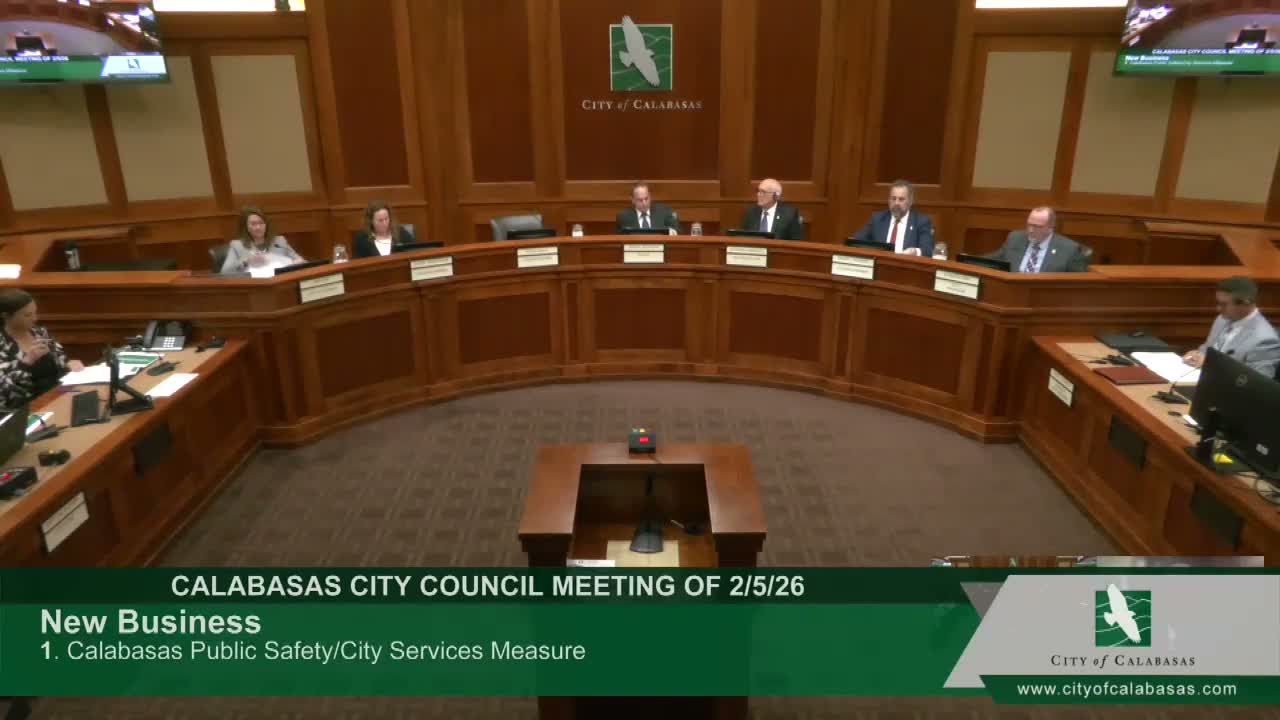
On Feb. 5 the Calabasas City Council unanimously declared a fiscal emergency and voted to place a proposed 1% transactions-and-use tax on a stand-alone all-mail special election, citing structural deficits and an estimated $5.3 million in annual revenue that city leaders say would fund public safety and essential services.
Calabasas, Calif. — The Calabasas City Council on Feb. 5 unanimously declared a fiscal emergency and voted to place a proposed 1% transactions and use tax on a stand-alone all-mail special election the council called for May, saying the measure would preserve local control of sales-tax capacity and generate roughly $5.3 million a year for the city if approved.
City Manager Ken Demick told the council and public the city is facing a structural general-fund deficit and declining reserves, and said staff projects the one-cent tax could produce approximately $5,300,000 annually for local use. “If we do not act first, then the county or another agency could claim that capacity,” Demick said, urging the council to move quickly after Los Angeles County advanced a separate half-cent county measure.
Pam Lee, who outlined the procedural steps, said council action is limited to deciding whether to put the question before voters; adoption of the tax itself would be up to residents. Lee told the council the requested actions are to (1) declare a fiscal emergency (a procedural finding to permit a special election under Article XIII C, §2(b) of the California Constitution), (2) call a special all-mail election, (3) place the 1¢ transactions-and-use tax measure on the ballot, and (4) direct staff to carry out election preparations. Lee also summarized consumer protections in the draft measure, including an independent audit, public reporting requirements and creation of a citizens advisory committee to review expenditures.
Members of the public largely urged the council to act, while asking for oversight and clearer ballot language. Brian Cameron, a public-safety commissioner, presented a household-cost example and urged passage to fund programs such as Firewise. “This is for a city that needs the additional funds for some of the critical programs that we’ve adopted,” Cameron said. Several speakers including Joe Chilco and Richard Sherman specifically requested a citizens oversight committee and transparency in the ballot materials. A smaller group of residents, including Planning Commissioner Michael Harrison, urged additional cuts and more quantified staff reductions before imposing a new tax.
Councilmembers framed the vote as a way to retain local control and address long-term capital needs. Councilmember David Shapiro noted the city faces deficits in upcoming budget projections and said public safety and emergency preparedness are priorities for the council. Mayor Pro Tem Ed Albrecht and others said a local measure is one of the few ways to secure revenue that remains in Calabasas rather than flowing to county programs.
On roll call the council unanimously adopted Resolution No. 2026-1994 declaring a fiscal emergency, then passed Resolution No. 2026-1995 calling an all-mail special election (to be conducted if so called on May 5, 2026) to consider Ordinance No. 2026-422, which would impose a 1% transactions and use tax administered by the California Department of Tax and Fee Administration. The council also directed the mayor to prepare the pro-argument for the ballot statement and authorized the city manager to execute election documents. The staff report estimated the cost of a stand-alone special election at roughly $200,000–$300,000.
Staff cautioned that wording matters: the council chose a general-government-purpose tax (with an emphasis on public safety) rather than a narrowly designated public-safety-only tax because the latter would require a two-thirds vote at the ballot. Pam Lee said the proposed general-fund approach preserves the majority-vote threshold and allows flexibility in spending while including oversight provisions.
If voters approve the measure and the state review proceeds, staff said implementation would begin in the quarter after the Department of Tax and Fee Administration processes the change (roughly beginning Oct. 1, following the timetable described by staff). Councilmembers said they will return with a resolution setting oversight committee parameters and any needed edits to the ballot materials.
The meeting concluded with the council’s unanimous votes and an adjournment at 5:25 p.m.; the council scheduled its next regular meeting for Feb. 11, 2026.