Get Full Government Meeting Transcripts, Videos, & Alerts Forever!
Get email alerts on the Cannabis Retail Policy topic
No spam. Unsubscribe anytime.
Danville council pauses plan to allow storefront cannabis after safety, zoning and enforcement concerns
Summary
After a two‑hour study session and extensive public comment, Danville council members told staff they would not move forward at this time with permitting brick‑and‑mortar cannabis retail in the town, citing public safety, buffer zones and enforcement costs; business owners and industry representatives urged reconsideration and described medical benefits and local economic impacts.
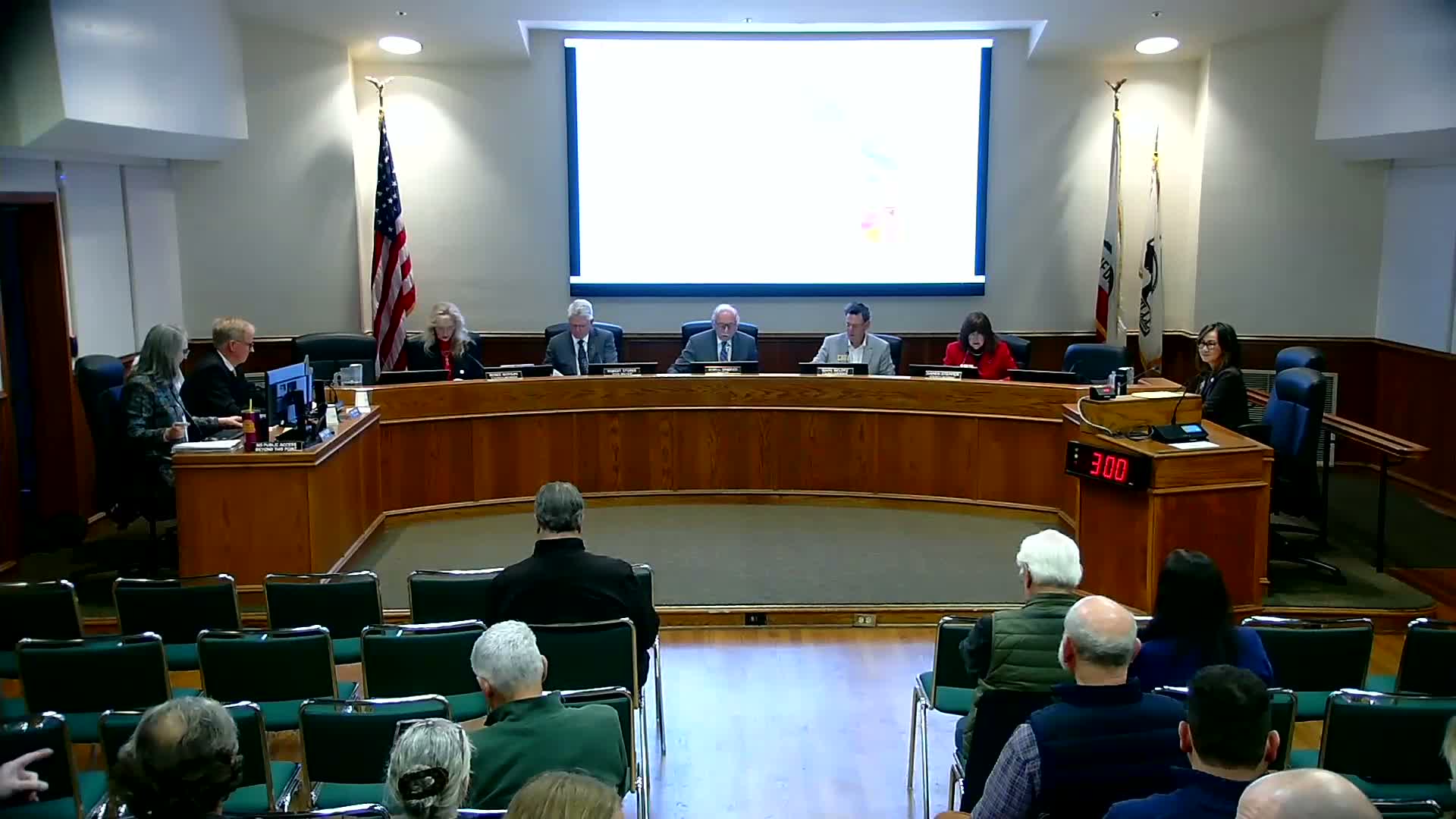
Danville officials on Feb. 17 weighed whether to allow storefront cannabis retail and, after staff presentations, police input and more than an hour of public comment, signaled they would not proceed under the current circumstances.
City Attorney Rob Ewing opened the study session by framing the issue as a zoning and policy question rather than a decision about any one business. He pointed council members to model ordinances from San Pablo, Benicia and Martinez and to maps showing the state’s 600‑foot buffer requirement from schools, day cares and youth centers. Ewing noted cities typically add detailed application and operational requirements — security plans, surveillance, and staffing standards — and said, “If we allow cannabis retail…they're licensed to sell the whole gamut,” meaning that a permited retailer could sell a wide range of cannabis products, not only hemp or CBD.
Police data and enforcement burdens figured prominently. Danville’s police chief, Tom Rosberg, briefed council on conversations with neighboring departments and the experience of some cities that have authorized retail cannabis. He said departments had reported increases in calls for service tied to cannabis retail and instances of burglaries and attempted burglaries. As he put it during council questioning, “They're not the ones we're worried about. We're worried about the bad actors… Do I wanna stop in Danville and commit crime in Danville? That's what I'm worried about.” Chief Rosberg and staff also described the time‑intensive nature of application reviews and post‑permit monitoring; Martinez, for example, retained consultants and recovers those costs through significant application fees.
Operators and supporters pushed back. Dozens of residents and business owners — including the former CBD shop owner’s family, nearby merchants and representatives from established dispensary operators — described therapeutic uses, local economic benefits and successful safety records at many retail outlets. Casey Sutherland, identifying herself as the shop owner’s wife, told council the prior downtown store served customers with medical needs and urged the town to permit licensed retail: “We are asking the town to reopen with the proper license, with the permit,” she said. Several operators and outside retailers said recent statewide retail crime reforms (cited during testimony) and stronger enforcement have helped reduce incidents in some jurisdictions.
Council members focused on three recurring points: compatibility with downtown character, buffer setbacks (staff illustrated both the state 600‑foot and an illustrative 1,000‑foot buffer used previously for tobacco), and enforceability — in particular the cash‑only reality created by federal banking limits for cannabis and the security burden that creates for downtown merchants. Staff outlined how an RFP/point‑scoring system typically works (applications scored on a 1–100 scale with thresholds such as Martinez’s 80/100 example), and said grandfathering prior nonregulated CBD retailers into a new licensed cannabis regime appears unlikely but would require further legal analysis.
When the study session returned to council deliberations, Mayor Arntrich asked members for direction. A majority indicated they do not want to proceed with permitting storefront cannabis sales in Danville at this time under the parameters presented. The mayor summarized the consensus as: staff should not move forward with authorizing retail cannabis now, though council members left open the possibility of revisiting the matter if key facts or circumstances change.
What happens next: This was a study session, not a decision to adopt an ordinance. Staff will not prepare permitting drafts or RFPs at this time per council direction, but council members and staff said they could return to the issue if new information, locations, or regulatory changes emerge.
Authorities, context and caveats: Staff repeatedly referenced the State Department of Cannabis Control guidance and the state requirement to separate cannabis retail from K–12 schools, day care centers and youth centers by 600 feet; sample local ordinances (San Pablo, Benicia, Martinez) and recent state bills and voter measures were cited in testimony (for example AB 2943 and Prop. 36 were mentioned in public comments). Council members emphasized that no formal permit or application process will proceed until council affirmatively directs staff to do so.
The council’s action tonight was directional rather than legislative: they declined, by consensus, to move forward with local authorization at this time and directed staff accordingly.