Get Full Government Meeting Transcripts, Videos, & Alerts Forever!
Get email alerts on the Government Ethics topic
No spam. Unsubscribe anytime.
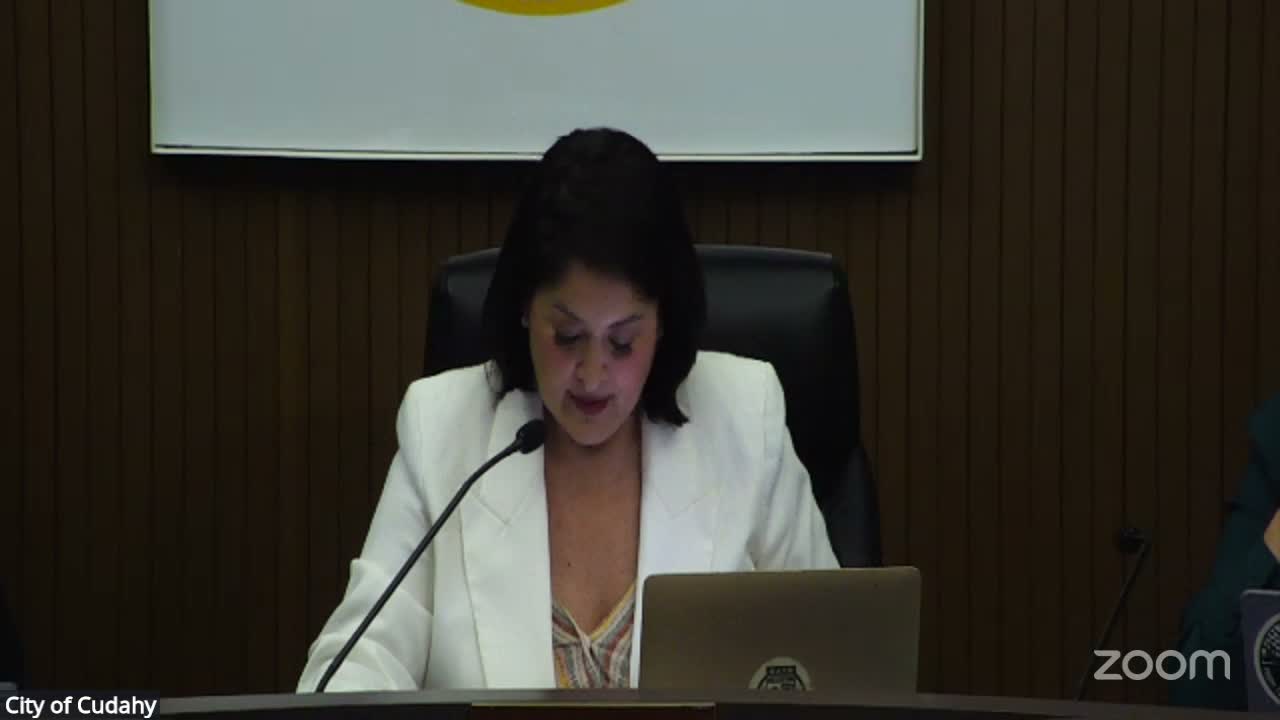
Cudahy council adopts censure resolution after confidential investigation; public voices concerns about transparency
Summary
The Cudahy City Council voted to censure Councilmember Martin Fuentes after an independent investigator sustained two allegations; the city attorney emphasized that the investigation and report are confidential and the council directed sanctions with Fuentes advised to abstain from the vote.
The Cudahy City Council adopted a resolution censuring Councilmember Martin Fuentes following a staff presentation that summarized the censure process and reviewed the council's role. Chelsea Bellett of the city attorney's office told the council the independent investigator sustained two of three allegations and that "the details, allegations, and findings of the investigation report are confidential and attorney-client privileged." The attorney's office also reminded the council that censure is a legislative, not a judicial, action.
Councilmember Fuentes requested a continuance earlier in the meeting citing limited time to prepare, and the council noted he should abstain from deliberation and final vote on the matter. Public commenters offered mixed views: some urged fairness and due process and questioned how the public could weigh in without access to the underlying report, while others expressed general support for holding elected officials to a higher standard.
After public comment the council debated the item. One councilmember said the matter "is not an easy topic to have on our agenda" and moved the resolution; another seconded the motion. The clerk recorded the vote with two affirmative votes called aloud (Vice Mayor Lomeli and the mayor); the motion passed and the resolution was adopted. The city reported the council gave direction in closed session earlier regarding anticipated litigation; no further reportable action was disclosed.
The censure is a formal declaration of disapproval and does not remove an elected official from office nor impose criminal or civil penalties. The city attorney emphasized the council's legal obligations during such hearings, including preserving confidentiality of investigative materials.
The council did not publish the investigator's full findings at the hearing. Councilmembers who supported the resolution said the action was difficult but necessary; speakers who opposed the process said the public lacked sufficient information to evaluate the allegations. The item concludes with the council directing staff and legal counsel on next steps; the clerk recorded that the motion passed.