Get Full Government Meeting Transcripts, Videos, & Alerts Forever!
Get email alerts on the Public Safety Technology topic
No spam. Unsubscribe anytime.
Bell council hears drone‑program pitch; members press for detailed costs, staffing and privacy rules
Summary
Police chief presented a proposal to deploy a Flock drone system for rapid incident assessment and mutual‑aid use; council members raised concerns about privacy, data sharing (including ICE access), staffing and long‑term costs and asked staff to return with a detailed policy and cost/staffing options.
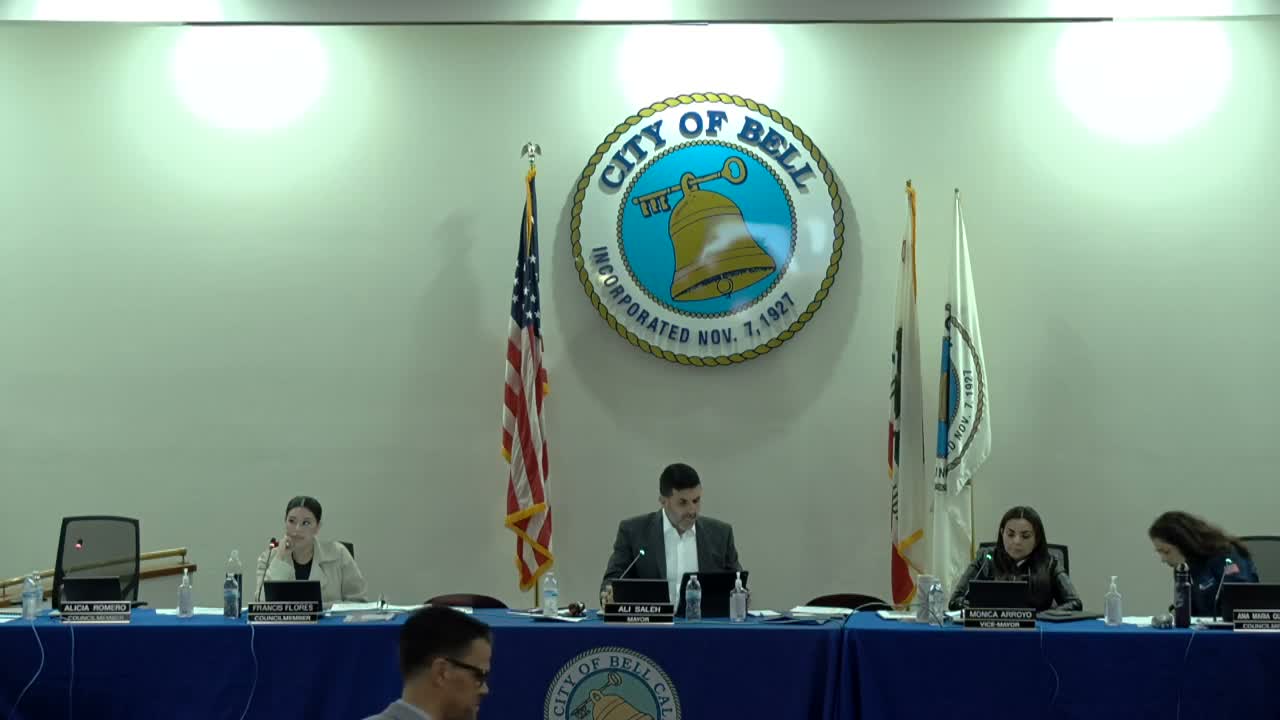
The Bell City Council heard a police presentation Wednesday on a proposed citywide drone program and debated privacy and staffing concerns raised by council members and residents.
Interim police Chief Velasco described recent operational uses and said a Flock dock‑and‑drone system could provide ‘‘eyes on scene within 60—I’m sorry—within 90 seconds,’’ enabling rapid assessment of critical incidents, structural damage and public‑safety needs. The chief and staff proposed two drones with docking stations and discussed vendor‑quoted pricing; examples in the presentation cited per‑system costs comparable to $50,000 per drone/docking arrangement and higher comparative municipal programs that run substantially more in other jurisdictions.
Council members acknowledged potential operational benefits but repeatedly pressed staff on accountability, transparency and cost. ‘‘Privacy is always an issue,’’ a councilmember said during questioning, noting concern about drones flying over private backyards and how footage would be stored and shared. Another councilmember asked explicitly whether federal agencies such as ICE could access footage and urged firm limits on data sharing.
Chief Velasco and staff said footage would be stored and subject to public‑records requests, and that operational safeguards and a comprehensive drone policy would be drafted with the city attorney before any procurement. The chief cautioned that if federal agencies sought data ‘‘they’re going to get access to it’’ in practice, while also noting he had not seen that access misused in his experience. Staff recommended further research and a policy return to council; no procurement or contract was approved at the meeting.
Council also sought clearer cost scenarios and staffing models (full‑time civilian operator, part‑time staff, or contracting alternatives), and several members asked staff to bring back a comparative analysis including total cost of ownership, ongoing staffing expenses and proposed privacy rules before any contract is authorized.
The presentation came amid other procurement discussions at the meeting, including a request to authorize a sales order with ADP for payroll services while a professional services agreement is finalized; several councilmembers asked for vendor comparisons before committing to a vendor without a finalized contract.
No vote was taken on drone procurement; staff was directed to return with more complete staffing, legal and budget information and a draft drone policy.