Get AI Briefings, Transcripts & Alerts on Local & National Government Meetings — Forever.
City presents draft Comprehensive Mobility Services Plan outlining short‑ and long‑term transit changes
Loading...
Summary
City staff previewed a Comprehensive Mobility Services Plan (CMSP) that reallocates existing bus resources to boost frequency in high‑demand corridors, proposes new lines and circulator expansions, and identifies facility and operator constraints that limit immediate fleet growth.
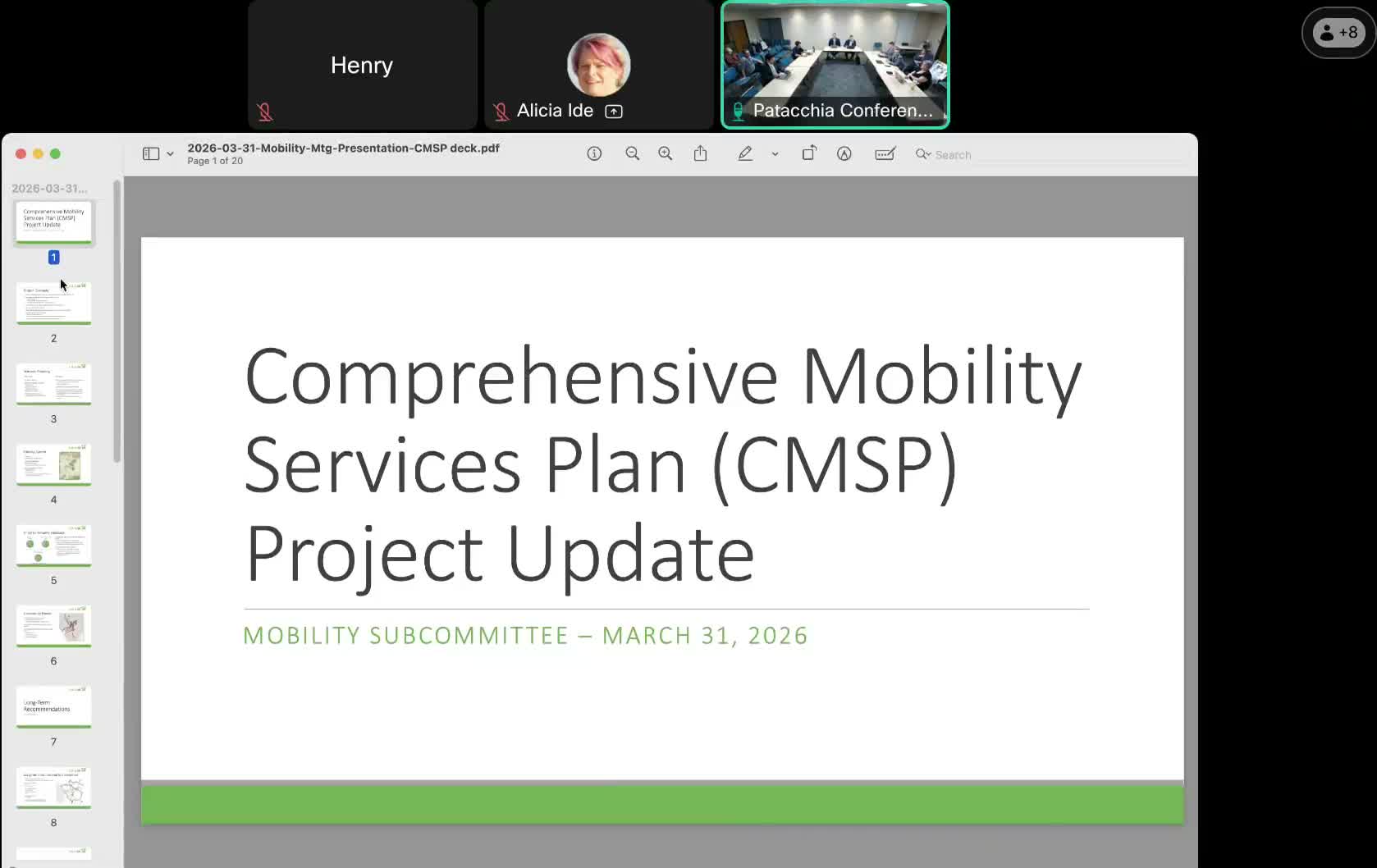
Henry Phipps, senior transportation planner, presented initial recommendations from the Comprehensive Mobility Services Plan (CMSP), an outreach‑informed roadmap to improve Culver City’s mobility services over short (2–4 years) and long (20‑year) horizons. Staff reported more than 1,000 community engagement contacts and emphasized short‑term proposals that reallocate existing fleet resources to improve frequency, peak reliability and stop consolidation rather than assuming new fleet purchases.
Short‑term recommendations include removing low‑performing elements (for example, line 1C/1 service consolidation and removing closely spaced stops) and reconfiguring other lines to improve headways; staff said grant funding is available for additional circulator vehicles and short‑term operations for a redesigned circulator on Jefferson/La Cienega. Long‑term aspirational concepts include a BRT‑style corridor on Sepulveda, a new Line 8 to Playa del Rey and improved mobility hubs at key transfer stations. The plan acknowledges hard constraints: yard capacity for buses, an operator shortage, and the state’s 2040 zero‑emission fleet requirement, all of which affect how quickly the city can expand frequency.
Public commenters broadly supported frequency and reliability improvements but raised concerns about proposed cuts or consolidations to certain lines (notably Line 7) and asked for further student outreach and equity analysis. Staff said many recommended changes are net‑zero in operating resources (reallocated rather than new service), that grant support exists for targeted circulator investment, and that detailed financial and equity analyses remain ongoing.
Council members asked staff to continue public engagement, refine business and operational details, and return with a more finalized set of proposals in mid to late summer for community review and potential subsequent adoption.