Get Full Government Meeting Transcripts, Videos, & Alerts Forever!
Get email alerts on the Transportation Better Overland topic
No spam. Unsubscribe anytime.
Culver City Council selects design Alternative B for Better Overland and directs concrete protection for key bike lanes
Summary
After months of outreach, the council voted unanimously to adopt Alternative B for a half-mile stretch of Overland Avenue and directed staff to install concrete protection on linear bike lanes, seeking to prioritize safety while pursuing grant funding to permanentize features.
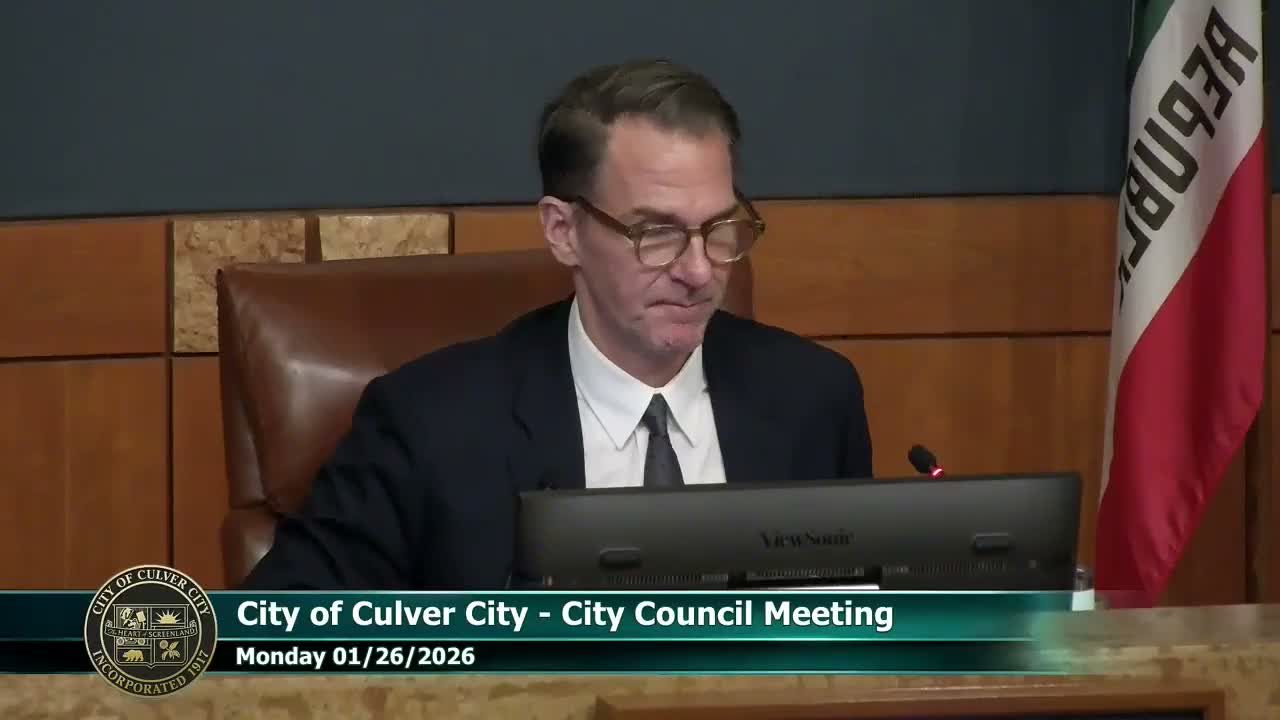
Culver City’s City Council on Jan. 27 selected Alternative B as the locally preferred design for the segment of the Better Overland project between Culver Boulevard and Bayona Creek and directed staff to pursue more durable concrete protection for linear bike lanes.
Public Works staff had presented two options for narrowing the roadway trade-offs: Alternative A would preserve parking on both sides and remove the center left‑turn lane; Alternative B would keep the center turn lane and remove parking on the west side to make room for curbside protected bike lanes. Thomas Check, the city’s senior traffic engineer, told the council that additional outreach and revised drawings produced more support for Alternative B.
"We received consistent feedback that preserving the center turn lane is important for driveway access and refuge maneuvers," Check said during the presentation, noting staff had logged hundreds of public comments and hosted open houses.
Council discussion focused on safety, parking impacts, construction phasing and costs for more permanent protection. Staff said a full concrete median or linear barrier for the phase under discussion would add roughly $100,000 to $200,000 to the phase‑1 price tag, above the quick‑build materials proposed for the initial work.
Vice Mayor Fish moved to direct staff to use concrete protection on the linear segments where feasible; Council Member McMoran seconded. The motion passed unanimously. Council later approved Alternative B as the preferred alternative for the culvert‑to‑creek stretch, also by a unanimous vote.
City staff said they will include the selected segment in future grant applications to fund design and construction, and will perform a parking‑regulation study and other mitigation—such as loading zones and adjusted street‑cleaning times—to address neighborhood concerns. The council also asked staff to pursue grants and budget options to permanentize quick‑build elements where possible.
Next steps: staff will advance design and coordinate a parking strategy, bring any required appropriations back for Council approval, and prepare grant submittals to fund the permanent build‑out.