Get Full Government Meeting Transcripts, Videos, & Alerts Forever!
Get email alerts on the Transportation topic
No spam. Unsubscribe anytime.
Design team pitches Randolph Street corridor plan to Bell council, urges traffic study and community engagement
Summary
City Fabric presented a preliminary vision to knit together Randolph Street across Bell and Maywood with sidewalks, up to 2 miles of bicycle facilities, improved crossings and tree plantings; staff said traffic modeling and coordination with Union Pacific Railway are needed before any roadway changes or parking trade-offs are finalized.
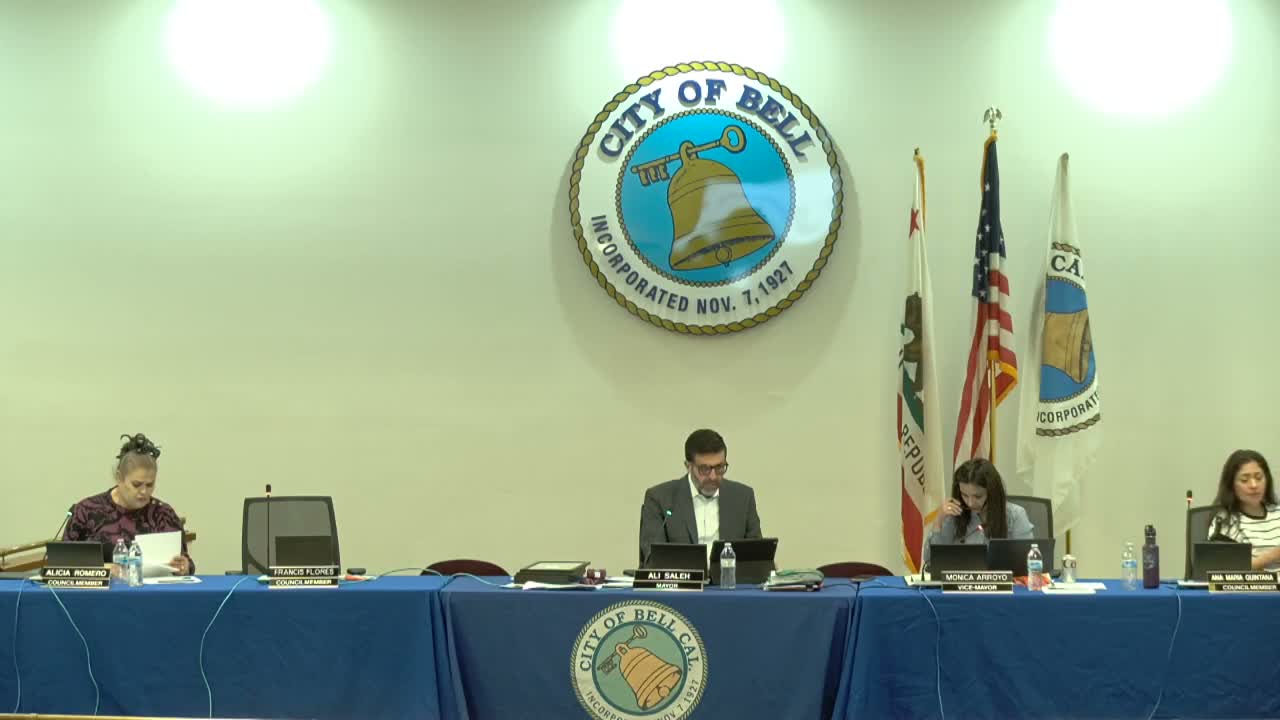
City Fabric's executive director, Brian Ullowetzky, outlined a preliminary Randolph Street corridor plan at the Bell City Council meeting on March 25, proposing pedestrian and bicycle improvements that would use public rights-of-way and portions of Union Pacific Railway land to connect assets between Bell and Maywood.
Ullowetzky said the concept — funded initially through planning grants including an LA County Regional Park and Open Space District award — could include up to roughly 2 miles of dedicated bike facilities, improved pedestrian crossings, curb extensions, and as much as 2 acres of new landscaping and an estimated 200 new trees. He emphasized the design is conceptual and contingent on traffic analysis, community outreach and agency coordination, including negotiation with Union Pacific Railway over the railway right-of-way.
City staff and the presenter said a traffic study timed during school sessions and summer will be critical to determine whether sections should be converted to one-way operations between Pine and Alamo to preserve on-street parking while adding buffered bike lanes. Ullowetzky and staff suggested incremental improvements — for example, community-led tree plantings and curb extensions — as interim steps while formal studies proceed.
Council members pressed staff on key trade-offs. One member asked whether the plan would follow neighboring Huntington Park’s protected Class 4 bike-lane approach or use the city’s preferred buffered (Class 3) lanes; Ullowetzky said the corridor could be studied block by block and that the team would evaluate options ranging from Class 2 to Class 4 facilities. Council members also asked about tree species choices where parkways are narrow and how the project would accommodate e-scooters, strollers and people with mobility devices.
Staff recommended starting with a traffic study and community engagement, then refining designs and pursuing construction funding through a mix of grants (for example, active-transportation and urban-greening sources). No formal action was taken beyond the presentation; staff said they will return with study results and community outreach plans.
The presentation identifies potential safety and accessibility gains but also flagged negotiation and right-of-way constraints with Union Pacific that could limit what is achievable in portions of the corridor. Councilmembers invited staff to pursue the traffic study promptly so designs can be tested while school is in session and during summer traffic conditions.