Culver City moves to create Public Finance Authority to issue up to roughly $36 million in bonds for housing and infrastructure
Loading...
Summary
The council authorized creation of a Culver City Public Financing Authority and directed staff to return with term-sheet documents next meeting; staff said a direct-purchase bond could raise about $27.5 million for economic development and $8.3 million for city infrastructure, with the first lease payment capitalized until 2028.
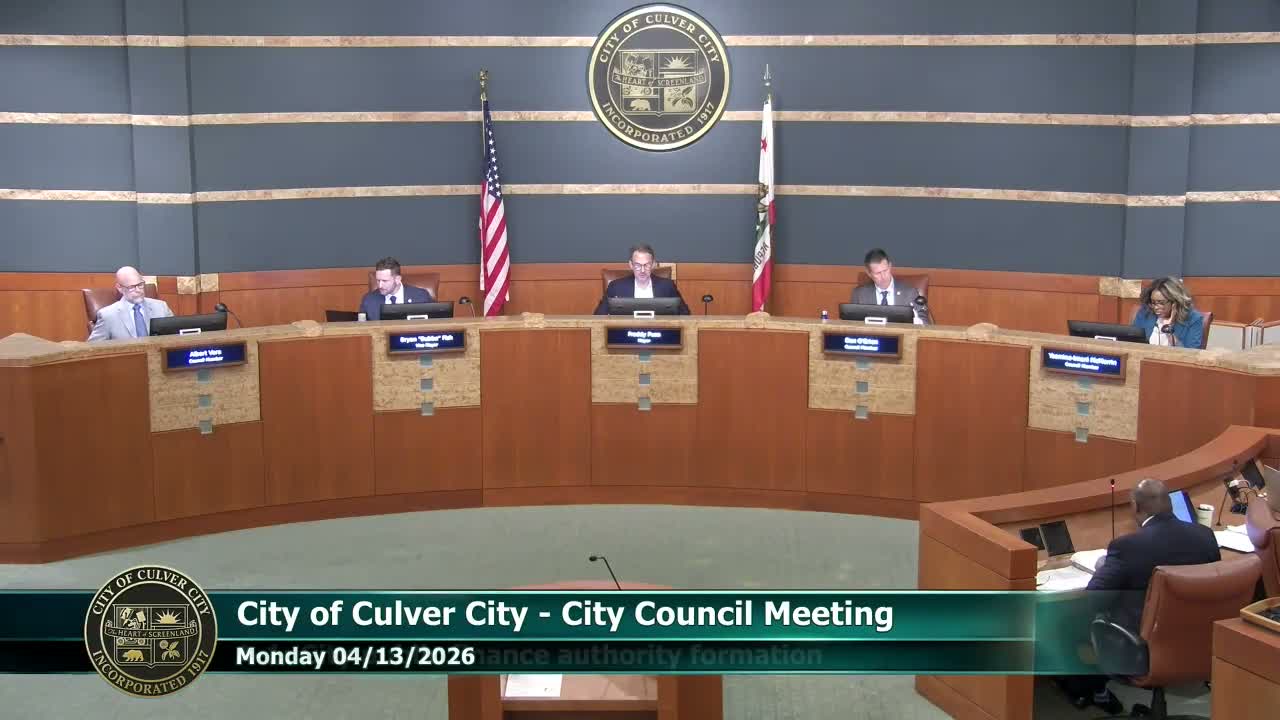
The Culver City Council voted unanimously April 13 to authorize formation of a joint powers authority called the Culver City Public Financing Authority and to advance a term sheet that would let the authority issue lease-revenue bonds to finance affordable housing and deferred maintenance projects.
City staff and bond counsel told the council the proposed financing, under a direct purchase with Barclays, would seek approximately $35.9 million in par amount in two tranches: an estimated $27.5 million taxable tranche intended to support economic development and affordable-housing initiatives and about $8.3 million of tax-exempt proceeds for traditional city capital projects. Steve Agostini, the city’s chief financial officer, said the plan includes capitalized interest so the first city lease payment would not be due until January 2028.
"This structure allows us to make principled, targeted investments in affordable housing and public infrastructure while enhancing liquidity in the general fund," City Manager Jones said as he framed why staff proposed the JPA. "It lets us bend the curve on our budget without immediate cuts to services."
Bond counsel and the city’s financial advisor described mechanics the council will see in the upcoming documents: the city will ground-lease two parking garages to the JPA, the JPA will issue lease-revenue bonds and lease the facilities back to the city, and the city’s base rental payments will be used to pay debt service. Kevin Hale, the city’s bond counsel, said such JPAs and lease structures are well established under California law.
Council members pressed staff on safeguards and spending priorities. Council Member Vera asked how the proceeds would be allocated; City Manager Jones committed to proposing a specific allocation in the city’s upcoming draft budget and recommended underwriting standards for the JPA. "You'll be appropriating those dollars as part of the budget process," he said.
Several residents and local advocates urged caution about adding long-term obligations. Marcy Bond, a member of the public, warned that debt service could grow substantially over time: "By the end of the bond, the city will have paid around $75,000,000 for $35,000,000 now," she said, arguing for stronger guardrails. City staff characterized the indicated yields as market-based and said pricing and final structure will be set shortly before closing; the term sheet presented a blended indicative true-interest cost in the mid‑5% range, subject to market conditions.
The council approved resolutions to form the JPA, authorized the city manager to sign the agreement and related transfers, and directed staff to return on April 27 with the formal financing documents and related resolutions including a plan for how proceeds would be spent and oversight mechanisms. Staff said they expect to seek an S&P rating and to price bonds in late May or early June with the objective of closing before June 30 if the council authorizes the transaction.