Get Full Government Meeting Transcripts, Videos, & Alerts Forever!
Get email alerts on the Transportation Maintenance topic
No spam. Unsubscribe anytime.
Senate committee hears 'fix‑it‑first' bill to prioritize maintenance over expansion
Summary
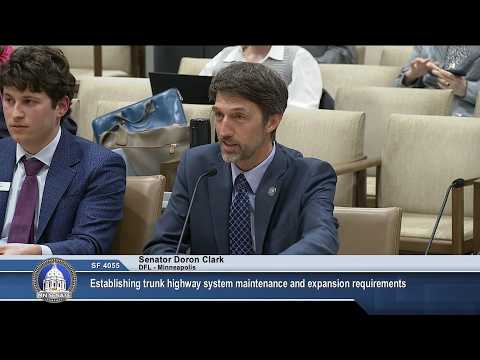
Senate File 4055, presented by Senator Clark, would require MnDOT to meet maintenance performance targets before programming trunk‑highway expansion. Supporters cited a $15–$20 billion maintenance shortfall; opponents warned the language could block needed rural safety expansions. The bill was laid over for further work.
Senator Clark, sponsor of Senate File 4055, told the Senate Transportation Committee that Minnesota faces a ‘‘15 to $20,000,000,000’’ maintenance shortfall over the next 20 years and urged a ‘‘fix‑it‑first’’ approach that would use the state’s Transportation Asset Management Plan as a guardrail to pause new trunk‑highway expansion until maintenance needs are met.
Joe Harrington, policy manager at Our Streets, walked the committee through bill provisions that add definitions, require maintenance plans for major projects and direct MnDOT to publish a fiscal‑transparency dashboard. Harrington disputed some of the assumptions in MnDOT’s fiscal note and emphasized that a maintenance‑first posture could save money over time: “for every $1 we spend on maintenance today, we save $6 to $10 in future costs,” he said.
John Siegmeyer, retired from MnDOT, urged reinstating annual performance targets and requiring that relevant licensed professional engineers sign off on performance documents. Michael Wojciech, executive director of the Bicycle Alliance of Minnesota, told senators the state is already carrying an $18,000,000,000 maintenance deficit and cited a nearby example — an interchange in Olmsted County he said has grown to roughly $92,000,000 — to argue that high‑price expansion projects can crowd out safety investments.
Opposition came most pointedly from Senator Jasinski, who said Subdivision 3’s ‘‘limitations on expansion’’ would prevent urgently needed rural projects such as Highway 14 and harm farmers and freight movement. ‘‘Rural Minnesota needs our Highway Fourteens,’’ Jasinski said, adding that many rural areas lack transit options and ‘you can’t bike 15 miles to work.’
Senator Clark and Harrington responded that the bill is intended to prioritize maintenance and geographic equity, not to indefinitely bar safety‑critical expansions. Clark said the measure would help refocus investments on the parts of highways that ‘‘really need to be enhanced’’ and urged a conversation to identify acute safety needs that might be exempted or prioritized.
Action: the committee did not advance SF4055. Chair Dibble said the bill will be ‘‘laid over’’ so sponsors can continue refining language and work across geographic differences in how the measure would apply.
What happens next: SF4055 remains under committee consideration; sponsors signaled they will continue discussions with stakeholders on carve‑outs for acute safety needs and definitions tied to major‑project thresholds.