Get Full Government Meeting Transcripts, Videos, & Alerts Forever!
Get email alerts on the Staffing Standards topic
No spam. Unsubscribe anytime.
Staff presentation warns full implementation of 2022 staffing standards would be costly; board asks for dollar estimates
Summary
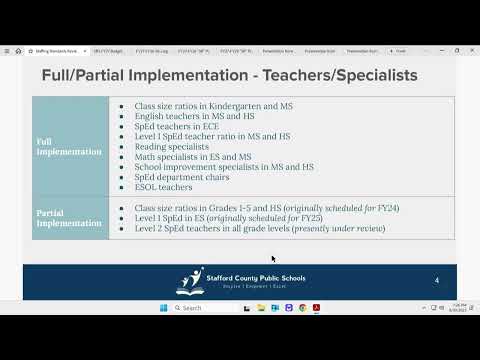
Staff told the Stafford County School Board that while many December 2022 staffing standards have been implemented, several critical positions remain unfunded. The presentation cited ASL interpreter and security-officer gaps, proposed additional deans, and estimated a teacher FTE cost of about $90,000.
Presenter delivered an update on Item 2.01, staffing standards, telling the board the division has implemented much of the board’s December 2022 staffing standards but still faces a “log jam” of unimplemented positions that would be “tremendously resource intensive” to fill in a single year. The Presenter said materials were updated to reflect the FY26 adopted budget and to show what full implementation would require.
The Presenter said two state-driven changes prompted revisions: updated ratios for reading specialists and higher staffing requirements to support English learners. To ensure compliance with the state’s Standards of Quality (SOQ) for English classes, staff separated high-school English allocations tied to verified-credit classes from other general-education staffing, a change intended to preserve class-size guardrails. “The state requires that there’s an average class size of 24 students to 1 teacher for English,” the Presenter said, explaining why staff now specifies English-teacher allocations earlier in staffing cycles.
Board members pressed staff on special-education caseloads and the limits of state guidance. The Presenter said state rules provide caseload limits but not a single clear ratio, and noted that parental requests for dedicated aides can rapidly increase costs. On ASL interpretation, the Presenter said the board-adopted target was expressed as a 1-to-1.5 ratio (described in presentation materials as roughly “3 interpreters for 2 students”), while current staffing was around 1-to-1.2 and supplemented by contracted services.
On administrative and operations staffing, the Presenter said most school-specific clerical and out-of-classroom specialist positions have been fully implemented, but school security officers remain partially implemented in high schools and not implemented at middle schools. Staff also recounted a one-year, budgeted exception in which one elementary school currently has a dean-of-students on a teacher contract; the Presenter said full implementation of the adopted standard would require 12 deans next year based on current enrollment projections.
Staff framed the financial scale: a fully burdened teacher FTE is currently budgeted at about $90,000 (salary plus benefits and health), and the Presenter offered to provide precise dollar totals for proposed positions. Board members asked staff to return with line-item cost estimates — staff agreed to provide them.
The board asked staff to reassess certain standards (for example, the middle-school security-officer formula and the distribution of deans by enrollment versus mentoring needs) and requested a list of grant-funded positions that may lapse. The Presenter said many positions are grant-funded and when grants end the board must choose whether to continue the positions with operating funds or allow them to lapse.
The meeting record shows the board will revisit these staffing and budget questions in the coming budget season and asked staff to bring dollar estimates and more detailed implementation options to upcoming work sessions.