Get Full Government Meeting Transcripts, Videos, & Alerts Forever!
Get email alerts on the School Board Policies topic
No spam. Unsubscribe anytime.
Cobb County School Board approves multiple policy revisions after heated public comments over livestreaming
Summary
After a 30‑minute public‑comment period with repeated calls to preserve livestreaming, the Cobb County School Board approved several policy revisions by narrow margins, accepted recommended personnel actions and adopted an 18.7‑mill FY2026 millage rate. Critics said removing live broadcasts would silence dissent; board members argued policies balance legal and operational concerns.
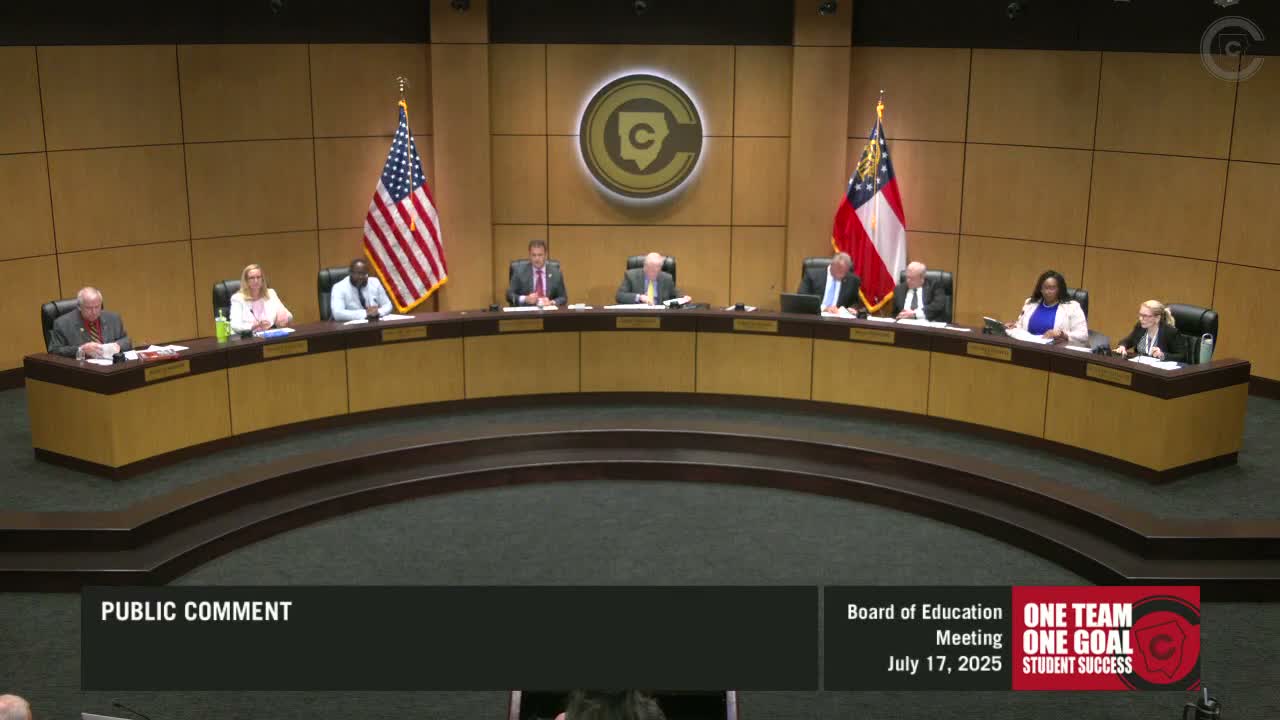
Dozens of residents urged the Cobb County School Board on July 17 to preserve live broadcasts of public comments, saying the livestream is essential for transparency and accountability. Speakers described teachers and students who fear retaliation and urged the board to reject proposed policy language that would limit or remove live recording of the comment period.
"This policy isn't about legal risk. It's about eliminating public accountability," said Laura Zist during the public‑comment period, arguing the change would "silence dissent." Parent Melissa Hagen told the board, "If you remove public comments from the livestream, you're not just changing a format. You are silencing people." Several other commenters—teachers, parents and students—urged the board to keep broadcasts and to lower barriers so 16‑ and 17‑year‑olds can speak.
The board moved from public comment to a series of policy votes. Mr. York introduced a revision package as agenda item 6 and the board voted to separate the item so each policy could be considered individually. After debate and a mix of failed amendments and close votes, the board approved the superintendent's recommendations for several policies, including board meeting procedures and public‑participation rules. Ms. Davis and other members pressed to retain explicit language preserving live broadcasts; those amendments were defeated and the recommendations passed by narrow margins.
The board also approved the human‑resources personnel report presented by Chief HR Officer Keelie Bowen, which included three principal‑level recommendations and multiple staffing changes. The motion to accept the personnel report passed on a recorded hand vote. Chief Financial Officer David Baker presented the FY2026 budget's millage recommendation; the board adopted an 18.7‑mill general‑fund rate, the same rate as the prior year.
Superintendent Ragsdale addressed several operational questions raised during public comment. He said the proposed changes would not eliminate public‑comment opportunities: "Public comment section will still remain. There will be no change in the time allotted for speakers," he said, adding the district will keep two public‑comment sections and no changes take effect immediately. On recently passed state cell‑phone legislation, Ragsdale clarified the board must adopt a policy by January 2026 and implementation is planned for the 2026‑27 school year, not this school year.
Votes at a glance (as recorded in the meeting transcript): personnel report — approved (recorded 7‑0); policy AEA (school calendar) — approved after amendment failed (recorded 4‑3); policy BC (board meetings) — approved as presented (recorded 4‑3); BCBI (public participation) and form BCBI‑1 (attendee conduct) — approved as presented (recorded 4‑3); policy BD (policy development) — approved (recorded vote in transcript); policy KA (treatment of stakeholders) — language change approved unanimously (recorded 7‑0); policy LEBA (parental involvement) — approved (recorded 7‑0); millage resolution (FY2026) — approved (transcript shows motion passed; recorded votes indicate six yes and one member answered "present").
What happened next: the board concluded the action agenda and adjourned. Several speakers and at least two board members asked legal counsel and administration to provide clearer language or schedules for enforcement (for example, clearer time frames for bans or remedial steps in attendee‑conduct rules), and members suggested splitting complex policy bundles into separate votes in future sessions.
The meeting reflected sharp public concern about the transparency of board processes and the role of livestreams in public oversight, while the board emphasized policy clarity, compliance with legal requirements and operational considerations. The administration said it will communicate implementation timelines and additional clarifications to the public.