Get Full Government Meeting Transcripts, Videos, & Alerts Forever!
Get email alerts on the Student Outcomes topic
No spam. Unsubscribe anytime.
Cobb presents record graduation and test-score results; officials debate federal accountability formula
Summary
District staff told the board the official graduation rate is 89.2% (a record high) and that students enrolled in the same Cobb high school for four years graduate at about 99.2%; SAT and ACT averages rose and Cobb ranked first among metro districts on Georgia Milestones, prompting board discussion about the federal graduation-rate formula and possible advocacy.
District staff presented a detailed student-outcomes update at the Oct. 16 work session that the administration described as a record performance across multiple measures.
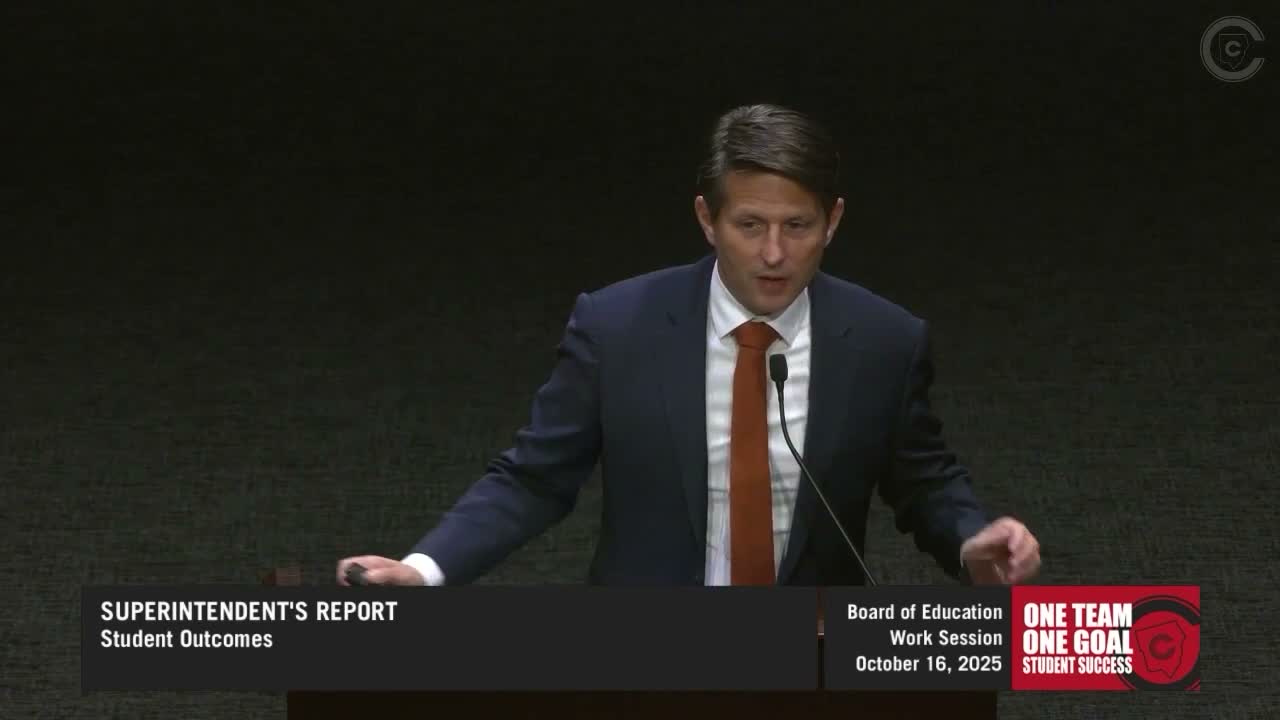
Mr. Floresta, who led the presentation, said the district's official federally calculated graduation rate is 89.2% — a record high that improved by about 1.3 points this year and nearly eight points since 2015. He emphasized a different measure for families and internal use: students enrolled in the same Cobb County high school for four years graduate on time at about 99.2%. "The 89.2 number is the district's official graduation rate, but the real effect of the work that you're leading ... when a student is in a school, in front of a Cobb County teacher for 4 years, they graduate at a 99.2 percent rate," Floresta said.
Floresta also noted changes in standardized testing: about 480 more Cobb students took the SAT this year and the district's SAT average rose by 11 points to a little over 1,100. He said six Cobb high schools exceeded an average of 1,100; Walton and Lassiter were among the top performers. The district's ACT average was 23.7, and staff reported Cobb students outscored metropolitan peers on both assessments.
Superintendent Ragsdale and some board members pushed back on the federally defined graduation calculation because it counts a student who attends for one day as part of a school's cohort; Ragsdale said that representation can be misleading. "The 89.2 is fake," Ragsdale said, adding that the district and many state stakeholders have discussed changes to the federal formula and that any advocacy would likely be a multi-state effort.
Board members praised teachers and staff for the gains and requested more disaggregated data at elementary and middle levels and further information on interventions used in lower grades. Floresta said supports such as early K'3 reading efforts and wraparound services contribute to long-term graduation success. Staff offered to return with more school-level breakdowns and materials board members could use if they choose to press for changes in how graduation rates are calculated.
The presentation closed with a reminder that final audited academic and financial reports will be available in forthcoming board materials, and staff said they would continue to provide more granular data on school-by-school performance upon the board's request.