Get Full Government Meeting Transcripts, Videos, & Alerts Forever!
Get email alerts on the School Safety topic
No spam. Unsubscribe anytime.
Board debates superintendent's request to use up to $2M for 8 vapor‑wake canines; motion to table fails
Summary
Superintendent requested authority to spend up to $2 million from fund balance to acquire eight additional vapor‑wake canines, handlers and equipment; the board debated training, data and budget impacts, a motion to table failed and discussion continued without a final recorded vote on the authorization.
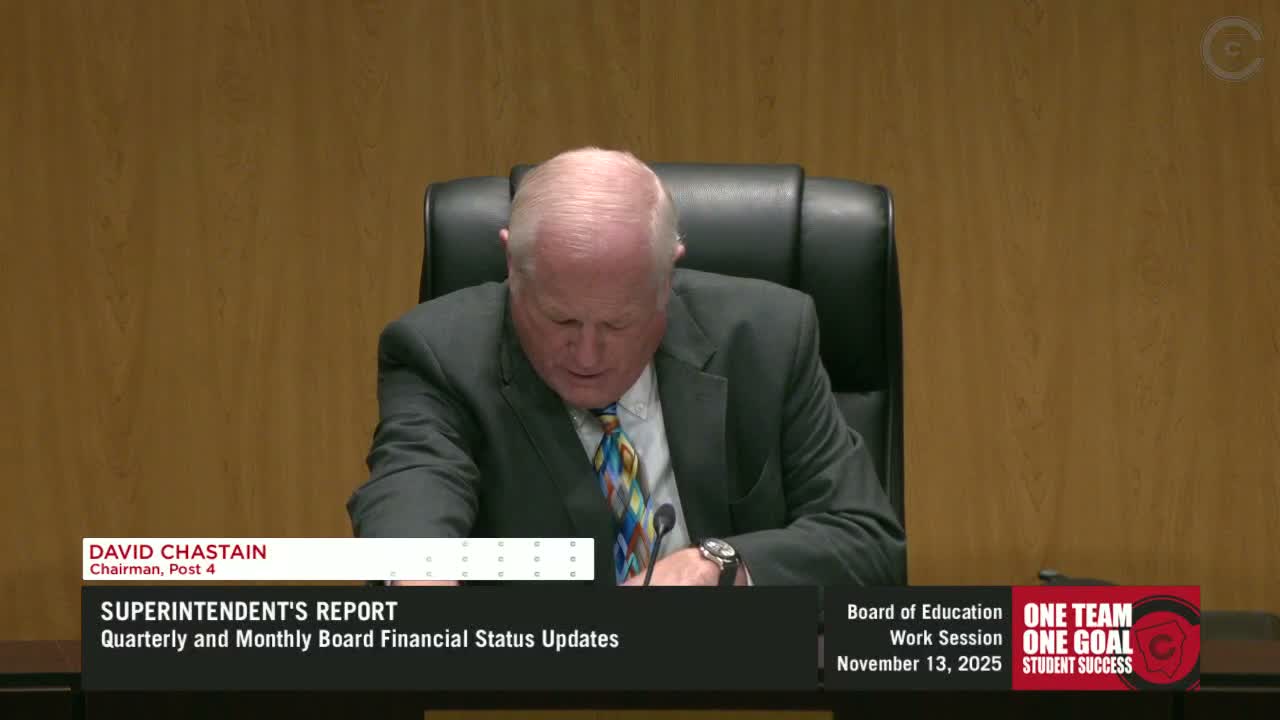
The Cobb County Board of Education debated on Nov. 13 a superintendent request to authorize up to $2,000,000 from the district's fund balance to buy eight additional vapor‑wake canines, associated handlers and equipment.
The superintendent (speaker 2) said the dogs and handlers have been accepted in schools and recounted an incident in which a vapor‑wake canine assisted a local police department by finding a weapon. He asked the board for permission to "use up to $2,000,000 from fund balance" to acquire eight additional vapor‑wake canines and eight handlers; vehicles and related equipment would come from SPLOST, he said. He added that the total program cost could approach $2.5 million.
Board member Mr. Wheeler (speaker 9) moved to approve the superintendent's recommendation; Ms. Davis (speaker 6) seconded. Several board members asked for more information before voting. Ms. Sailor (speaker 5) asked how often the current canines had been involved in confiscations and whether that data could be provided; the superintendent said such details were not immediately available but could be gathered. Ms. Sailor also asked what training K‑9 handlers would receive for interacting with students, including students with disabilities; the superintendent said handlers would receive the same training the district's current officers receive and that training would be appropriate to the K‑12 environment.
During the discussion, questions included whether one dog per high school is adequate given differences in school size, how the long‑term handler costs would be budgeted, and whether the district could recruit handlers from within the current ranks or would need external hires. The superintendent said handler salaries would be rolled into the annual budget and equipment/vehicle costs would be paid from SPLOST.
Ms. Sailor then moved to table the request until more information is provided; the motion to table was seconded and put to a hand vote. The board recorded the motion to table as failing after the vote. The transcript does not record a subsequent final roll‑call vote on the original authorization during the excerpt; the discussion continued after the failed tabling motion.
What happens next: Board members requested additional details (usage data on existing canines, training documentation and clearer cost breakdowns) before a final vote; the transcript ends with continued discussion rather than a recorded adoption or rejection of the spending authorization.