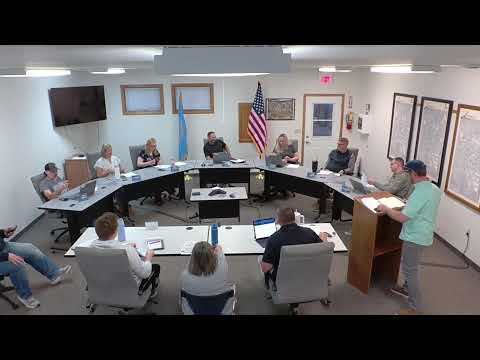
Lenox committees weigh using DOC funds to extend utilities for proposed industrial park
Loading...
Summary
City economic development and DOC funds committees discussed using about $10.5 million in DOC proceeds to extend water and sewer to land owned by the Cooper family, heard concerns about project cost and timing, and agreed to pursue a broker valuation and land option before committing funds.
Lenox officials and development partners discussed a plan to use roughly $10.5 million in Department of Corrections (DOC) proceeds to expand utilities and make land shovel-ready for industrial development, but they stopped short of committing the money and agreed to seek a broker valuation and a land option first.
City administrator Nate Maderplatz opened the discussion by outlining the proposal: committees are considering funding two infrastructure projects—a water main extension and a lift station and sewer trunk line—whose combined preliminary estimates are just under $6.5 million. "The committee tasked with developing plans for 10 and a half million dollars that the city has and DOC proceeds from the prison agreement is here to talk with the economic development planning committee about using some of that money to fund an infrastructure expansion for future industrial expansion," Maderplatz said.
Why it matters: committee members said extending utilities could make several acres of otherwise rural land marketable to larger industrial prospects, boosting property and sales tax revenue and creating jobs. But several members and a public commenter raised questions about the pace of return on investment and the risk of reducing reserves used to keep water bills low.
Public comment and local concerns surfaced early. Mitch Marquette, a visitor who identified himself during the public-comment period, questioned the cost analysis and the scale of the proposed investment. "So that's about, you know, $6,000,000," Marquette said, pressing the group on how the figures were calculated and warning about potential quality-of-life issues — particularly odors from certain industrial uses — if development occurs on the south side of town.
Committees discussed approaches to reduce financial risk. Options included securing a committed tenant before construction or establishing a cost-recovery district in which developers or future property owners pay a fee to recoup the city's investment over time. Maderplatz said he would prefer not to proceed "speculatively" and stressed the DOC funds committee’s interest in ensuring a concrete prospect or a defined plan before spending the proceeds.
Development partners and consultants told the group that site selection typically starts with utility availability: power, water and wastewater discharge capacity. A consultant said those three items generally narrow candidate sites quickly and recommended lining up a tenant prospect while pursuing options for grants and incentive funding. Committee members reviewed potential programs — including EDA and USDA opportunities — and discussed past local projects used as models for phased investment.
A recurring theme was land control. The parcel known as the Cooper plan has a preliminary concept approved by the planning commission, but committee members agreed that the city should not invest heavily unless the landowner is willing to sell or give the city an option at a marketable price. The group directed staff and partners to obtain an updated broker valuation and to explore an option or contractual agreement with the Cooper family as the first step.
Next steps and timing: the group agreed to convene follow-up discussions with grant partners (EDA, USDA and similar) and consultant SMGA and A1 (consultants listed in the meeting) to align a prospect outreach strategy. Committee members suggested reconvening in about five weeks to review the broker valuation and firm up recommended guidance for city council. No formal vote was taken on committing funding.
The meeting closed after members agreed to combine the DOC funds and economic development committees for this work for the year and to continue outreach to potential tenants and grant sources. Chair Dan Bergen closed the meeting with a formal motion to adjourn, which carried by voice vote.
Ending: The committees left the discussion with two clear tasks: secure an updated broker valuation of the Cooper parcel and pursue an option/acquisition strategy, then reconvene to review funding mechanics and grant alignment before any formal commitment of DOC proceeds.