Board of Natural Resources begins framing EIS alternatives and asks staff for concrete scenarios and financial analysis
Loading...
Summary
At a special April 21 study session, the Washington Board of Natural Resources received briefings on the draft EIS process and multi‑objective optimization for the Eastern Washington sustainable harvest calculation, and asked staff to return with specific alternatives, financial metrics and an RFI on modelers.
The Washington Board of Natural Resources on April 21 convened a special study session to begin shaping alternatives for the Eastern Washington sustainable harvest calculation (SHC) and to introduce multi‑objective optimization tools for the draft environmental impact statement (EIS).
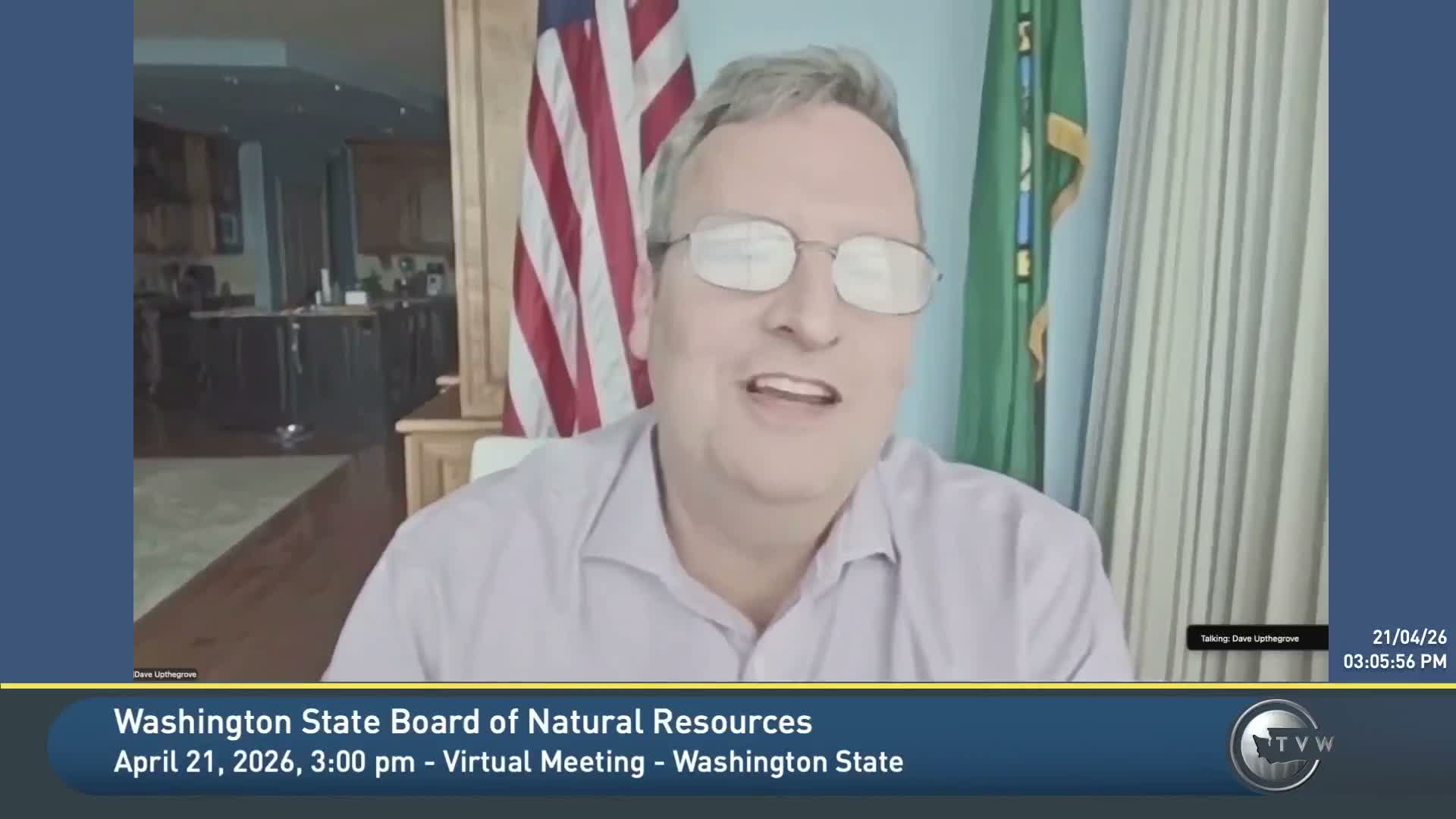
Chair Dave Upthegrove opened the session and turned the presentation over to Susan Beal, Asset Management Division Manager, and Cameron Crump, Forest Resources Division Manager, who described the SEPA/EIS process and how staff plan to develop alternatives for board guidance. Beal said the meeting was “an educational presentation for the Eastern Washington sustainable harvest calculation” and reminded members there were no formal board decisions tied to the session.
The presenters told the board the EIS will compare a required no‑action alternative (DNR's current operating environment) against action alternatives that explore feasible approaches to meeting the project’s purpose and need. Beal said the purpose of the project is “to recalculate the sustainable harvest level and evaluate potential impacts,” and that the EIS will analyze impacts at the scale of sustainable harvest units rather than individual timber sales.
Board members pressed staff for trade‑off analysis between revenue and long‑term forest health. Chris Reykdal, State Superintendent, said the process should prioritize long‑term resilience: “we would probably put very long term health ahead of short term revenue.” Randy Johnson, a board member and county commissioner, echoed concern about feasibility in the field, warning succinctly that “if it all burns up, we’ve done nothing.”
Staff explained legal and procedural constraints. Duane Owens (assistant deputy for State Uplands) clarified that the Department of Ecology defines what constitutes “reasonable alternatives” under SEPA and interprets the relevant RCWs. Beal noted that DNR’s Policy for Sustainable Forests (PSF) includes a harvest‑flow constraint that normally limits decade‑to‑decade variation to about 25 percent.
Discussion also covered existing conservation direction on the West Side. Upthegrove said an executive order that people reference as the “77,000‑acre” designation applies to West Side lands; staff stated that the East Side’s different fire regime and ecology require distinct management approaches.
Board members asked staff to return with more concrete material at future sessions: sample alternatives (three scenario examples), associated cost estimates and financial metrics including analysis of net present value versus forest‑health objectives. Staff agreed to add a financial‑analysis briefing and to prepare alternatives for the May meeting (noted as May 12), with further work on modeling and metrics planned for June and a financial‑metrics focus in July.
On modeling, Cameron Crump introduced multi‑objective optimization as a way to show the Pareto front of trade‑offs across conflicting objectives such as net present value, forest resilience and carbon storage. He said the project team plans to issue a request for information to modelers to get costs and timelines for running these analyses.
Members also queried whether models could quantify public‑health costs from wildfire smoke. Staff replied that explicit smoke‑to‑health‑cost modeling is currently out of scope but could be pursued with public‑health partners or included in the EIS if the board asks.
No motions or votes were taken. Staff told the board the steering committee will bring recommendations on how combinations of alternatives should be analyzed, and the board will decide which alternatives to analyze. The session ended with Upthegrove thanking presenters and adjourning.
What’s next: staff will return in May with proposed action alternatives and initial financial analysis; the board will consider multi‑objective optimization, spatial modeling options and funding implications in subsequent sessions.