Get Full Government Meeting Transcripts, Videos, & Alerts Forever!
Get email alerts on the Fafsa Statewide Progress topic
No spam. Unsubscribe anytime.
Washington FAFSA campaign near goal but equity gaps and a slowing weekly pace worry advisers
Summary
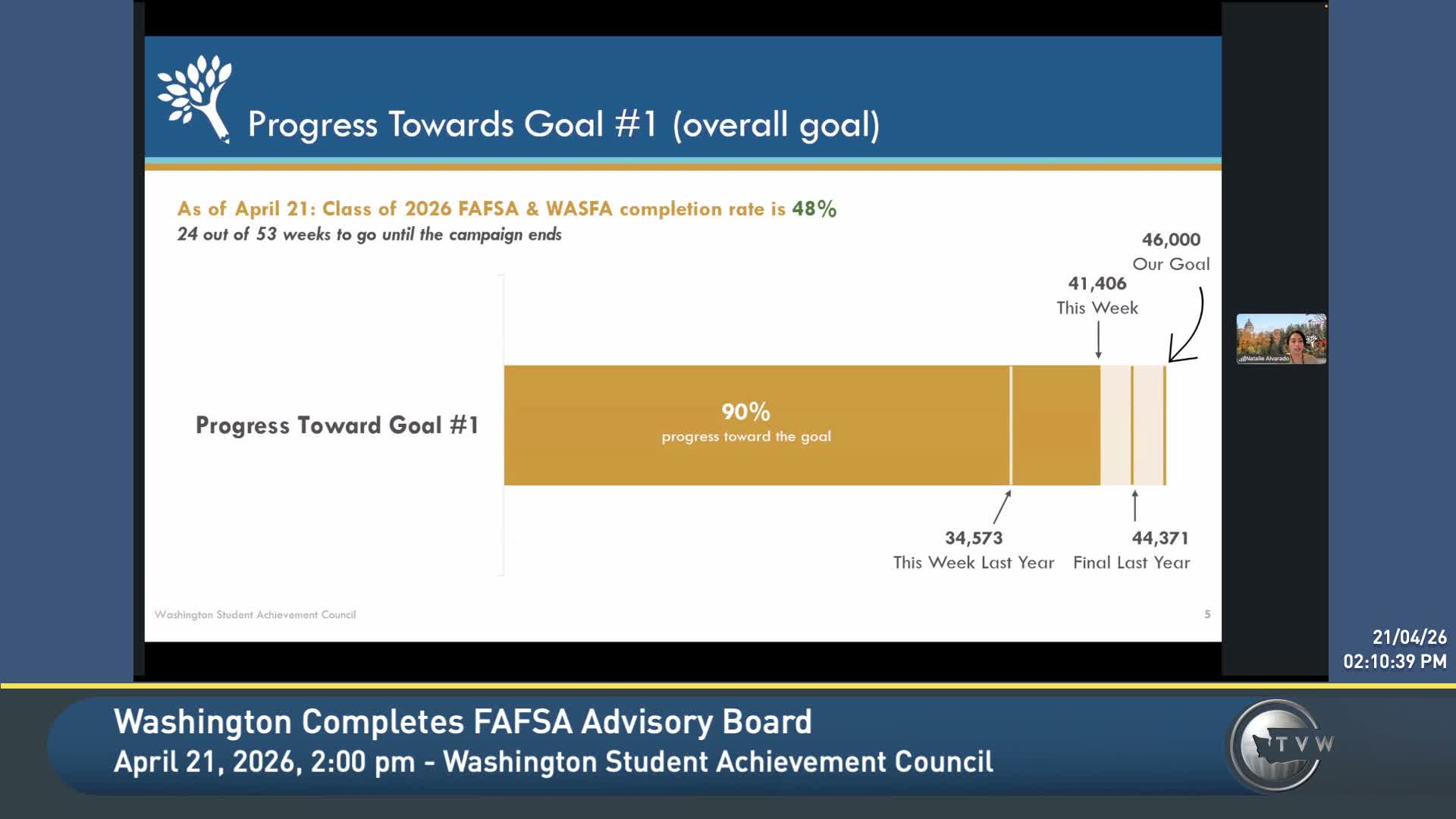
WASAC data presented April 21 show 41,406 FAFSA/WASFA completions (about 90% of the 46,000 target). Advisers said weekly filings have slowed to ~719 and urged targeted, personalized outreach to close persistent equity gaps among student groups.
As of April 21, Natalie Alvarado of WASAC told the advisory board that Washington has recorded 41,406 FAFSA and WASFA completions, about 90% of the campaign’s 46,000-senior target for the class of 2026. "The takeaway here is that momentum is strong," Alvarado said, but she cautioned that the campaign must sustain and intensify outreach to reach the goal.
Alvarado and other WASAC staff framed the current challenge as a slowdown in the weekly filing pace. Since March the state has averaged about 719 new FAFSA submissions per week, down from earlier in the cycle. "The question is, can we maintain at least 1,000 new FAFSAs each week?" Alvarado asked. Board members and staff described a shift from broad reminders toward more personalized, repeated follow-up for students who have not completed applications.
The presentation included the campaign’s four stated goals: (1) 46,000 total completions statewide, (2) at least 150 high schools raising completion by 6 percentage points among free-and-reduced-price-lunch–eligible students, (3) closing the gap between FERPA-eligible and non–FERPA-eligible students, and (4) narrowing completion disparities by race and ethnicity. Alvarado reported that Goal 2 has been met: 175 schools have exceeded the 6-point threshold.
On equity, Alvarado noted mixed progress. She reported that completion among FERPA-eligible students has grown (reported figures in the meeting moved from the high 20s/low 30s to the low 40s percentage points) while completion among the comparison group rose as well, leaving an 8-percentage-point gap that has narrowed from a higher recent peak. The briefing also cited group-level rates by race and ethnicity: for example, Asian students were reported at 61% completion while Native Hawaiian and Pacific Islander students were reported at 29%.
Advisory members and the governor’s policy advisor, Patricia Loera, emphasized that remaining work will require targeted, culturally responsive outreach and sustained staffing in schools. Loera noted the governor’s proclamation declaring Financial Aid Completion Week and thanked partners for the campaign’s visibility efforts.
The advisory board plans to follow up with a survey and to continue the conversation at its next meeting on May 12, 2–4 p.m., including developing recommendations for longer-term staffing and outreach strategies.