Get Full Government Meeting Transcripts, Videos, & Alerts Forever!
Get email alerts on the Growth And Infrastructure Policy topic
No spam. Unsubscribe anytime.
Council advances planning changes to school and transportation impact rules amid revenue concerns
Summary
The Montgomery County Council accepted the PHP committee's recommendations on several growth and infrastructure policy updates, including shifting school impact area boundaries to transportation policy areas and revising student-generation methodology; the committee approved the boundary change in a 10–1 straw vote amid questions about potential revenue impacts.
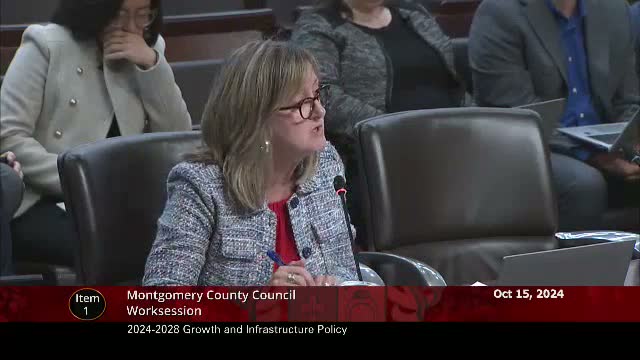
The Montgomery County Council on Oct. 15 moved forward a set of revisions to the 2024–2028 Growth and Infrastructure Policy (GIP) designed to refine how the county measures school and transportation impacts from development.
Council staff and planning officials told the council the Planning Board's principal recommendation would realign school impact area boundaries so they match transportation policy areas and reclassify areas as infill, turnover or greenfield based on updated housing and capacity metrics. Planning staff showed maps and a high-level 10-year retrospective revenue comparison indicating the change could reduce projected impact-tax receipts in some years; the County Executive's office estimated a potential capital revenue loss of about $300,000 per year if the change were adopted as proposed.
Miss Dunn, planning staff, said the analysis used 10 years of past pipeline data to estimate the effect and cautioned it is not a forecast of future revenue. She said the transportation-policy-area boundaries are smaller and more granular in places such as North Bethesda, producing classifications that better reflect where growth is actually occurring.
Several council members pressed staff on the sales and revenue implications. Council Member Sales asked explicitly how any projected shortfall would be replaced. Council Member Mink said she was concerned about any step that reduces school-construction revenue before a replacement revenue source is identified. Council Member Gonzalez and others argued the GIP is a technical policy document intended to produce accurate impact assessments rather than to be used to raise revenue.
After debate and requests for additional fiscal analysis, the Planning, Housing and Parks committee's recommendation to use transportation-policy-area boundaries was approved in a straw vote, with "all those opposed" counted as 10 to 1.
The council also considered changes to the methodology used to classify school impact areas. Staff described a shift in the weighting of indices used to generate student-generation rates — reducing reliance on enrollment trends distorted by the pandemic and increasing weight on future capacity and the development pipeline — and the committee recommended replacing the phrase "latest growth context and potential" with the more concrete "growth and enrollment impacts." Committee members said the new approach better reflects expected enrollment over the 4–6 year window used for annual school tests.
Other school-related recommendations the council accepted without objection would: adjust seat-deficit thresholds for utilization-premium payment tiers to match MCPS capital-guidelines; allow UPP funds to be used on adjacent schools identified in the school utilization report; keep the 1990 cutoff for multifamily units used in student-generation calculations; and retain distinctions between low-rise and high-rise multifamily for generation-rate calculations.
Why this matters: The GIP establishes how development is judged against school and transportation capacity and how mitigation payments are calculated. Small changes in geography or weighting can shift where development faces higher mitigation payments and where capital revenue is expected, with downstream effects on housing feasibility, school capital planning and the county's budget.
What comes next: The council plans another work session on Oct. 22 to take straw votes on remaining items. Council staff asked members to reserve policy discussions tied to impact-tax rates for the Government Operations and Fiscal Policy committee, which is considering broader impact-tax reforms.