Get Full Government Meeting Transcripts, Videos, & Alerts Forever!
Get email alerts on the Climate Regulation topic
No spam. Unsubscribe anytime.
City staff brief council on Climate Commitment Act; municipal gas utility 'marginally' over threshold and faces rising compliance costs
Summary
City Administrator Chris Searcy told the council Enumclaw's municipal gas utility is just over the 25,000 metric-ton threshold that requires participation in Washington's Climate Commitment Act. Staff outlined how allowances, auctions and declining no-cost allowances affect customer bills and recommended further council guidance and updated cost projections in May.
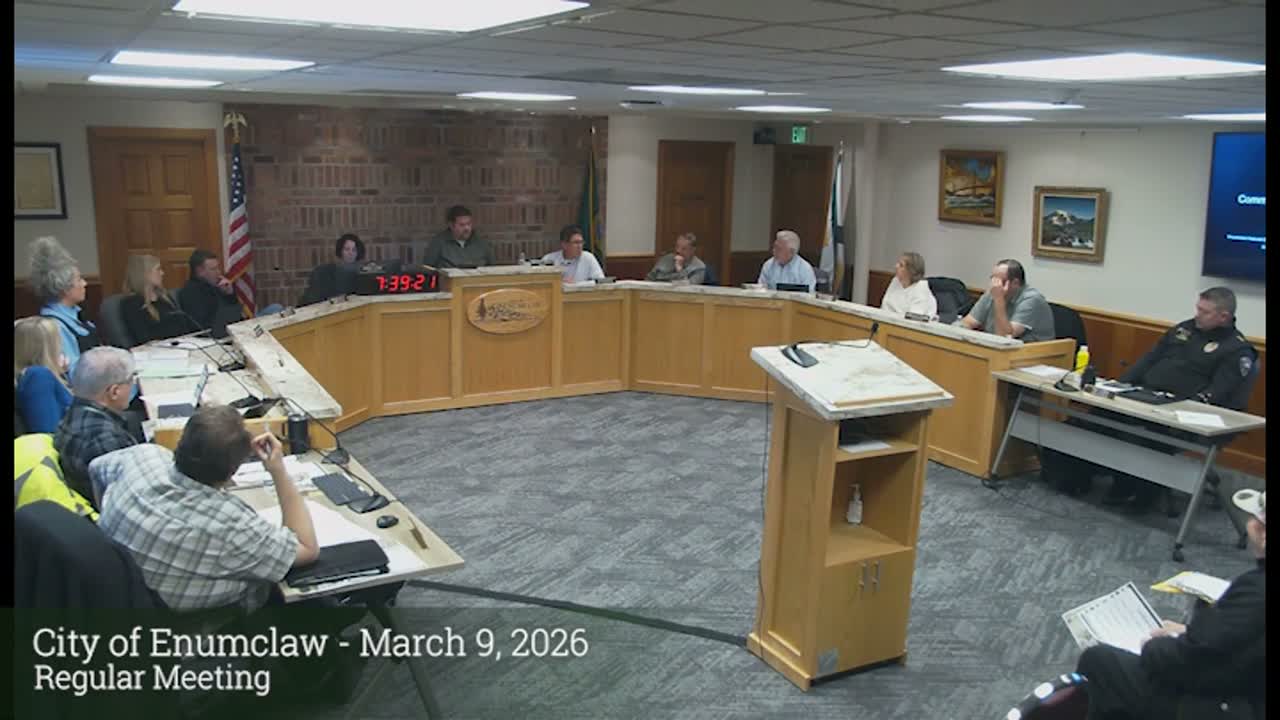
City Administrator Chris Searcy presented an informational Climate Commitment Act (CCA) workshop on March 9 outlining the program's framework and what it means for Enumclaw's municipal gas utility.
Searcy explained the CCA is a state cap-and-invest program intended to reduce greenhouse-gas emissions. He said the city is "just marginally over the threshold of being pulled into the program," noting the 25,000 metric-ton annual-emissions threshold and that the city's 2023'025 average was just over that level. He said the city could theoretically exit the program if it remained below 25,000 metric tons for each year of a four-year compliance period but recommended aiming for a 10% buffer (about 22,500 metric tons) to avoid being pulled back in when Ecology exercises a 10% discretionary buffer.
Searcy outlined how the program allocates "no-cost" allowances to certain entities based on a baseline (2015'019 for Enumclaw) and that those no-cost allowances and the share of allowances consigned to auctions decline over time (by about 7% annually for the city), increasing the amount the city must buy on the auction market. He said proceeds from auctioned allowances can offset customer bill impacts for low-income and qualifying customers but that non-legacy customers who connected after July 25, 2021, do not receive auction-proceeds benefits and pay a higher per-unit compliance charge.
Searcy provided rough cost figures: he said the first-year CCA cost for the city was about $250,000 in 2023 and that recent figures were a little over $400,000, with the potential to exceed $1,000,000 in later years depending on auction prices and program linkage. He described high uncertainty around future carbon prices and the potential effect of linking Washington to larger markets such as California's cap-and-trade. He noted Ellensburg's advance planning and a $750,000 state grant they received to support decarbonization planning and suggested the council consider whether Enumclaw should pursue an alternative compliance path for municipal gas utilities through the legislature or seek similar planning grants.
Council members asked for clearer projections and additional information; Searcy said staff will return in May with refined projections and options for policy direction, including potential legislative coordination with Ellensburg and alternatives for recovering full costs of new customer connections.
The council took no formal action; the presentation was informational and staff requested guidance for future policy work.