Lifetime Citizen Portal Access — AI Briefings, Alerts & Unlimited Follows
Placentia Council upholds revocation of two short‑term rental permits, adopts stricter STR rules
Loading...
Summary
The City Council upheld a planning commission revocation of two short‑term rental permits for unpaid transient‑occupancy taxes, rejected immediate reinstatement, and approved a new short‑term rental ordinance that caps permits and tightens enforcement and reporting requirements.
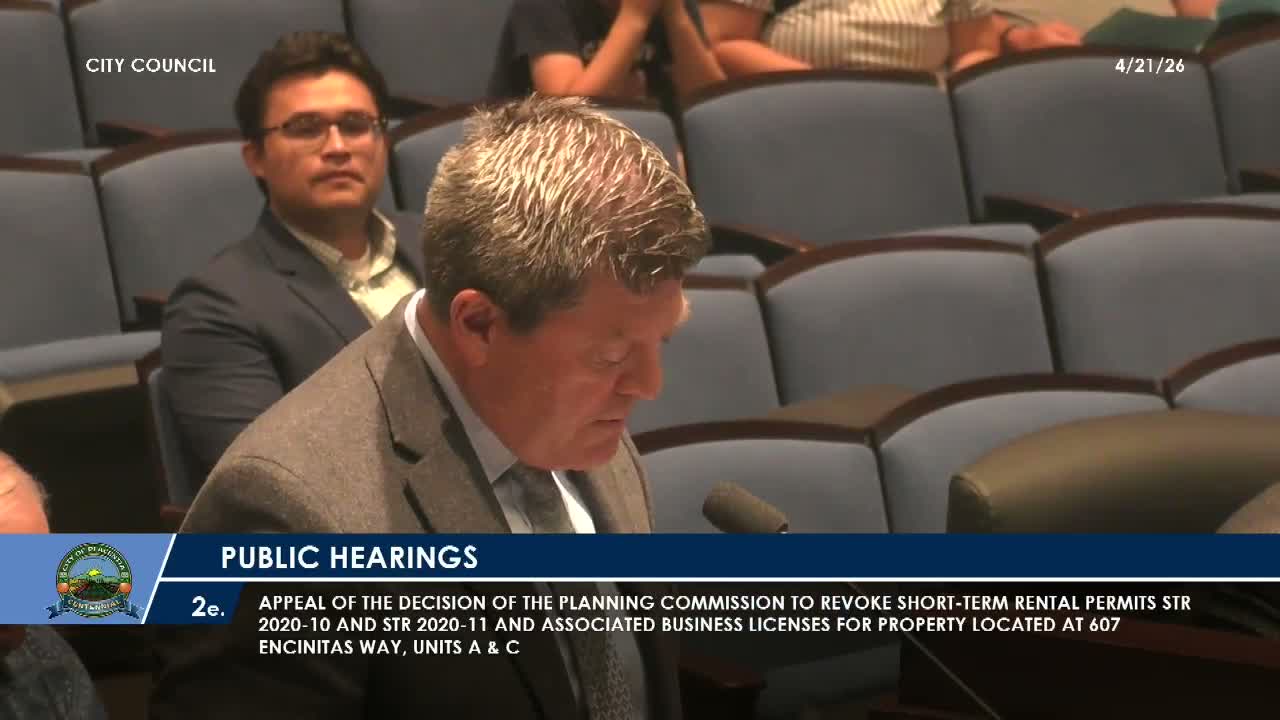
Placentia City Council on April 21 denied an appeal by two short‑term rental operators and upheld the Planning Commission’s revocation of permits for 607 Encinitas Way, Units A and C, saying the record shows years of noncompliance and unpaid transient occupancy taxes. Councilmembers voted 4–0 with one member not voting to deny the appeal and directed staff to return with a revised payment arrangement that includes unpaid administrative citations.
Planning staff said the applicants, Alexander and Selenia Perez, had a documented enforcement history dating to 2020 that included repeated notices, administrative citations and a remaining gap of more than $17,000 in unpaid TOT. Planning staff told the council the applicants later proposed a 24‑month payment plan to cover arrears and current quarters; staff and the city attorney drafted an agreement that would restore permits only if applicants complied, with automatic revocation for any missed payment. “The agreement would allow them to pay their TOT in monthly payments over 24 months,” Planning staff member Lambert told the council.
Several councilmembers said they were reluctant to reward repeated noncompliance and stressed fairness to other businesses and residents who timely pay taxes. “I don’t think we should be rewarding people who choose not to follow the rules,” the presiding councilmember said during deliberations, urging caution about setting a precedent. Council ultimately voted to keep the revocation in place and to send staff back to negotiate an account‑only payment plan that also collects outstanding administrative citation fees.
Council members and staff also discussed enforcement safeguards. Staff said the proposed ordinance changes and compliance tools would help verify platform activity and TOT remittance going forward: the new short‑term rental ordinance requires platforms to provide booking records on request, requires documentation for exemptions (for stays over 30 days), and notes the city’s use of third‑party compliance software to reconcile reported rentals and TOT.
At the same meeting council adopted the city’s new short‑term rental ordinance, O2026‑04, which imposes a citywide cap equal to roughly 0.5% of housing stock (about 85 permits), sets a hard 300‑foot separation rule (measured property corner to corner for single‑family homes), bars non‑owner‑occupied STRs in apartment buildings, and sets an occupancy cap of 10 persons and a minimum stay of two consecutive nights. The ordinance requires a local 24‑hour contact for complaints and raises the initial administrative penalty to $250 for violations. Staff said the ordinance also makes appeals of director decisions go directly to city council rather than the Planning Commission.
Councilmembers said the combined approach—maintaining enforcement in individual cases while adopting clearer citywide rules—aims to prevent the kinds of repeated compliance failures that led to the Perez permit revocations. The council’s action on the appeal was final at the meeting; the revised payment arrangement (collection‑only, without permit reinstatement language) was directed to be returned to council or placed on a consent calendar item for future action.