Get Full Government Meeting Transcripts, Videos, & Alerts Forever!
Get email alerts on the Education Fund Constitutional Amendment topic
No spam. Unsubscribe anytime.
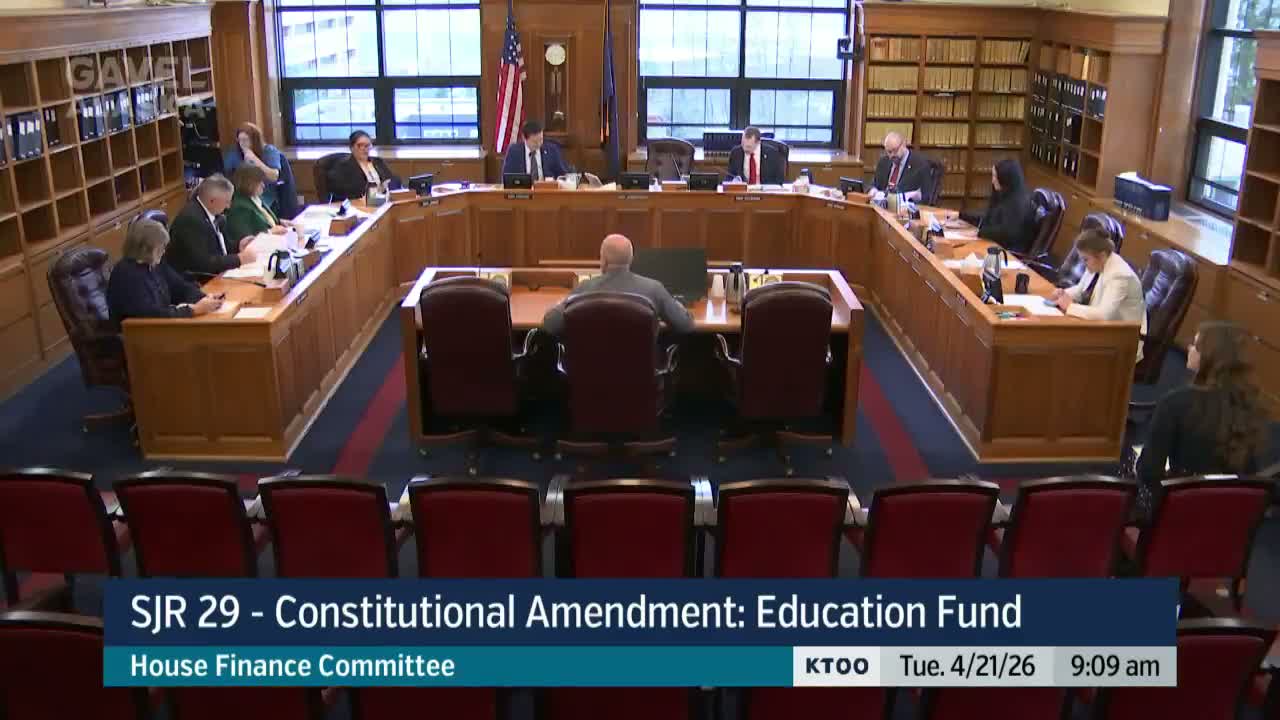
House Finance Committee hears introduction to constitutional education fund amendment
Summary
At an April 21 introduction hearing, the House Finance Committee questioned sponsor staff and legal counsel about SJR 29, which would add a section to Article 9 to allow the legislature to create an education fund whose money could be used only for public education; members pressed for clarity on definition, funding, sweep protection and who controls appropriations.
Cochair Foster convened the House Finance Committee at 7:00 a.m. on April 21 to hear an introduction to Senate Joint Resolution 29, a proposed amendment to Article 9 of the Alaska Constitution to authorize the legislature to create an education fund in the state treasury.
Tim Gruesendorf, staff to Sen. Hoffman, told the committee SJR 29 "proposes an amendment to Article 9 of the Alaska Constitution, creating a new section in the Constitution to allow that allows the legislature to create an education fund separate as a separate fund in the treasury. The money in the fund may be appropriated only for public education." He said if both chambers pass the resolution by a two-thirds majority it would go to the people to vote on whether to add the fund to the constitution.
Committee members focused on how the fund would operate. Representative Schrage summarized the measure as creating a constitutional "parking lot" for money: it establishes the fund in the constitution but does not, by itself, put money in the fund or prescribe a formulaic draw. Gruesendorf confirmed the resolution contains no seed money or automatic draw and that decisions about draw rates or endowment rules would be left to future legislation.
Legal counsel and agency witnesses addressed mechanics and timing. Carol Beecher, director of the Division of Elections, said state statute AS 15.50.030 requires constitutional amendment propositions to be placed on the next statewide general election ballot, so a successful two-thirds legislative passage would send the question to the November general election ballot. Marie Marks of Legislative Legal Services explained the resolution "protects the money once the legislature places it into the fund" but does not itself create a dedicated revenue stream; she said "the funding source would not be able to be dedicated" by the resolution as drafted and that dedicating a stream would require amendment.
Members pressed on the fund's scope. Gruesendorf said the original view was that the fund would be available for K–12 education and for both maintenance and construction needs, but that the resolution does not define "public education" and that the legislature could later legislate a definition. He added that placing money in a separate treasury fund typically makes it not sweepable; "because it's a separate account within the treasury, that keeps it from being sweepable," he said.
Representatives also asked whether the fund would be effectively untouchable. Marks noted the amendment uses permissive language—"may create"—and told the committee that because the provision is permissive the legislature could establish or repeal the fund later; she suggested clarifying language could be added if the committee wanted to make that point explicit.
Treasury Director Pam Leary said she was not aware that the Alaska Housing Finance Corporation had provided school funding of the type addressed by the public school trust or basic school allocation. Committee members discussed existing education funding sources—including the public school trust fund and other statutory accounts—and whether the constitutional fund would differ in practice.
The committee did not vote. Foster said remaining legal questions would be revisited at a later meeting and announced the committee would reconvene at 1:30 p.m. to hear House Bill 362 and take public testimony on SJR 29. The meeting adjourned at 9:52 a.m.