Get Full Government Meeting Transcripts, Videos, & Alerts Forever!
Get email alerts on the Civil Rights topic
No spam. Unsubscribe anytime.
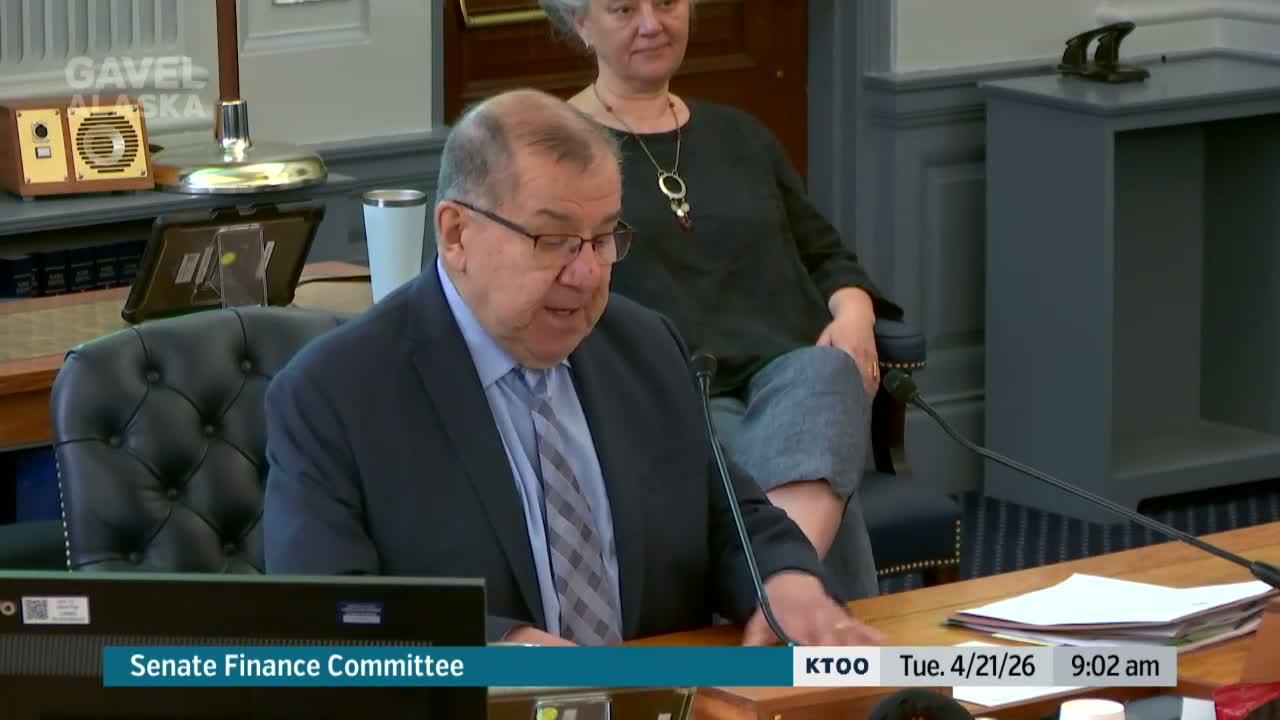
Senate Finance Committee holds first hearing on bill to rename, expand Alaska State Commission for Human Rights
Summary
At a first hearing April 21, sponsors and commission staff told the Alaska Senate Finance Committee that House Bill 23 would rename the Alaska State Commission for Human Rights the Civil Rights Commission, extend its jurisdiction to most nonprofit employers (with religious/fraternal exceptions), move its annual report date and make commissioners removable only for cause; the committee set the bill aside without a vote.
The Alaska Senate Finance Committee held a first hearing April 21 on House Bill 23, which would rename the Alaska State Commission for Human Rights the Civil Rights Commission, expand its jurisdiction to cover most nonprofit employers (excluding religious and fraternal organizations), change the commission’s annual report timing and add a for‑cause removal standard for commissioners.
Representative Andy Josephson, House District 13 (South Midtown Anchorage), introduced the bill and told the committee the measures passed the House 39–0 and have broad support. "The bill does 4 principal things," Josephson said, noting the name change and the extension of jurisdiction over many nonprofit employers as the most significant elements.
The measure would close a gap that currently leaves many nonprofit employees outside state protection and reliant on the federal Equal Employment Opportunity Commission or private lawsuits, sponsors said. "If you're working for a small nonprofit outside of Anchorage and you're being harassed... you have no recourse other than to file your own private lawsuit," said Rob Corbusier, executive director of the Alaska State Commission for Human Rights, who described the nonprofit jurisdiction change as the commission’s most substantial long‑standing request.
Ken Alper, staff to Representative Josephson, summarized commission data and independent estimates that tens of thousands of nonprofit employees statewide would gain state protection if the change is enacted; Alper cited figures of roughly 35,000 to 44,000 nonprofit workers in Alaska. He and Corbusier also described a modest fiscal upside: the commission has a federal work‑share arrangement and receives reimbursement for closed cases. Corbusier and staff updated the committee that federal reimbursement has been $850 per closed case, producing an estimated $32,000–$34,000 in additional federal receipts annually to cover increased caseload costs.
Other provisions in the bill would move the commission’s annual report deadline earlier in the cycle (to about Nov. 15) to permit more complete data synthesis and EEO assessments of the executive branch, and would place commissioners under a for‑cause removal standard to protect continuity for the quasi‑judicial panel.
Sponsors and commission staff emphasized that religious and fraternal organizations remain exempt from the new employer definition for ecclesiastical employment decisions. Josephson also said the commission unanimously supports the four principal changes in the bill.
There were no committee questions of the prime sponsor or invited witnesses during the hearing. With no further discussion, the committee set HB 23 aside; no committee vote or formal recommendation was recorded at the April 21 session. The committee adjourned and scheduled its next meeting for the afternoon session at 1:30 p.m., when it is slated to hear HB 280 on taxable income.