Get Full Government Meeting Transcripts, Videos, & Alerts Forever!
Get email alerts on the Energy Supply Chain topic
No spam. Unsubscribe anytime.
Assembly committee hears AB2516 to create California Grid Manufacturing Initiative to ease supply‑chain, proponents say it would boost jobs
Summary
The Assembly committee heard AB2516 proposing a California Grid Manufacturing Initiative to centralize procurement, incentivize in‑state production of electric‑grid equipment and address supply‑chain delays; labor and environmental groups supported the bill, citing potential job gains and lower costs for ratepayers.
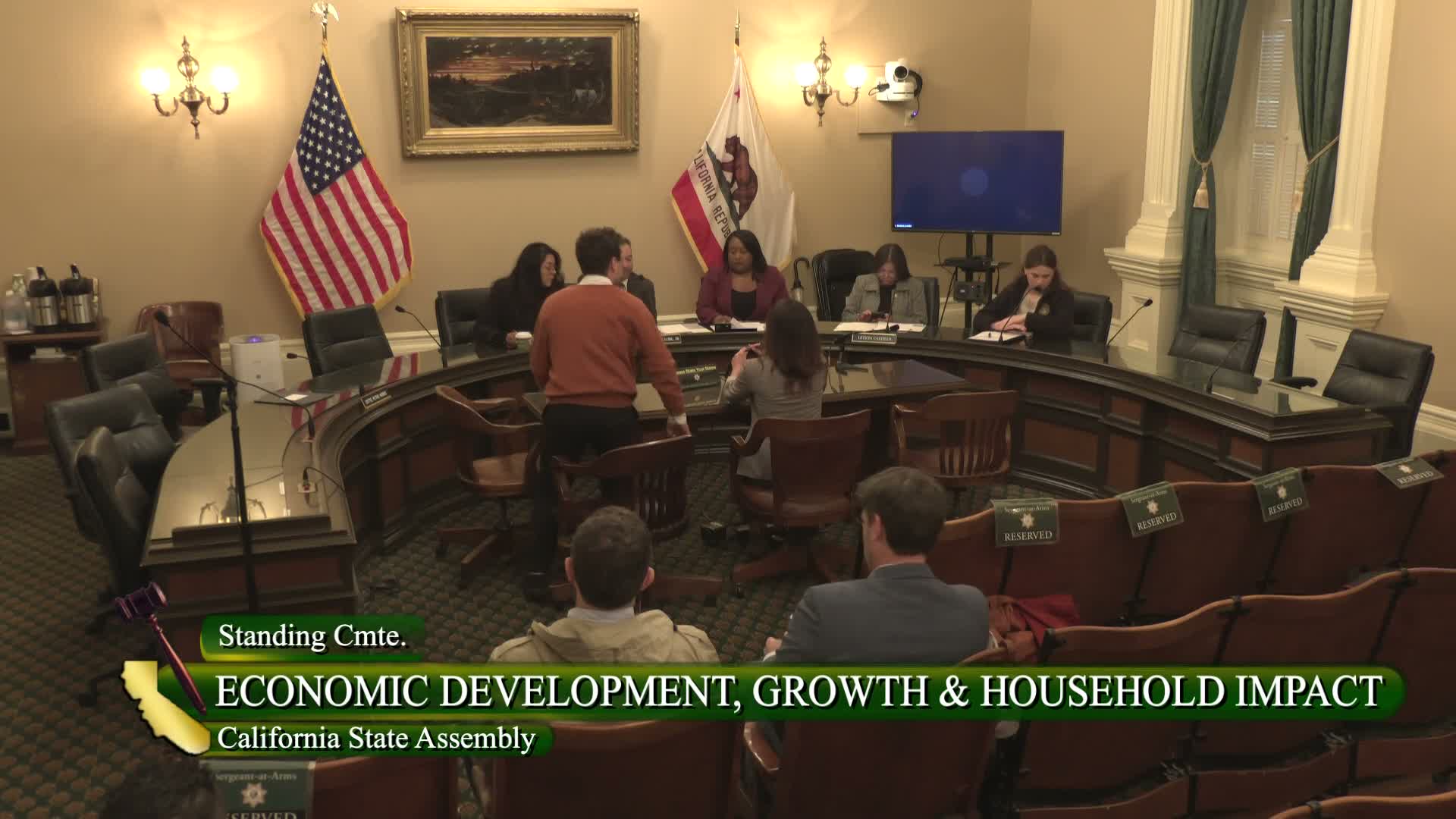
The Assembly Economic Development, Growth and Household Impact Committee on Wednesday heard AB2516, a bill the author said would establish a California Grid Manufacturing Initiative (CGMI) to address supply‑chain delays for critical electric‑grid equipment and accelerate clean‑energy deployment. The panel moved the bill to the Appropriations Committee for further consideration.
The author, speaking as chair of the Utilities and Energy Committee, said California must prepare for a rapid build‑out of generation and transmission capacity and that shortages and rising equipment costs are slowing the state’s clean‑energy transition. “The goal of AB2516 is really to take those challenges and create an opportunity,” the author said, framing the measure as a way to reduce costs, shorten lead times and promote in‑state manufacturing.
Labor witnesses told the committee they view the bill as an economic opportunity. “My name is Sam Appel. I’m the policy director for the United Auto Workers Region 6,” Appel said, and argued that modeling showed very large capital‑equipment costs to ratepayers if the supply chain remains unchanged; he cited a modeled figure of roughly $200 billion in capital costs. Appel also said that if 30% of private utilities’ capital expenditures were produced in California, the change could create about 12,500 direct jobs and roughly 5,000 high‑road manufacturing positions in the state.
Hunter Stern of IBW Local 1245 and the Coalition of California Utility Employees also urged support, saying California manufactures some electrical equipment but not at the scale needed for the coming build‑out and that the bill could improve training and bargaining for stronger jobs.
Representatives of several other labor and environmental groups — including the California Labor Federation, the Communication Workers of America District 9, BlueGreen Alliance and California Labor for Climate Jobs — registered support during the hearing; staff reported no witnesses in opposition in the room.
Under the proposal described at the hearing, the CGMI would identify critical grid components that delay build‑out, coordinate statewide assistance including centralized procurement where necessary, aggregate utility demand to reduce cost and incentivize in‑state manufacturing through financial assistance and public–private ventures. The author told members the proposal aims to deliver reliability and affordability while creating “thousands of high road jobs.”
The committee took a formal motion and, with a roll call, moved AB2516 to the Appropriations Committee for further review. The clerk’s final disposition language recorded the bill as out to appropriations at the close of the hearing. The committee left additional policy and fiscal details for later review in the appropriations process.
What happens next: AB2516 will be considered by the Assembly Appropriations Committee, where fiscal analysis and potential amendments are expected before any floor consideration.