Get Full Government Meeting Transcripts, Videos, & Alerts Forever!
Get email alerts on the Homelessness Services topic
No spam. Unsubscribe anytime.
LA CADA outlines homelessness and substance-use services for Huntington Park; council questions data and funding
Summary
The Los Angeles Centers for Alcohol and Drug Abuse presented its continuum of care to Huntington Park officials, describing screening/navigation, residential and outpatient treatment, 421 recovery bridge housing beds and mobile crisis outreach; councilmembers asked about funding sources, HMIS data and local shelter partnerships.
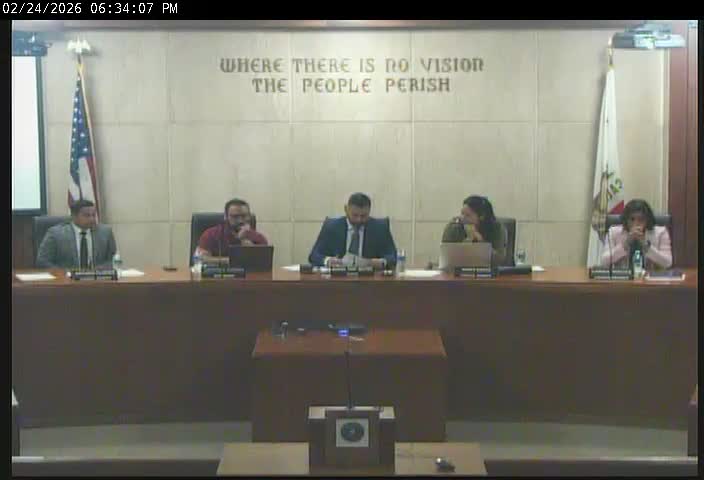
Representatives from the Los Angeles Centers for Alcohol and Drug Abuse (LA CADA) briefed the Huntington Park City Council on Feb. 24 about the agency’s countywide services and how they serve Huntington Park residents.
Joanne May, development and outreach manager, and John Gray, a LA CADA representative, outlined the agency’s continuum of care: screening and navigation (SEND) co-located at probation offices and courthouses, residential detox and treatment, intensive outpatient programs, recovery bridge housing with 421 beds, mobile crisis response, reentry services inside county jails and specialized programs for pregnant or postpartum women and LGBTQ clients. Gray said LA CADA operates 34 site locations across Los Angeles County and provides services in SPA 7, which includes Huntington Park.
Gray cited recent service statistics, saying LA CADA served more than 14,600 clients across its facilities in the past year and that stimulant (predominantly methamphetamine) use is a leading substance of concern in some areas. He explained the agency’s sequential-intercept model, which aims to meet individuals in the community, at pre-arrest and court stages, in custody and during reentry to reduce incarceration and link people to treatment instead.
Councilmembers pressed for details on outreach-team funding and data systems. Vice Mayor Sanabria and others asked whether street-outreach teams are ICMS (Integrated Crisis Management Services) teams and how they are financed; Gray said funding comes from a Council of Governments arrangement among 31 cities (historically ARPA and now partially Measure A/HSH) and that LA CADA uses HMIS along with internal databases and geo-mapping software for tracking encounters. Council members also asked about partnerships with permanent supportive housing and local shelters; LA CADA confirmed partnerships with local PSH sites and shelter programs and said it coordinates with organizations such as Homeboy Industries.
Councilmember questions covered program age distributions, tiny homes operated in partnership with cities, locations of services and options to expand outreach and education. Gray invited councilmembers to tour LA CADA facilities and requested continued coordination to connect Huntington Park residents to county services.
The presentation did not result in any formal council action but prompted a series of clarifying requests and offers to coordinate outreach and public education efforts.