Lifetime Citizen Portal Access — AI Briefings, Alerts & Unlimited Follows
Diamond Bar council introduces ordinance banning camping on public property, adds service-station language
Loading...
Summary
Council introduced (first reading) an ordinance that would prohibit camping, sleeping or lodging on public streets, parks and other publicly owned or maintained property; after discussion the council amended the draft to explicitly cover service stations and voted 5-0 to schedule second reading on May 5, 2026.
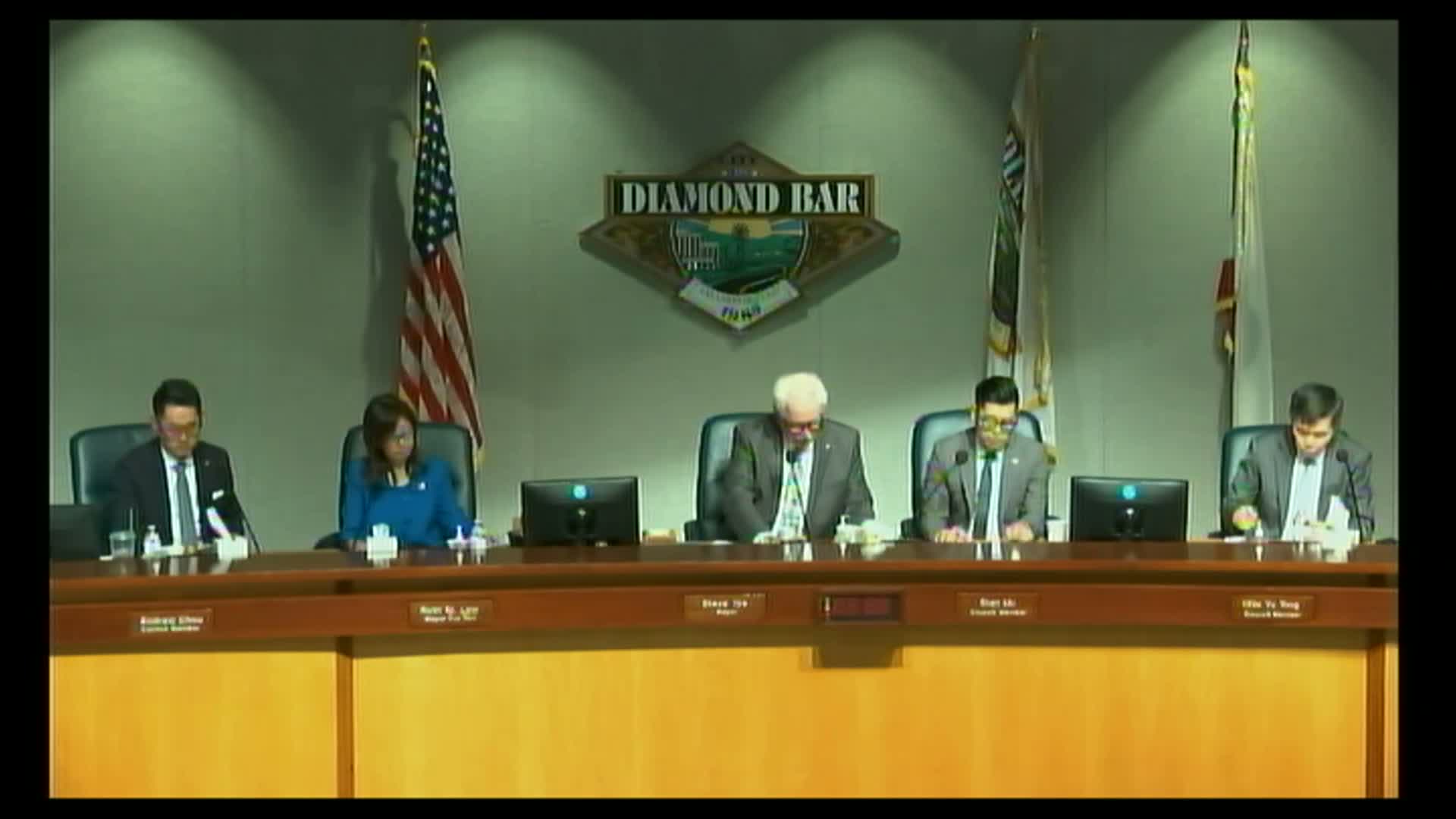
The Diamond Bar City Council on April 21 introduced an ordinance to prohibit camping, lodging or sleeping on public streets, sidewalks, parks and other publicly owned or maintained property and voted unanimously to amend the draft to explicitly include service stations.
City Manager Fox summarized the proposal, saying the ordinance would make it unlawful to “camp, lodge or sleep on public streets, sidewalks, parks, open space areas” and would repeal an existing code section prohibiting sleeping in vehicles to avoid redundancy. Fox said the city’s 2025 point-in-time count identified 42 unsheltered people in the city and that about 81% were residing in cars, vans or RVs.
City Attorney Sandoval and law enforcement staff described enforcement and prosecution options. Sandoval said violations would be misdemeanors but described the provision as a “wobbler,” meaning prosecutors or judges could treat or reduce offenses as infractions in some cases. A sheriff’s office representative explained how cite-and-release would typically be used and described the practical enforcement difference the ordinance would create: it would allow officers to detain someone occupying public space rather than simply have them walk away.
Captain (law enforcement representative) said the code change gives officers the ability to stop and detain people occupying public spaces: “If they want to walk away from us, they are not allowed to walk away from us because they have committed a Diamond Bar misdemeanor.” The officer added that most enforcement contacts would remain site-and-release (a citation issued on scene), but the new code would create an avenue for detention when an individual has committed the ordinance violation.
Council members asked whether the ordinance would cover RVs used for habitation, parks owned by school districts, Caltrans right-of-way, buffers near schools and childcare centers, and the practical effect on private properties such as gas stations and retail stores. Staff said publicly owned or maintained property (including school district property and parking lots) would be covered; private businesses (for example, CVS or Smart & Final) would not be covered by the city’s public-property prohibition, though private property owners can pursue trespass remedies.
Lo asked that the draft be amended to add the phrase “service station” to the section on interfering with public access; council moved, seconded and voted unanimously to introduce the ordinance with that amendment and to schedule second reading and adoption for May 5, 2026.
Why it matters: the proposal gives local enforcement another tool to address encampments that staff say present fire, sanitation and access risks. City officials emphasized the measure is intended to supplement outreach and referral to services, not to solve homelessness on its own.