Get Full Government Meeting Transcripts, Videos, & Alerts Forever!
Get email alerts on the Town Center topic
No spam. Unsubscribe anytime.
Diamond Bar council adopts Town Center framework, certifies supplemental EIR and introduces implementing ordinance
Summary
The City Council unanimously certified a supplemental EIR and adopted general plan amendments to establish a Town Center Specific Plan framework that allows up to 2,055 dwelling units at build‑out, sets a 30‑du/acre minimum, and introduces an inclusionary point system to earn higher density; an implementing ordinance was introduced and set for second reading March 17, 2026.
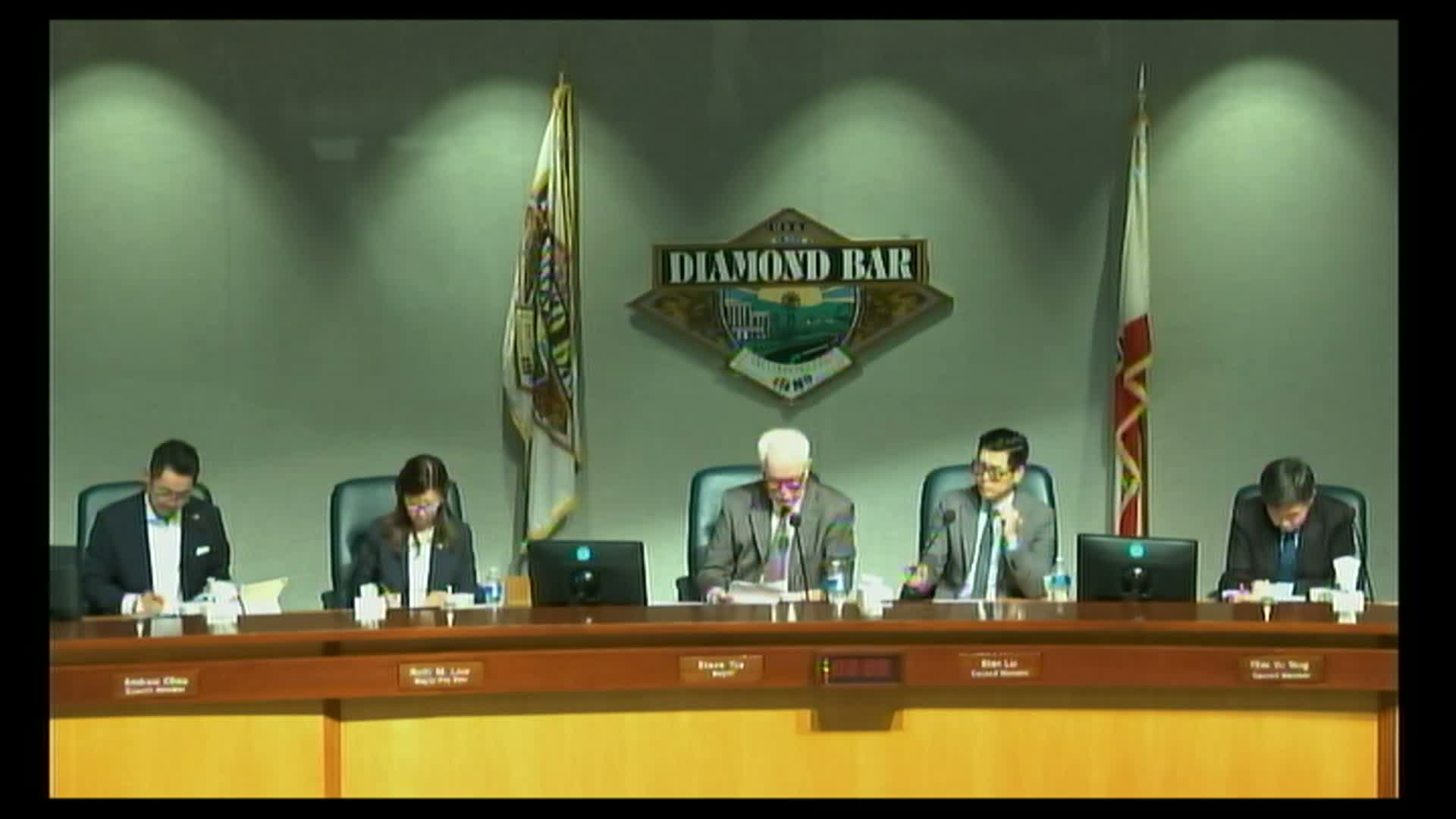
Diamond Bar — The City Council on March 3 unanimously certified the supplemental environmental impact report (EIR) and approved legislative changes to establish a Town Center Specific Plan that sets the regulatory framework for a future downtown along Diamond Bar Boulevard.
Community Development Director Greg Gubman told the council the plan covers about 45 acres between Golden Springs Drive and the 60 Freeway and is intended to guide redevelopment into a walkable, mixed‑use downtown. Gubman said the document establishes a base residential density of 30 dwelling units per acre and describes a theoretical build‑out of 2,055 units (about 45.7 du/acre) achievable through an inclusionary point system that awards density for public benefits such as affordable housing, ground‑floor commercial activation and parcel consolidation.
“The specific plan regulates land uses, build‑out density, architecture and transitions using objective, predictable standards intended to guide redevelopment over time,” Gubman said, summarizing the plan’s chapters, outreach and the rationale for treating some existing businesses as conforming uses.
The council’s environmental action included adoption of the required Statement of Overriding Considerations because the final supplemental EIR identified two significant and unavoidable impacts — air quality and vehicle miles traveled. Gubman said staff incorporated all feasible mitigation and documented the economic, housing and planning benefits the council may consider when weighing those impacts.
Traffic congestion was a central concern raised by residents and councilmembers. Remote caller Efrain Uvalde told the council he worries added housing in the downtown will worsen local congestion and urged the city to address traffic before adding units. Traffic consultant Jonathan Chambers of Gibson Transportation Consulting said the EIR compared the specific plan to a general plan baseline that already assumed significant residential capacity; his analysis estimated the net increase in units was several hundred (roughly 700–800) beyond what the general plan previously allowed and that multifamily, mixed‑use apartments generate fewer peak‑hour trips than single‑family homes.
“Most of the traffic on Diamond Bar Boulevard is regional through‑traffic,” Chambers said, adding that intersection improvements and project‑related turn pockets would reduce delay at critical locations.
Councilmembers pressed staff on how the plan’s zoning and incentives translate to actual development. Gubman said property owners can continue existing uses but new development proposing housing must meet the minimum density; higher densities are voluntary and earned through the point system or via state density bonus law — applicants cannot combine both.
After discussion, Mayor Pro Tem Low moved to adopt the resolution certifying the supplemental EIR and adopting findings and the mitigation monitoring program; Councilmember Chow seconded. The council voted 5–0. The council then adopted a resolution amending the general plan to reference the Town Center specific plan (5–0) and introduced an implementing ordinance amending Title 22 to establish the Town Center Specific Plan (first reading; set for second reading and adoption on March 17, 2026).
What happens next: staff will finalize the ordinance language, publish required notices, and the council will consider the ordinance for second reading and adoption on March 17. The specific plan does not authorize immediate development; it creates a regulatory framework and incentives intended to guide property owners and prospective developers over time.