Get Full Government Meeting Transcripts, Videos, & Alerts Forever!
Get email alerts on the Transportation Speed Limits topic
No spam. Unsubscribe anytime.
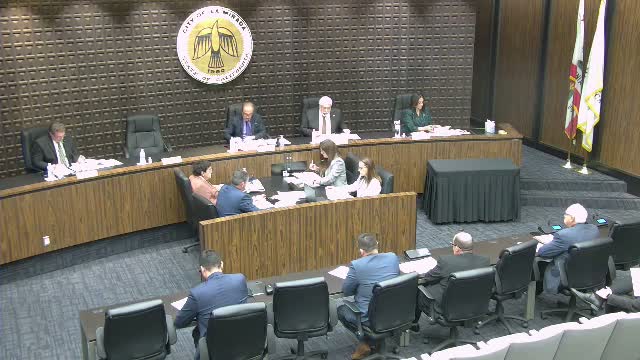
La Mirada council adopts traffic survey and introduces ordinance to adjust speed limits on six streets
Summary
The La Mirada City Council on March 10 adopted a staff engineering and traffic survey and introduced an ordinance setting new posted speeds on six arterial streets after staff said the survey justified changes; the vote was unanimous among those present (Mayor Pro Tematero absent).
The La Mirada City Council on March 10 adopted a staff engineering and traffic survey and introduced an ordinance that will change posted speed limits on six city streets, after staff said a February 2026 study justified the adjustments and the council discussed enforcement and school-adjacent pedestrian safety.
Assistant City Manager Anne Herrickson told the council the survey followed the California Vehicle Code and the California Manual on Uniform Traffic Control Devices, and used the 80th percentile speed (rounded to the nearest 5 miles per hour) as the basis for recommendations. "The methodology used to establish a speed limit is to round the 80 fifth percentile speed to the nearest 5 miles per hour," Herrickson said, summarizing the technical approach used in the report.
The ENTS (engineering and traffic survey) and ordinance (municipal code amendment, ordinance No. 749) would change posted limits as follows: Adelphi Drive (Rosecrans Ave to Santa Gertrudes Ave) from 35 to 40 mph; eastbound Artesia Blvd (Valley View to Knott Ave) from 40 to 45 mph; Biola Avenue (Imperial Hwy to Stage Rd) from 30 to 35 mph (staff said the measured 85th/"80 fifth" percentile would justify 40 mph but recommended 35 mph because of pedestrian volumes and proximity to schools); Firestone Boulevard North (Phoebe Ave to Knott Ave) from 45 to 50 mph; Northam Street (Trojan Way to Desmond Rd) from 35 to 40 mph; and Trojan Way (Alondra Blvd to Firestone Blvd North) from 40 to 45 mph.
Traffic engineer Bill Zimmerman (staff) and Herrickson answered council questions about data collection and enforcement. Staff said counts were collected with 24‑hour rubber hose counters and that higher-traffic arterials are surveyed as part of the city's circulation-element arterials and collectors, consistent with state and federal mapping. Herrickson noted the Public Safety Commission reviewed and recommended the survey at its Feb. 26 meeting.
Several councilmembers said they appreciated the staff work but voiced concern that higher posted limits could be perceived as permission to drive faster. "I look at this and I say, wow, this is a license to go fast, but on the other hand, it is a public safety measuring tool," one councilmember said during the discussion, urging continued enforcement and attention to pedestrian and school crossings.
The council adopted resolution No. 2608, which formally adopts the engineering and traffic survey, and introduced ordinance No. 749 by roll call; the ordinance was introduced for first reading (the staff presentation had requested introduction by title only and waiver of further reading). The roll call recorded "aye" votes from the councilmembers present and recorded Mayor Pro Tematero as absent.
The ordinance and resolution change how several arterials will be posted and will be used by enforcement and in contested-citation hearings, because the engineering study provides the technical justification required by state law. The council did not amend the staff recommendations at the March 10 meeting.
The council's action was procedural: the resolution adopting the survey passed and the ordinance was introduced for first reading. Further action on the ordinance will follow the city's standard ordinance-adoption process.