Get Full Government Meeting Transcripts, Videos, & Alerts Forever!
Get email alerts on the Property Tax topic
No spam. Unsubscribe anytime.
City manager: state property-tax changes shrink Belgrade's voted-levy revenue, staff recommends converting mills to dollars
Summary
The city manager told the council that recent state legislation shifting residential property tax rates reduced Belgrade's voted-levy revenue this year and presented two options: convert existing voted mills to fixed dollar levies (staff's recommendation) or recalculate and freeze mills; staff estimated about $459,080 less for the police levy and $54,009 less for the library this year.
City Manager Neil presented a detailed analysis of two state laws (referred to in the presentation as SB 542 and HB 231) that change how residential property tax rates are applied and how those changes affect Belgrade's voted mill levies. He said the laws were intended to shift some tax burden away from primary residences toward second homes, rentals and commercial properties, but that the mechanics of the shift materially reduce the value of voted mills for Belgrade in the short term.
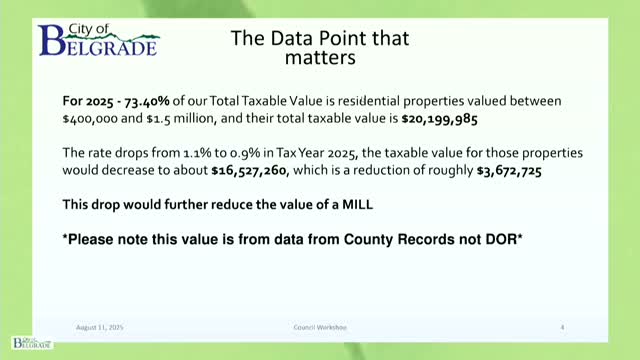
"For this tax year," the city manager said, "the police department has lost $459,080 in this tax year alone because of the changes made," and he told councilors the library lost roughly $54,009. He explained those figures come from county valuation records the city used for its analysis and cautioned some values remain subject to Department of Revenue finalization and property tax protests.
Why it matters: Belgrade's public-safety and library budgets rely in part on citizen-approved voted levies. The city manager said the shift to lower residential taxable percentages means the traditional mill-based approach will no longer automatically capture growth in taxable value, and that towns will face a choice that affects long-term revenue predictability.
Two options: The manager described two statutorily available responses. Option 1 (staff-preferred) would convert voted mill levies to a dollar amount equal to last year's revenue and allow adjustments tied to a capped inflation formula (a rolling three-year average and a limited annual cap). Option 2 would convert last year's revenue back into a new mill count for this year and then freeze that new mill count going forward, which avoids immediate dollar conversion but does not allow routine CPI adjustments.
Staff's rationale: The city manager argued Option 1 provides stability during the reset period because it matches a fixed dollar amount to ongoing costs and allows modest inflationary increases. He warned that if the city chose to remain on mills, it could see multi-year drops in collected revenue and would likely need to ask voters for additional dollar levies more frequently to maintain service levels.
Trade-offs and local context: The manager noted that Belgrade is unusually reliant on residential value within the $400,000'$1.5 million band; he said 73.4% of taxable value this year sits in the $400K'$1.5M residential class, making Belgrade particularly exposed to the new tiering rules. He also said the option chosen now will affect how future growth is captured and whether new development contributes proportionally to voted-levy revenue.
Next steps: Staff recommended returning at the next council meeting with a resolution for council consideration to select an option and begin the statutorily required process. The manager emphasized the figures shared are preliminary and rely on county-provided values pending Department of Revenue certification and potential appeals.
Sources and attribution: Statements and figures in this article are drawn from the city manager's presentation to the Belgrade City Council during a workshop session; direct quotes are attributed to the city manager as recorded in the transcript.