Get Full Government Meeting Transcripts, Videos, & Alerts Forever!
Get email alerts on the Accessibility topic
No spam. Unsubscribe anytime.
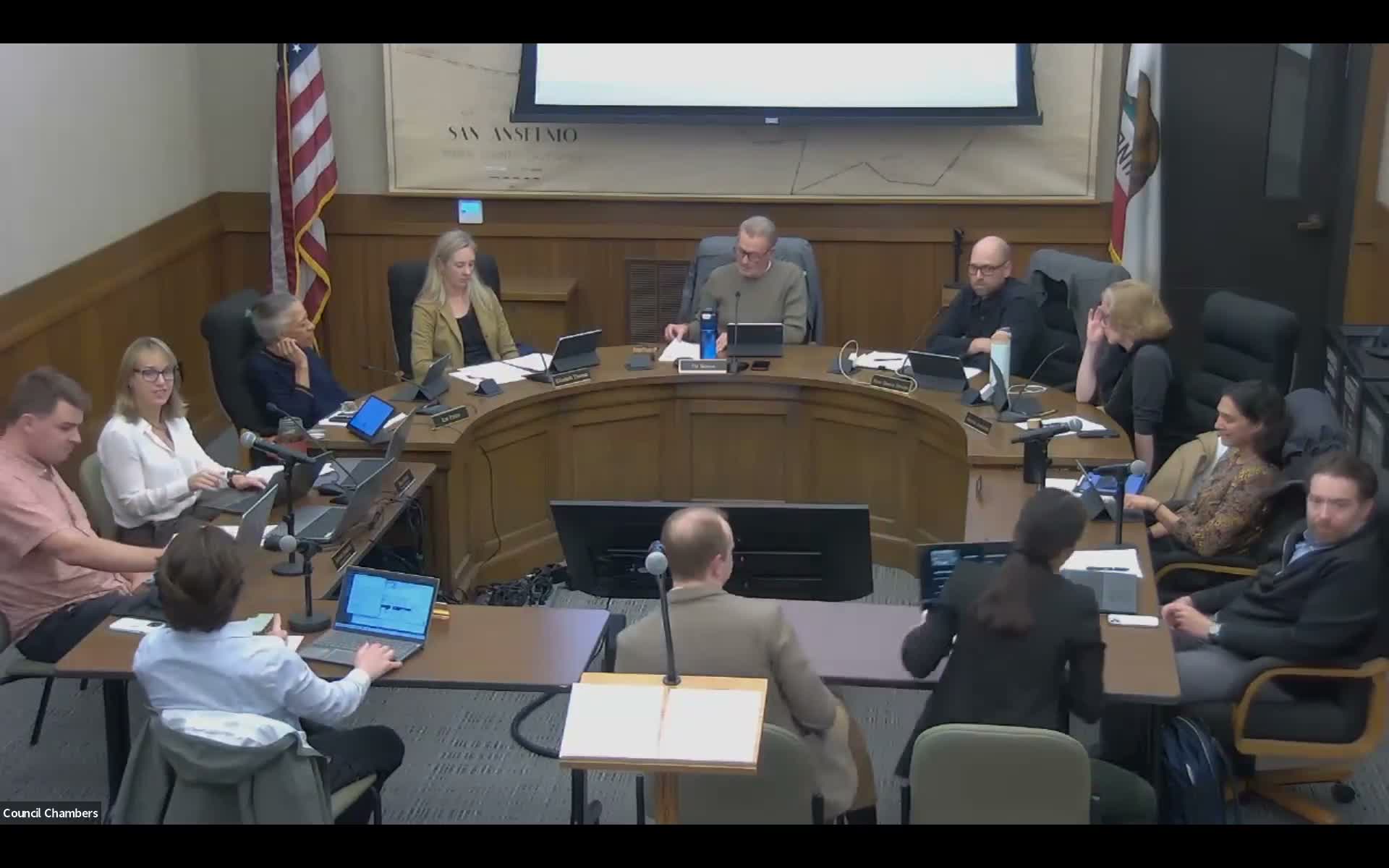
Planning commission approves church infill and ADA lift at 921 Sir Francis Drake Boulevard; easement for ingress/egress required
Summary
The Ensemble Planning Commission approved a 340‑sq‑ft infill to close a breezeway at the church on Sir Francis Drake Boulevard to improve safety and provide an ADA lift, and attached conditions require formalized ingress/egress easements (staff asked the commission to avoid requiring parking easements). The vote was unanimous.
The Ensemble Planning Commission voted unanimously to approve a design review permit and a street‑side setback variance for improvements at the church property on 921 Sir Francis Drake Boulevard, including a roughly 340‑square‑foot infill to enclose a breezeway and an ADA lift to provide second‑floor access.
Associate planner Jackson Deroney told commissioners the church site is a corner, parallelogram‑shaped lot in an R‑3 zone and that the proposed infill does not extend the building closer to the street than the existing building plane. On parking, Deroney noted a staff typo in the report’s parking math and cited state law: “state law AB 2,097 … prohibits local agencies from imposing minimum parking requirements on projects located within a half mile of a major transit stop,” meaning the town cannot impose a minimum parking count for this project.
Michael Snurley, identified as the pastor at Grace Church of Marin, said the primary reasons for enclosing the breezeway are safety and accessibility: the open breezeway has invited people to shelter overnight, and closing it would allow the church to isolate and manage interior spaces more securely and to install an ADA lift to make its second floor accessible. Church building committee members explained informal parking and circulation arrangements with adjacent property owners and said they will seek to record formal easements to secure the existing circulation plan.
Commissioners discussed options if the church cannot obtain recorded easements from neighbors: staff said the town could require a revised circulation plan that meets fire‑safety requirements or, in some cases, issue a temporary certificate of occupancy while the parties work out easement matters. Commissioners suggested amending the staff condition to require formalization of ingress and egress rights but not to force a parking easement on neighboring owners. The commission approved the project as recommended with the vice chair’s amendment (striking the word “parking” from the recordation requirement), and the motion passed unanimously; a 10‑day appeal period was noted.
The approval includes design review findings, CEQA Class 1 exemption for the work described, and conditions addressing easements or, alternatively, a revised circulation plan to ensure emergency access and ADA compliance.