Get Full Government Meeting Transcripts, Videos, & Alerts Forever!
Get email alerts on the Historic Preservation topic
No spam. Unsubscribe anytime.
Staff outlines San Anselmo's historic-resource review approach; commission discusses possible local protections
Summary
Staff summarized how historic resources are handled today through CEQA and the State Office of Historic Preservation's CRIS database, when an architectural historian report is required, and steps to create a local historic-preservation ordinance and pursue Certified Local Government status.
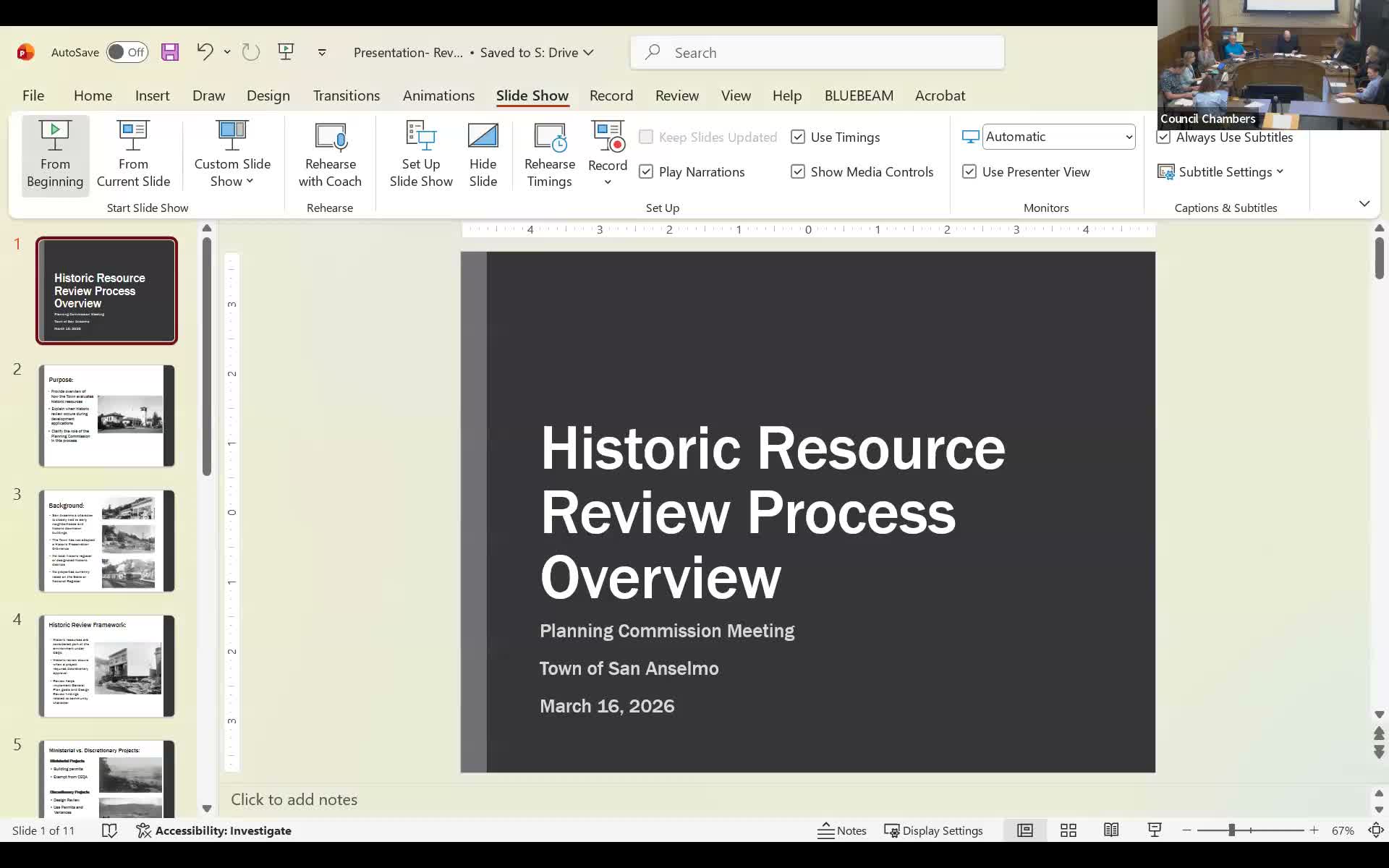
Planning staff presented an overview of the town's historic-resource review process and the role the Planning Commission plays when discretionary projects implicate potential historic resources.
Staff explained the town currently relies on the California Historic Resources Information System (CRIS) maintained by the State Office of Historic Preservation to identify properties that may be historically significant. If a property appears on CRIS or a project is discretionary (for example design review, variances or demolition permits), staff will typically require an architectural historian to prepare a DPR 5-23 or DPR 6-60 form or a historic-resource evaluation report to determine eligibility for state or national listing. Staff said properties eligible under the Secretary of the Interior's standards can trigger CEQA review paths such as an initial study and mitigated negative declaration or an environmental impact report if adverse impacts cannot be mitigated.
Staff also described a less onerous compliance-analysis option developed with the local historical museum for older properties that may not need a full report. The presentation identified examples of properties already on CRIS and noted how ministerial permitting can gradually erode historic integrity if character-defining features are repeatedly altered.
Commissioners asked about local options, whether parks or landscape features can be listed, and the implications of listing for ministerial or state "by-right" housing programs (including SB 9). Staff said creating a local historic-preservation ordinance and seeking Certified Local Government status would allow the town to adopt local listings and access grant funding to prepare a historic context statement and formal protections. Commissioners generally favored a moderate, public-engaged approach, and asked staff to return with next steps if the Town Council wishes to pursue local protections.
There was no public comment on the item and the matter was filed and received by the commission as an informational item.