Get Full Government Meeting Transcripts, Videos, & Alerts Forever!
Get email alerts on the Entertainment Hours topic
No spam. Unsubscribe anytime.
Planning commission recommends 10 PM cap on restaurant entertainment to town council after residents cite late‑night amplified music
Summary
After multiple residents described repeated late‑night amplified events at Marinitas, the San Anselmo Planning Commission voted to advise the Town Council to adopt a zoning change that allows restaurant‑related entertainment by right until 10:00 PM and requires a conditional use permit thereafter; commissioners debated enforcement, decibel thresholds and CUP revocation procedures before forwarding the measure.
San Anselmo — The Planning Commission on a majority vote recommended that the Town Council adopt a narrow zoning amendment to allow entertainment secondary to a restaurant use "by right" until 10:00 PM and require a conditional use permit (CUP) for entertainment after that hour.
Assistant Town Attorney Emily Longfellow told the commission the proposal is intended to be a narrowly tailored, enforceable ceiling. “Restaurants may provide entertainment that is subordinate and secondary to the restaurant use by right until 10:00 PM, and after that time they would need to get a conditional use permit,” Longfellow said, adding the change aims to be proactive and align with the town’s existing noise‑ordinance time tranche.
Multiple residents described recurring late‑night amplified events at Marinitas that they said have disrupted sleep and quality of life. William Bright read a written statement from neighbor Bill Murray saying events advertised across the Bay had run until 1:00–1:30 AM and that noise routinely prevented his family from sleeping. Another resident reported a tenant decibel reading of about 60 dB at 1:15 AM and said patrons lingered outside, leaving bottles and trash.
Commissioners debated policy options during a lengthy exchange. Staff outlined enforcement pathways: police take noise complaints and code enforcement opens investigations; the town can impose administrative fines (staff said they go up to roughly $500) and pursue nuisance abatement, but those abatement proceedings are expensive and slow. By contrast, staff explained, a CUP can be revoked more quickly if conditions are violated because the CUP runs with the land and revocation is a clearer, faster administrative path.
Commissioners discussed alternatives, including limiting only amplified sound after 10:00 PM or tying post‑10 PM review explicitly to the town’s 55 dB threshold; some commissioners favored allowing amplified or live entertainment after 10:00 by CUP if operators could demonstrate mitigation. Others said 10:00 PM is a reasonable starting point that aligns with current town practice and the noise ordinance.
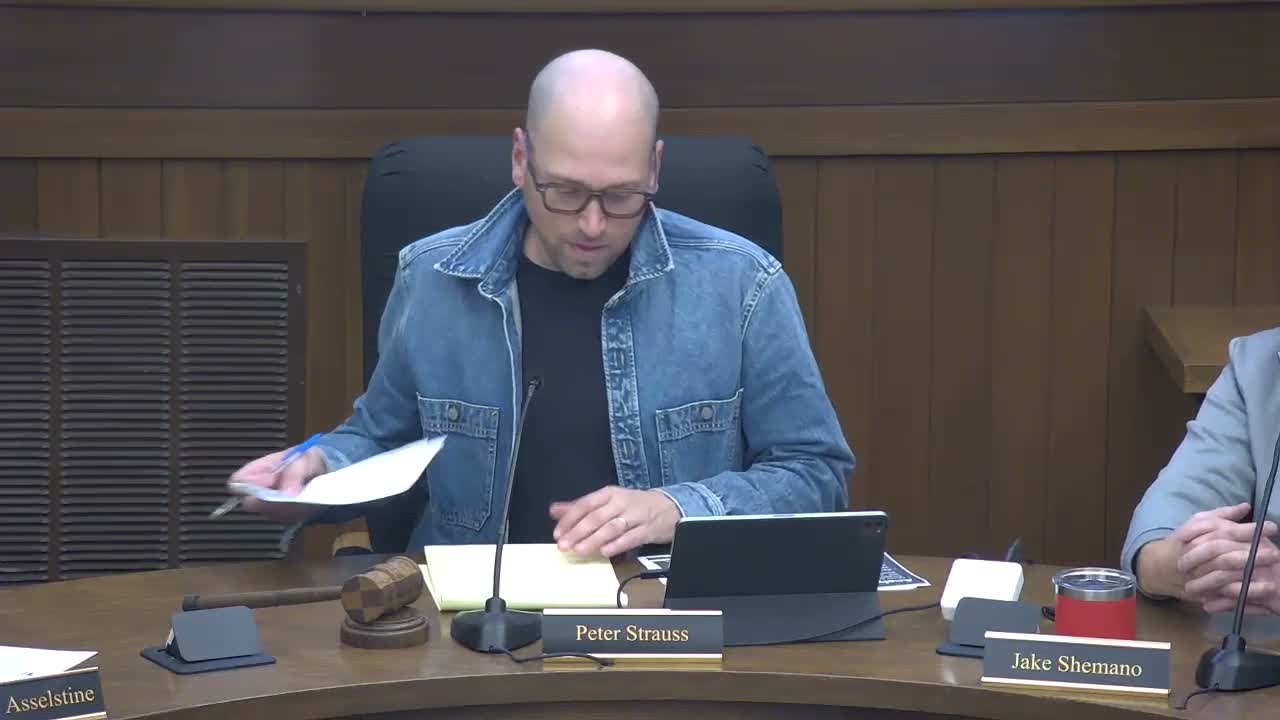
After discussion, the commission voted to forward the staff‑recommended ordinance language to the Town Council. The roll call included affirmative votes from Commissioner Tara Tickner and Commissioners Pipkin and Asselstine; Chair Peter Strauss cast the lone recorded "no" vote. Staff noted the Town Council will have final consideration and that CUPs remain a vehicle to allow later hours after careful review and mitigation.
The ordinance would not retroactively change any current CUPs; staff said they are pursuing enforcement and potential revocation of any existing CUPs that are being violated. The commission also asked staff about potentially streamlining CUP processing so operators are not unduly delayed when seeking mitigation‑based approvals.