Get Full Government Meeting Transcripts, Videos, & Alerts Forever!
Get email alerts on the Land Use topic
No spam. Unsubscribe anytime.
Planning commission approves downtown pet-grooming and self‑service dog wash with tree-protection condition
Summary
The San Anselmo Planning Commission voted to approve a conditional use permit for a pet grooming, retail and self-serve dog wash at 115 Tinstead, subject to a condition that the applicant coordinate tree‑protection measures with the Department of Public Works; staff said the project is categorically exempt from CEQA.
Planning staff recommended approval of a conditional use permit for a pet grooming, retail and self‑service dog-wash proposed at 115 Tinstead, and the Planning Commission voted to grant the permit with a condition that the applicant consult with the Department of Public Works about protecting an adjacent street tree.
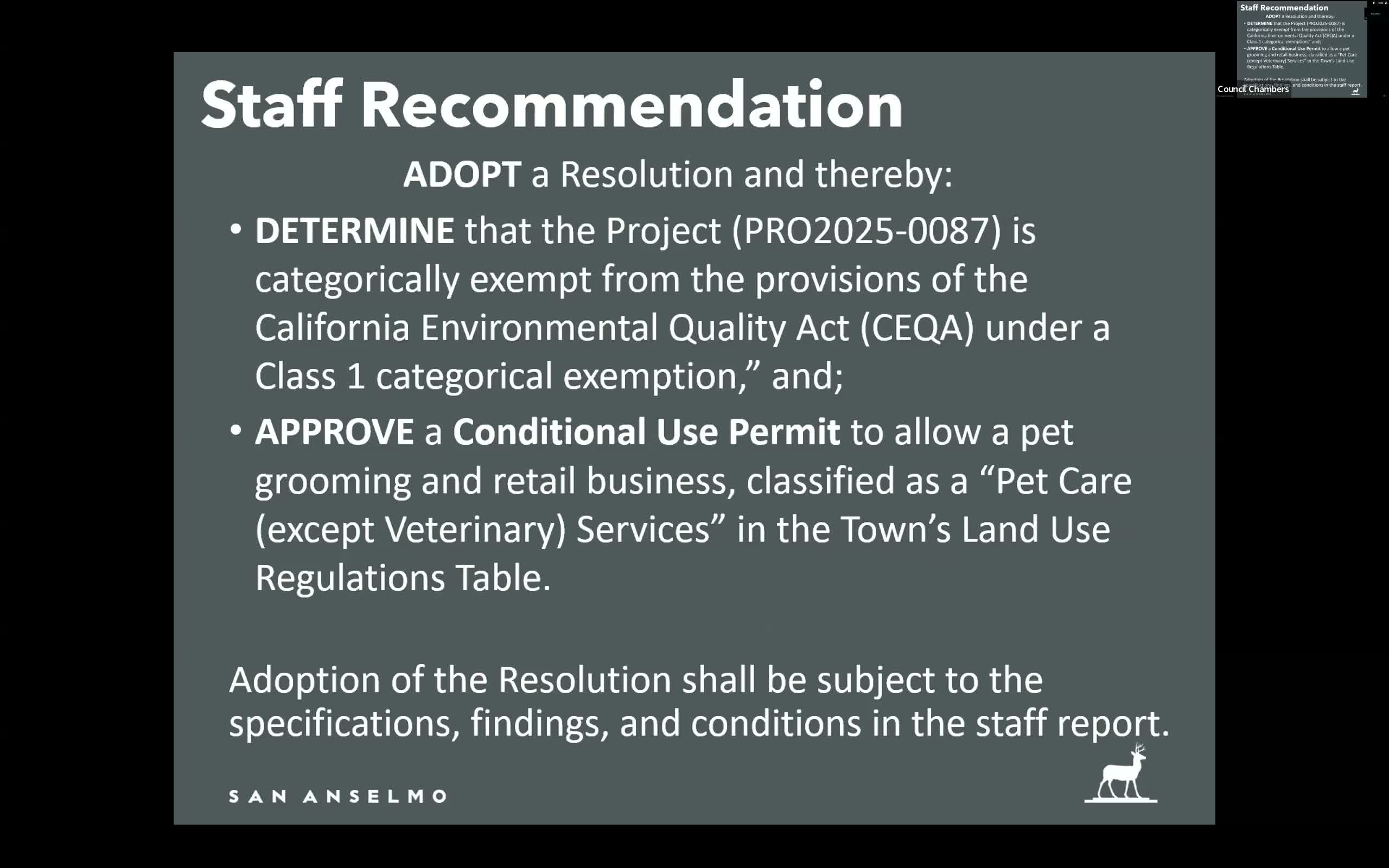
Jackson, a planning staff member, said staff's recommendation was to "adopt the resolution, thereby determining that the project is categorically exempt from the provisions of CEQA, and approve a conditional use permit" subject to the findings and conditions in the staff report.
Architect and project representative Paul Wang said the single-story downtown storefront would include a retail area, three self-serve dog-wash stations, four grooming stations and kennels with space for about 12–16 animals. Wang said hours would be Monday through Saturday, 10 a.m. to 6 p.m., with three staff on duty. He described proposed mitigation measures including interior pet-relief facilities, a dedicated enclosed trash room, HVAC and humidity control in wash areas, insulation and sound-attenuation materials, UV air filtration and HEPA filters to reduce airborne bacteria and allergens, and door closers and latches to prevent escapes.
"We are gonna relocate the cashier checking station...so it has more visibility to the customers," Wang said when describing storefront layout. He added the dog-wash area would have windows to bring in natural light and to provide visual contact for staff supervising self-serve customers.
Commissioners focused questions on public‑realm impacts. Commissioner Jennifer raised concern about a single street tree in front of the site and asked whether mitigation such as protective surfacing or a dog guard should be required. Jennifer moved to approve the permit with a condition that the applicant "be required to discuss the options for protection of the tree with the Department of Public Works." Staff said it would strengthen the condition language to make implementation contingent on Public Works' requirements.
Paul Wang said he had not previously discussed tree protection with the owners but would research options. Staff reminded the commission that street trees fall under the Department of Public Works, and that any specific measure would need the department's approval.
Commissioners also asked about handling of pet waste and trash. Jackson said the application includes an interior pet‑relief area and immediate cleanup and disposal procedures; staff indicated standard trash pickup (Marin Sanitary) would collect waste placed in an enclosed trash room off the staff area. On the topic of noise, staff described the town's existing noise ordinance and said the building inspector can measure decibel levels at the property line; if levels exceed limits after attenuation is installed the town would work with the applicant to add measures and would consider revocation only after remedies are exhausted.
Bella Wasserman, who identified herself as the operations manager, said grooming and wash services would be the primary revenue source and that retail sales would be a secondary income stream.
Following discussion the commission approved the permit in a roll-call vote and the chair announced a 10‑day appeal period. The motion directed staff to add the tree‑protection discussion with Public Works as either a condition of approval or an advisory note with language to be refined.
The commission recorded no public comment on the item. The approved permits and conditions, the staff findings and the 10‑day appeal timeline are reflected in the official action.
Next steps: staff will finalize the precise condition language regarding Public Works coordination and will process the permit paperwork; the approval is subject to the standard 10‑day appeal period.