Get Full Government Meeting Transcripts, Videos, & Alerts Forever!
Get email alerts on the Building Codes topic
No spam. Unsubscribe anytime.
Mono County moves to adopt 2025 California building codes; building official says county will keep local snow‑load standards
Summary
Building Official Tom Perry briefed the board on adopting the 2025 California Building Codes, highlighted the new Wildland Urban Interface Code and Appendix P (sleeping lofts), and said Mono County will continue using local snow‑load values rather than ASCE hazard-tool outputs to avoid large construction-cost increases.
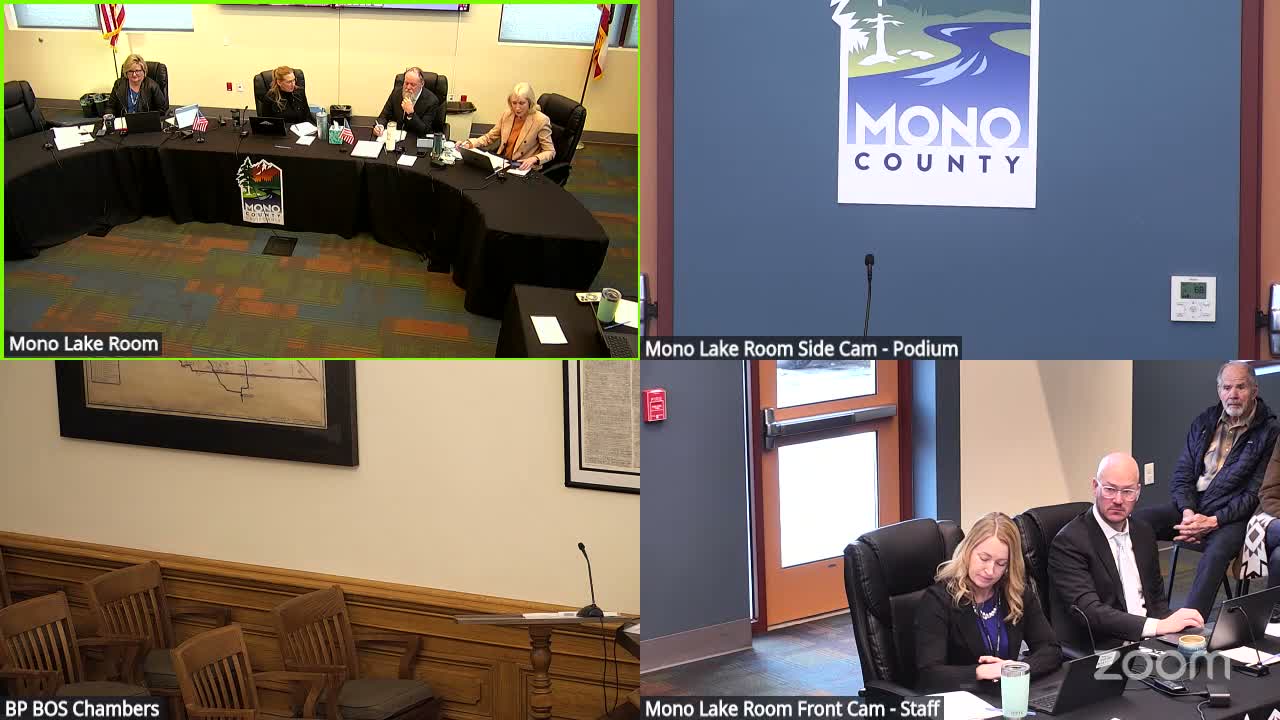
Tom Perry, Mono County's building official, led a Jan. 20 workshop on adopting the 2025 California Building Codes and highlighted several items of local relevance.
Perry said the state codes became effective Jan. 1, 2026, and that local adoption is largely a formality to align county code with the state cycle. He called out the new standalone California Wildland Urban Interface (WUI) Code, intended to address growing wildfire threats, and described Appendix P (sleeping lofts), which relaxes dimensional and egress standards for very small sleeping areas in multifamily buildings.
Perry also addressed AB 130, legislation that limits local jurisdictions' ability to add code requirements through a temporary "building-code freeze," with narrow exceptions for WUI, emergency standards and similar local codes. He said the county's proposed updates were reviewed and do not violate AB 130.
A significant technical issue was the ASCE 7-22 hazard tool, which assigns ground-snow-load values nationwide. Perry gave local examples showing dramatic increases under the hazard tool — for June Lake he said the tool would raise snow-load criteria from roughly 155 to 335 pounds per square foot, more than doubling structural load requirements and likely increasing construction costs substantially. Perry said Mono County building officials and a coalition of engineers and stakeholders reviewed the hazard tool, identified flaws and used the building-code alternative-method provision to continue using locally derived snow loads specific to Mono County.
Supervisors thanked Perry for his review and said keeping local snow loads will help avoid excessive construction-cost increases in high-snow areas. Perry said staff will bring a public hearing item at the Feb. 3 meeting and return with the proposed ordinance to adopt the state codes with the noted local clarifications.
What happens next: staff will hold the public hearing on Feb. 3 and return with a recommended local ordinance adopting the 2025 California Building Codes with identified local exceptions for snow loads and limited housekeeping edits.