Get Full Government Meeting Transcripts, Videos, & Alerts Forever!
Get email alerts on the Downtown Development topic
No spam. Unsubscribe anytime.
Napa leaders weigh downtown growth, branded residential and entertainment boundaries
Summary
City staff and elected officials at a joint Planning Commission–City Council meeting debated how to balance downtown economic growth driven by hotels and entertainment with housing goals, historic preservation and noise/public-safety regulation. Staff will return with entitlement and zoning follow-ups.
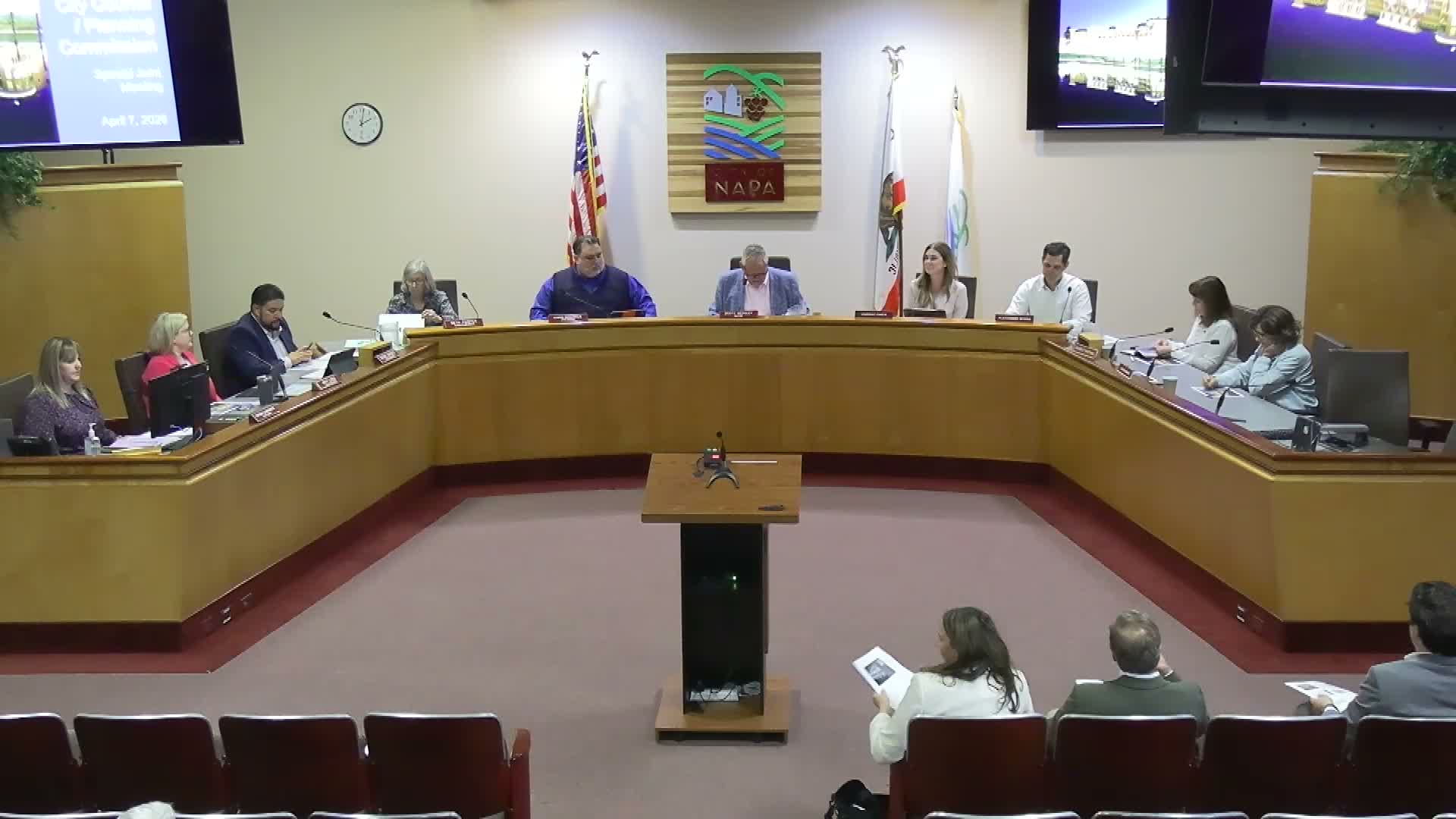
Molly Radagon, the City of Napa’s community resources and development director, opened a joint Planning Commission and City Council special meeting by asking commissioners and council members to weigh in on downtown priorities including hotels, entertainment uses and parking.
City staff emphasized that downtown has been a significant generator of municipal revenue since the 2012 downtown specific plan. "Property tax is around $11.12 million," Neil Harrison, the city’s economic development manager, said, noting downtown accounted for roughly 20% of the general fund. Harrison also said restaurant and bar businesses, while about 15% of downtown businesses, generate about 64% of downtown sales tax.
Why it matters: council members said the revenue benefit must be balanced against housing availability and neighborhood livability. Staff flagged a cluster of entitled hotel and branded-residential projects — including the 1st Street phase 2 project with 261 hotel rooms and 78 branded-residential units — and noted several long-standing entitlements such as a Ritz-Carlton entitlement from 2008 that have not proceeded to construction.
Ryder Dilley, interim planning manager, described the city’s entertainment overlay, which regulates hours and noise in the Main Street corridor and a portion of 1st Street. Dilley stated clearly that Napa does not have an 'entertainment zone' under AB 969 and that many new use-permit applications have been filed outside the overlay, prompting discussion about whether the overlay boundary or the downtown specific plan needs updating.
Discussion focused on a few concrete tensions: whether 'branded residential' should count toward housing production or be treated as hotel units for environmental review and impact-fee purposes; whether to prioritize hotel-driven economic activity or preserve additional sites for infill residential; and how to address noise and public-safety conditions for nearby residences. "Branded residential is not something recognized by us in our code or by the state that we have been able to find," Radagon said, adding staff’s conservative approach is to treat those units as hotel-like until HCD guidance is received.
Several councilmembers urged a comprehensive look at the downtown specific plan during the next budget cycle and asked staff to return with more information on aging entitlements and options to spur or limit extensions on long-dormant approvals. The meeting produced no formal actions; staff said they will report back on entitlements (including the Ritz-Carlton site) and continue the zoning update process.