Get Full Government Meeting Transcripts, Videos, & Alerts Forever!
Get email alerts on the Land Conservation topic
No spam. Unsubscribe anytime.
Chair pushes split tracks, committee debates scoring as staff readies three parcels and eight applications
Summary
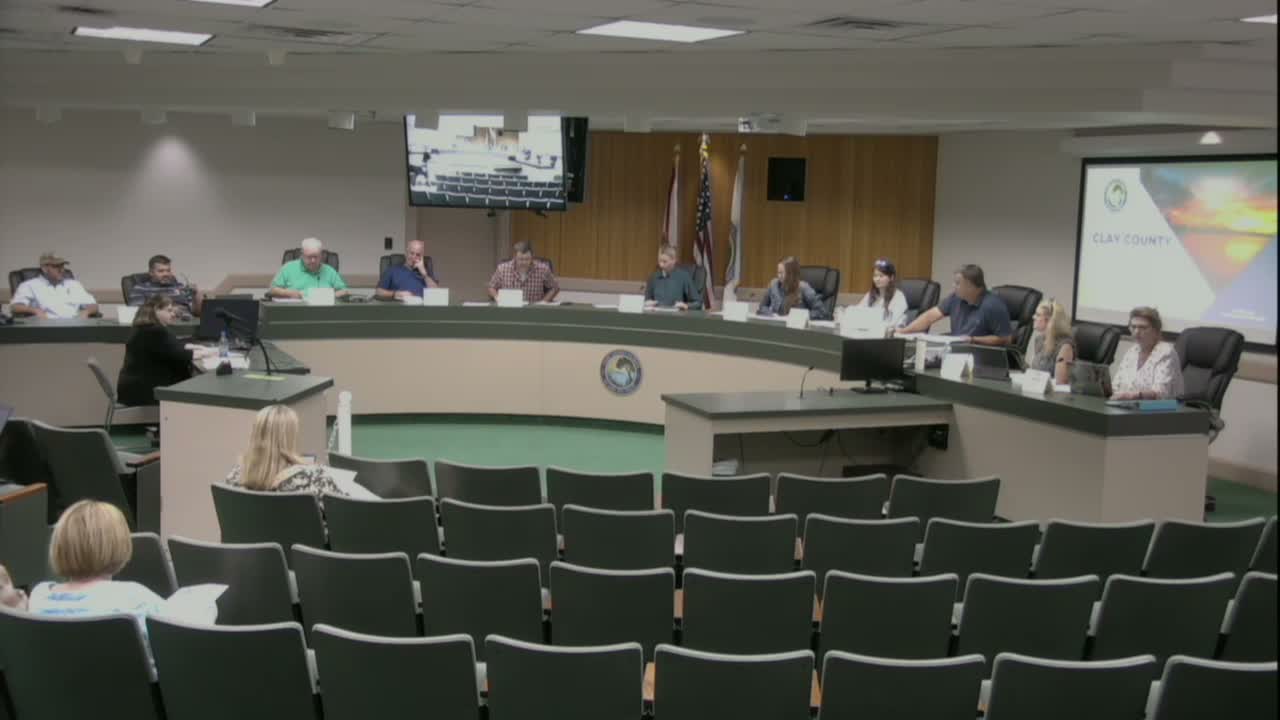
Members of a Clay County conservation committee practiced scoring candidate parcels, debated a 0–10 rubric and a first-round yes/no eligibility vote, and agreed to separate conservation-easement and fee-simple acquisition tracks; staff said three parcels will be brought in May and that eight applications have been received.
Chair opened the meeting and moved quickly from procedural business into a working session on how the committee will evaluate candidate parcels for the county conservation program. Staff member Dodi told the committee the evening would be a practice run on three parcels, and that staff will post an Excel scoring sheet so members can enter scores electronically.
The committee spent most of the meeting clarifying a two-step evaluation: a binary go/no-go eligibility vote followed by a numeric ranking. "The first vote says that we want you to look at it further," a committee member said, describing the nomination pool → eligibility pool → priority ranking workflow staff proposed. Committee members emphasized that the first round should often be a simple yes-or-no to avoid staff expending resources on parcels that are clearly unsuitable.
A recurring point was how subjective category scoring can be without calibration. One member offered to draft calibration examples for what counts as a 1, 3 and 5 in the rubric. Staff located a spreadsheet in county files that used a 1–5 scale (1 none → 5 high) and agreed to circulate that and adapt it for the committee. Members also asked staff to include taxable values from the property appraiser on data sheets so reviewers have at least a ballpark valuation to guide prioritization.
Discussion turned to the program’s scale. "I mean, there's $42,000,000 to be spent here," one member said, arguing fee-simple purchases at current market prices will buy very little and that conservation easements or partnerships may yield more conserved acres per dollar. Several members pushed the committee to separate conservation easements and full-fee acquisitions into distinct tracks or to add explicit points for easement value so easements are not systematically disadvantaged by the matrix.
Staff reported the program has received eight applications; three applications included an owner signature and one nomination listed an HOA agent as signer, prompting staff to consult legal counsel about whether additional documentation is required before a parcel is formally advanced. Committee members agreed staff should note applicant preference (fee vs. easement) on each submission so members can prioritize within or across tracks.
On timing and process, the committee agreed staff would present three parcels at the May meeting as the initial practice set; additional parcels would be brought in June while staff gathers environmental overlays and consultant analysis, and the first three would return in July with added data for a final committee decision and possible referral to the board. Members said photos, consultant notes and Google Earth imagery should suffice for most parcels, reserving in-person site visits for exceptional or unusually valuable properties.
The meeting closed with no public comments. Staff thanked the committee and said it would circulate the spreadsheet, sample calibrations and the list of applicants before the next meeting.