Get Full Government Meeting Transcripts, Videos, & Alerts Forever!
Get email alerts on the Land Use School Expansion topic
No spam. Unsubscribe anytime.
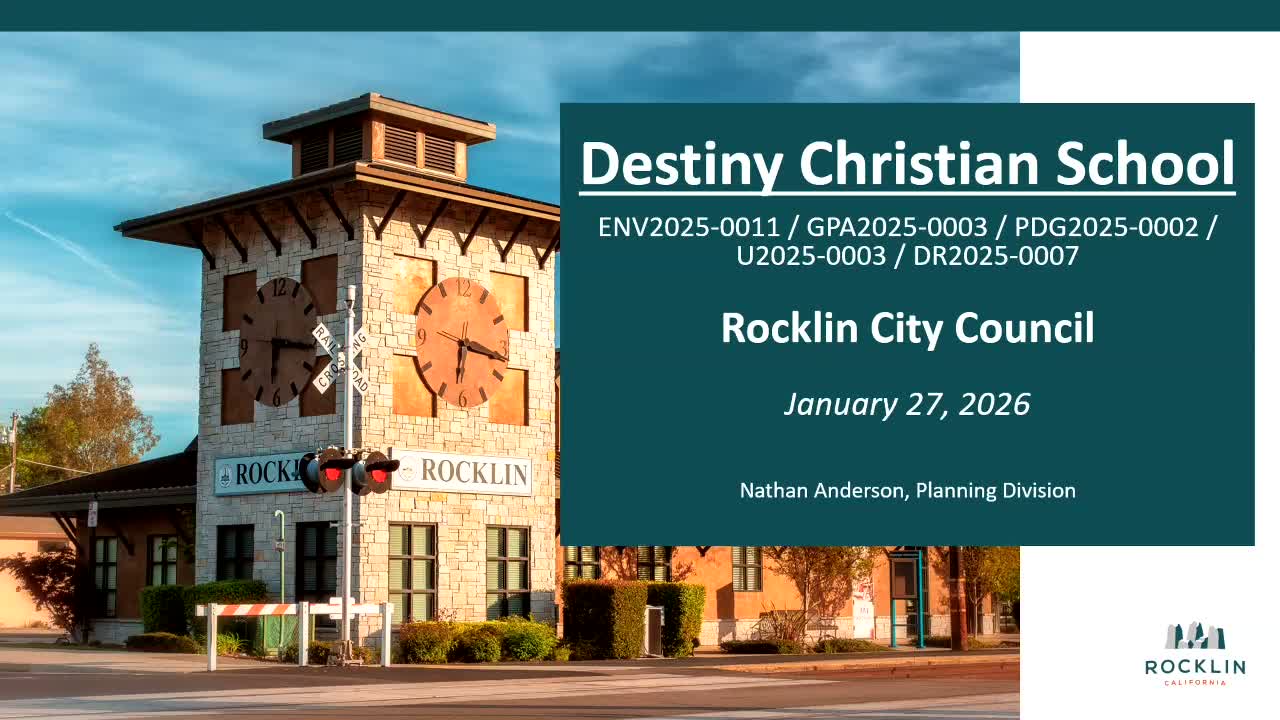
Rockland council approves Destiny Christian School expansion, conditions $15,000 annual payment
Summary
The Rockland City Council on Jan. 27 approved a package of land‑use actions allowing Destiny Christian School to expand into a 53,000‑square‑foot shopping‑center tenant space for grades 4–8, imposing a condition that the school execute a contract to pay the city $15,000 per year while the permit is valid. Council debated traffic, parking and a consultant’s fiscal estimate of up to $122,200 in annual lost sales tax revenue.
The Rockland City Council voted Jan. 27 to allow Destiny Christian School to expand into a vacant 53,000‑square‑foot tenant space in the 5 Star Plaza shopping center, approving a general development plan amendment, conditional‑use permit and design review with a condition that the applicant sign a contract to pay the city $15,000 annually while the permit remains valid.
Nathan Anderson, planner with the Rockland Planning Division, told the council the proposal would convert commercial space to a school serving grades 4–8 with 15 classrooms capped at 20 students each, limiting total enrollment to 250 and anticipating initial enrollment of about 210. The project would remove 28 parking spaces to create a net parking count the staff said would be consistent with school standards, and the applicant must prepare and implement a traffic management plan to keep vehicle queues on private property.
Staff also highlighted two engineering studies. A traffic study identified the Stamford Ranch Road/5 Star Boulevard intersection — under neighboring Roseville’s control — as the only intersection projected to operate below the city’s standard; staff said Rockland may list that intersection as infeasible for local improvements because Roseville controls the signal timing. A separate noise study by E Corp Consulting found existing and future Highway 65 traffic would exceed Rockland’s outdoor noise standards for playground use without mitigation; the project therefore proposes a concrete masonry sound wall about 13.5 feet tall along the playground edges.
The project’s fiscal‑impact report, prepared for the applicant by a consulting firm, estimated a potential annual general‑fund shortfall of up to $122,200 if the space were retained by a retail tenant’s taxable sales. Assistant City Manager Andrew Keyes told the council the report used standard sales‑per‑square‑foot factors (including Urban Land Institute guidance and city experience) and did not represent a market‑viability study. Keyes said portions of the consultant’s underlying data were proprietary, limiting staff’s ability to provide a line‑by‑line breakdown at the meeting.
Greg Farrington, lead pastor of Destiny Christian Church and the property owner, told the council Destiny had owned the building since a foreclosure and bought what had been a hard‑to‑lease retail parcel after Walmart moved away years ago. Farrington said Destiny would use the space to expand its existing elementary program and that, if the council refused the school, the church would likely repurpose the space for office or other nonprofit uses that would generate little or no taxable sales. "We are blessed to be a blessing," Farrington said, and he described the school as a community benefit that creates local jobs and educational choice.
More than a dozen public commenters — including teachers, parents and the school administrator — urged approval, describing Destiny as affordable and supportive of students with special needs. Laura Schmidt, a Destiny teacher, said the proposed playground and improvements would be an aesthetic upgrade and that the school offered a positive environment for children. Several councilmembers acknowledged the community benefits but pressed for greater clarity on the fiscal assumptions and how the city could offset lost sales‑tax dollars.
Faced with that tension, the council pursued a compromise. After discussion and brief caucusing, the city attorney read new language to be added as a condition: prior to occupancy the applicant must execute an agreement, subject to city‑attorney review, obligating Destiny to pay an annual fee of $15,000 for as long as the conditional‑use permit remains valid; the first payment is due before occupancy and subsequent payments are due every 12 months. Vice Mayor Holden moved approval of the conditional‑use permit as amended; the motion, with recorded second, carried. Council also approved the related general‑plan amendment, design review and ordinance introduction to allow school uses in Area 15A.
Council members differed on whether the fee appropriately offsets the consultant’s higher fiscal estimate. Some members argued the site’s long history of vacancy and its marginal retail prospects supported approval; others said the city should demand a more detailed, third‑party economic analysis before permanently converting commercial acreage. The record shows staff will continue negotiating the precise agreement language and will return documentation for final review before certificate of occupancy is issued.
Next steps: staff will finalize the required traffic management plan, finalize design and sound‑wall details, and work with the applicant to prepare the payment agreement and any development‑agreement language required by the council; the conditional‑use permit and related approvals will not be effective until the required agreement is executed and the certificate of occupancy conditions are met.