Get Full Government Meeting Transcripts, Videos, & Alerts Forever!
Get email alerts on the Transportation topic
No spam. Unsubscribe anytime.
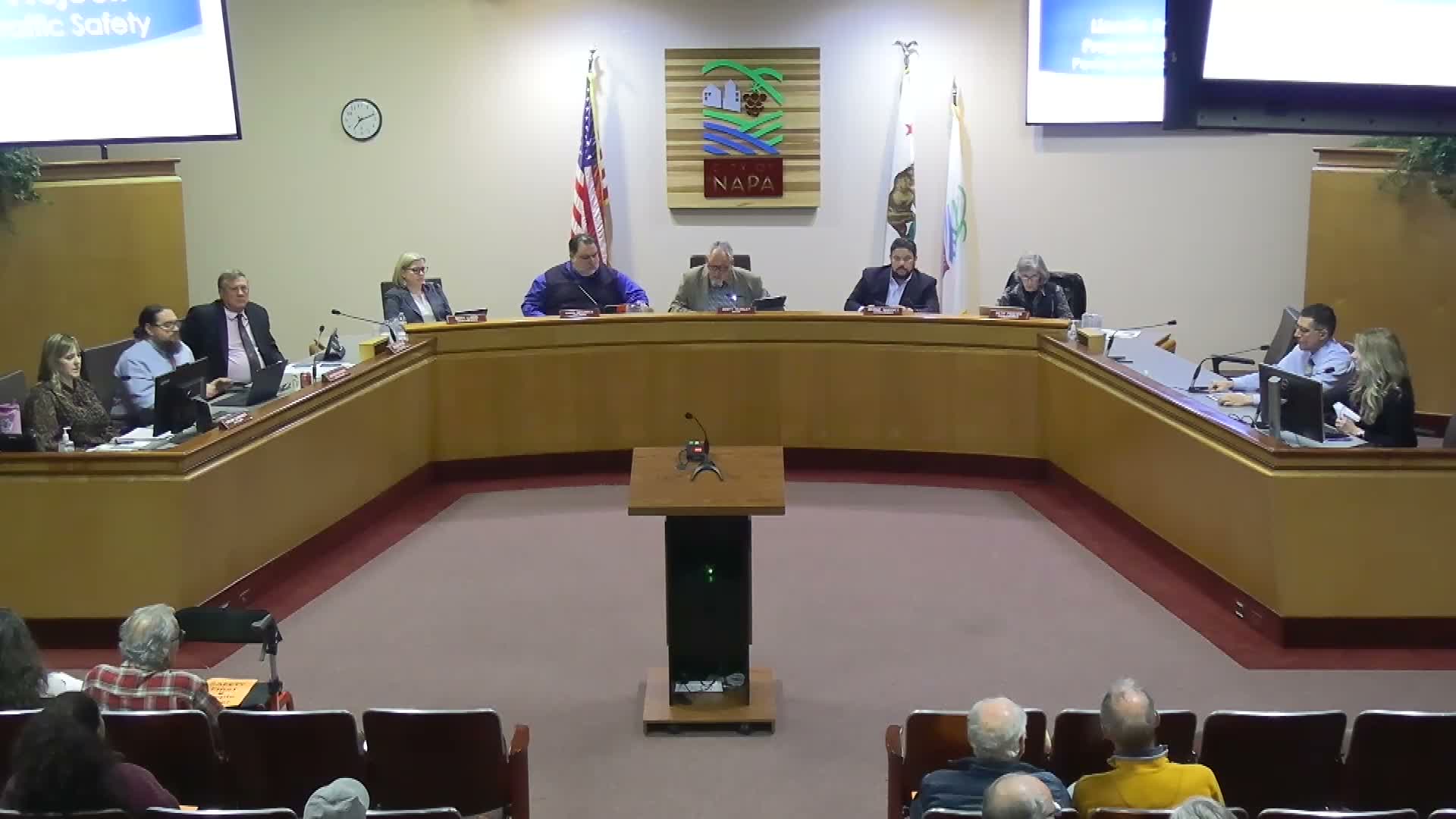
Napa council approves Lincoln Avenue ‘road diet’ after hours of public comment
Summary
After weeks of outreach and a lengthy public‑comment period, the council approved a restriping and safety redesign for Lincoln Avenue (California–Soscol) that narrows travel lanes, adds buffered bike lanes and turn pockets; staff will monitor traffic, collisions and modal shifts post‑implementation.
Public Works Director Julie Lucido and senior traffic engineer Fareed Jovindel presented the Lincoln Avenue Safety and Rehabilitation Project, proposing a ‘‘road diet’’ that converts four travel lanes into three (one lane each direction plus a two‑way left‑turn lane), widens and buffers bike lanes, extends turn pockets, and creates bus boarding islands at two stops.
Staff said Lincoln appears on Napa’s high‑injury roadway list and summarized collision data that documented dozens of injuries in the corridor over a recent five‑year period, noting a concentration of bike and pedestrian collisions near Napa High School. Jovindel said traffic modeling and connected‑vehicle telemetry analysis showed the configuration would modestly increase end‑to‑end travel time (about 12–15% longer during peak morning periods) while substantially reducing collision risk and door‑zone exposure for cyclists.
The project was modified after extensive outreach: plans largely removed most floating (curb‑offset) parking lanes and instead keep curbside parking for 92% of the corridor, add painted buffers and delineators in higher‑concern areas, lengthen left‑turn pockets to prevent spillback into through lanes, and move two bus stops out of the travel lane to islands. Staff said median turn lanes and signal timing adjustments (shorter cycle lengths) will reduce the incidence of rear‑end and broadside crashes and keep emergency preemption systems functional.
Public comment ran more than two hours and split heavily. Dozens of residents, bicyclists and neighborhood advocates urged the full configuration, citing safety for students and vulnerable road users; other residents warned of added congestion, cut‑through traffic on residential side streets and peak‑period queuing at specific intersections (for example, Lincoln at Kennedy). Engineers responded that simulations and independent peer review showed intersections would remain within adopted service standards, that some queues would lengthen but remain within capacity, and that monitoring, enforcement and targeted traffic calming on side streets could be used if diversion increased.
Councilmembers emphasized implementation safeguards: the city will use thermoplastic lane markings and, where suitable, methyl methacrylate green surfacing at bike facilities; consider raised reflectors where safe for cyclists; coordinate striping timing to avoid school arrival; and collect post‑installation data (travel time, collision counts, mode shift, and any diversion into adjacent neighborhoods). Councilmember Revais made the motion to adopt the project; Vice Mayor De Natale seconded and the measure passed unanimously.
Implementation timeline: staff expects to finalize construction documents, advertise for bids and begin construction in summer; restriping can follow shortly after repaving, typically within days of new pavement placement. The city expects to post clear public outreach and warning messages the day restriping occurs and to review performance metrics at six months.