Lifetime Citizen Portal Access — AI Briefings, Alerts & Unlimited Follows
Simsbury board flags $2.6M health-fund shortfall, votes to re-notice 2027 budget
Loading...
Summary
Board of Finance members heard that unusually large health-insurance claims could produce about a $2.6 million deficit in the town health fund and voted to re-notice the proposed FY2027 budget with a conservative $1,000,000 adjustment while staff obtains claim-level data from their benefits consultant.
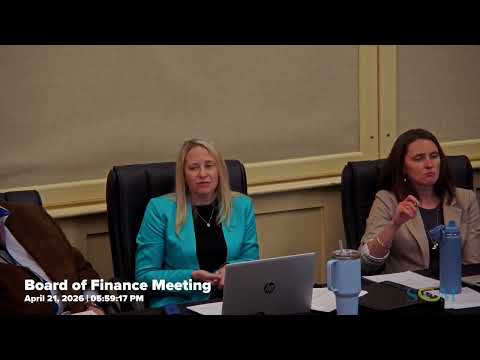
At a continued public hearing on the town’s proposed 2027 budget, the Simsbury Board of Finance was told an unexpected surge in health‑insurance claims could drive year‑end claims to about $19.8 million and create roughly a $2.6 million shortfall in the town’s health insurance fund if stop‑loss reimbursements do not fully materialize. The board voted to re‑notice the proposed budget with a conservative $1,000,000 addition while staff obtains detailed claim reports from its benefits consultant.
Finance staffer Amy summarized the quarterly report, saying the town’s budgeted health‑insurance claims for the year were about $16.3 million and that, to date, actual claims stand “just shy of 14 and a half million.” If current activity persists, “our claims could be about 19,800,000,” she said, a projection that creates an estimated deficit of about $2.6 million in the health fund.
Amy told the board the town had received roughly $800,000 in stop‑loss reimbursements to date but has not yet received all documentation from the stop‑loss vendor to verify additional expected reimbursements. She said the firm Lockton (the town’s consultant) is re‑running projections and will deliver more granular claims data and actuarial advice this week to help determine whether the increase is a one‑time spike or a durable trend.
Chair Lisa framed the board’s next move as a choice between preserving the referendum schedule and taking a conservative approach with the public. She recommended re‑noticing the proposed budget at the higher, conservative level so the hearing would present a worst‑case scenario; if Lockton’s data later shows the spike is temporary, the board could reduce the figure without a second notice. “What we’re doing is giving ourselves those options next week,” a member summarized.
Board members and staff discussed three basic options: (1) proceed as planned and use the $1,000,000 planned withdrawal from the health fund reserves; (2) assign $1,000,000 of the expected general‑fund year‑end surplus to 'feather in' the claim impact while replenishing reserves later; or (3) build the $1,000,000 into the FY27 budget, which finance staff estimated would raise the mill rate to about 34.01–34.02 (roughly a 3.0–3.03% tax increase). Staff emphasized the town’s reserve target is 20–25% of expected claims; current projections place the health fund near 18% if the spike persists.
To preserve flexibility while the consultant finishes its review, the board adopted motions that: (a) eliminate use of $800,000 of health fund reserves and increase the Board of Education FY27 bottom‑line budget by $800,000, and (b) eliminate use of $200,000 of health fund reserves and increase the Board of Selectmen major medical insurance line item by $200,000 (recorded with two 'no' votes). The board also voted to re‑notice the proposed FY27 budget and scheduled a follow‑up public hearing so Lockton’s analysis could be considered before final votes or referendum scheduling.
The board repeatedly emphasized it is not yet making a final budget decision. Amy told members the town has historically used year‑end transfers to replenish reserves when appropriate, but directors said they were reluctant to use general‑fund reserves to support recurring operating costs absent confirmation the claims spike was truly one‑time. The board asked staff to present Lockton’s claim‑level findings at the next hearing before any final decision that would increase the mill rate.
The hearing also produced a package of administrative votes: the board moved the purchase of an ambulance ($200,000) to the capital improvement plan and funded it with capital reserves, assigned $100,000 of general‑fund reserves as a contingency for fuel prices, and approved an $180,000 upward adjustment to expected investment income; those motions carried at the meeting.
The Board of Finance set the next meeting to continue budget discussion and to consider Lockton’s updated projections.
Why this matters: the health‑insurance claim spike affects recurring costs (premiums and reserves) that shape the town’s structural budget health and the size of any tax increase presented to voters. The board’s decision to re‑notice the proposed budget buys time for actuarial verification but makes a conservative scenario visible to the public ahead of a referendum.