Lifetime Citizen Portal Access — AI Briefings, Alerts & Unlimited Follows
Senate passes bill setting rules for subsurface hydrogen exploration, royalties and severance tax
Loading...
Summary
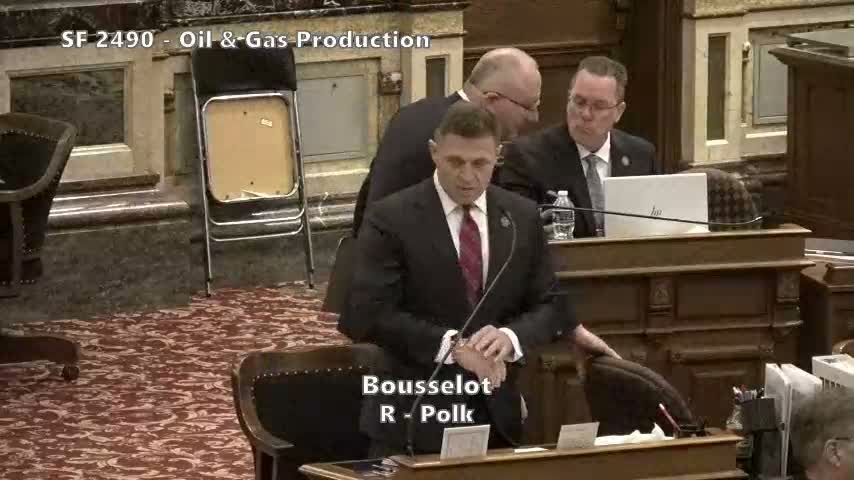
After extended floor debate about landowner protections and confidential filings, the Iowa Senate passed Senate File 2490, which bars eminent‑domain authority, sets pooling and cost‑recovery rules, and establishes a severance tax with specified county and state allocations; the vote was 32‑15.
Senate File 2490, a bill that would regulate exploration and production of subsurface hydrogen and set revenue rules, cleared the Iowa Senate after a floor debate that divided lawmakers over confidentiality, revenue allocation and property rights.
Senator Buslow, the bill sponsor, said the measure protects landowners while creating a regulatory framework for companies that find and produce hydrogen deep beneath Iowa soil. "Let me be clear: there's no eminent domain in this bill," the sponsor said in opening remarks, and he repeatedly emphasized that the bill would prevent forced drilling on surface owners and require consent or specified pooling thresholds before exploration and production proceed.
The bill requires that pooling—combined development of an underground pool—can be sought only where at least 25% of landowners have agreed to exploration if a 100% consent threshold is not met. It also sets cost‑recovery limits: companies that secure consent may recover 100% of exploration costs before paying royalties; for non‑consenting surface owners, companies may recover up to 200% of costs, after which non‑consenting owners would receive a statutory 12.5% share of proceeds. The measure authorizes the Department of Natural Resources director to issue pooling orders, which can be challenged under the state administrative review process (referenced on the floor as a 17A action). The bill also requires annual filings with the DNR by companies engaged in exploration or production.
The sponsor described a severance‑tax scheme to remit proceeds across the state: a portion distributed to all 99 counties, an extra 5% to producing counties, 10% directed to state water‑quality funds, and the majority—70.1%—to the taxpayer relief fund. "Doing nothing is vast," the sponsor said, arguing the current legal vacuum permits extraction that bypasses surface owners and state revenues.
Opponents emphasized two central concerns. Senator Petersen said she would oppose the bill because of confidentiality provisions and the decision to route funds into the taxpayer relief fund rather than the state general fund at a time of projected budget shortfalls: "I just believe that we need revenue coming into the general fund," she said. Senator Kornbach voiced broader worries about the speed of floor action and the risk of a divisive, neighbor‑against‑neighbor conflict reminiscent of recent pipeline debates.
Senator Zimmer raised specific factual and administrative concerns, saying the Iowa Geological Survey (IGS) appeared excluded from required filings and that past practice showed sample release and redaction problems; she urged stronger IGS involvement in the data flow. The sponsor said certain proprietary information (agreements, payment details and commercially sensitive operational data) would remain confidential for a limited time to prevent competitive free‑riding, but that annual reporting to the DNR would still be required.
The Senate adopted the final reading motion and voted to pass the bill. The secretary recorded 32 ayes and 15 nays; the presiding officer declared the bill passed. Senator Klemish asked unanimous consent to immediately message the bill to the House and, hearing no objection, the Senate ordered it sent.
What happens next: SF 2490 will be transmitted to the House for its consideration and any changes there could return the measure to conference. The bill sets administrative responsibilities for the DNR and establishes statutory thresholds and royalty formulas; landowners and counties where operations occur would be directly affected if exploration yields commercially producible hydrogen.