Get Full Government Meeting Transcripts, Videos, & Alerts Forever!
Get email alerts on the Land Use topic
No spam. Unsubscribe anytime.
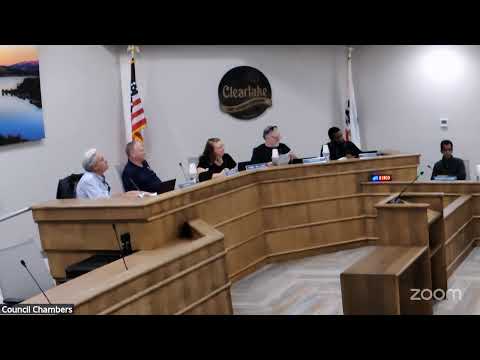
Clearlake planners approve Hope Center expansion after neighbors raise safety, parking concerns
Summary
The Clearlake Planning Commission on April 21 approved a conditional use permit allowing the Hope Center at 3400 Emerson Street to expand by about 7,000 sq ft, adding space for roughly 30 more clients; neighbors pressed the commission on safety, parking and sidewalks, while police data showed manageable calls for service.
The Clearlake Planning Commission voted to approve a conditional use permit for the Hope Center’s expansion at 3400 Emerson Street, advancing a proposal that will add roughly 7,000 square feet to bring total building area to about 13,100 square feet and create 15 additional dual‑occupancy rooms (30 clients).
The action, adopted by roll call as PC resolution PC 2026‑06, followed a staff presentation that recommended approval under the California Environmental Quality Act exemption for small new construction (CEQA §15303). Senior Planner Roberts told the commission the project includes meeting rooms, a commercial kitchen, restrooms and changes to on‑site angled parking that will reduce current parking from about 24–25 spaces to 19 spaces.
Neighbors who spoke at the public hearing urged caution. Joanne Cox, who said she lives directly behind the Hope Center, described thefts and trespass and said, “I now sleep with a gun. I don't feel safe.” Daniel Hu, a neighbor on Olympic Drive, cited the absence of sidewalks and asked where pedestrians would walk if the center sees more foot traffic.
The applicant representative, identified during the hearing as Miss Duncan, acknowledged the concerns and said the site’s operation prioritizes safety. Miss Duncan said staff frequently perform outreach off‑site so the lot is rarely full, said they will limit larger community events, and described on‑site controls including security cameras, a recently repaired six‑foot perimeter fence and participant agreements that require residents to follow rules. She told the commission, “We will relocate [the smoking area]; I will have that conversation tomorrow morning,” and offered to provide a direct cell number to a neighbor who asked for better contact.
Chief Hobbs summarized three years of police contacts involving the facility, saying the department logged 19 cases during that period (ranging from found property to a restraining‑order related call) and that most incidents occurred after staff requested police assistance. “The level of police activity associated with the facility has remained manageable and has not placed a burden on our resources,” Chief Hobbs said.
Commissioners pressed the applicant on operational details. Commissioners were told average client stays run about three to six months; daytime staffing after expansion is expected to be about eight (staggered shifts) with five staff on in the evenings and two overnight at present (the applicant said evening staffing could rise to six if budget permits). The applicant said they do not plan a net increase in on‑site administrative staffing beyond what the expansion requires.
Staff clarified that the proposed angled parking will sit on the property (not in the public travel lane), and that valley gutters would handle drainage where the angled parking meets the roadway; staff also said the city is in the process of finalizing separate paving plans for Emerson that could add parallel parking, curb, gutter and sidewalk in the future.
After deliberation the commission approved the conditional use permit on a roll‑call vote. The resolution adoption instructs staff to finalize permit details and conditions of approval; no additional environmental review was required under the cited CEQA exemption.
The permit approval does not change the commission’s expectation that the operator and staff maintain open lines of communication with neighbors and work with the police department to address future concerns. The commission’s action is final unless appealed under the city’s appeal procedures.