Get Full Government Meeting Transcripts, Videos, & Alerts Forever!
Get email alerts on the Economic Development topic
No spam. Unsubscribe anytime.
Albany commission authorizes staff to negotiate $2 million bridge-loan term sheet for downtown Look Again project
Summary
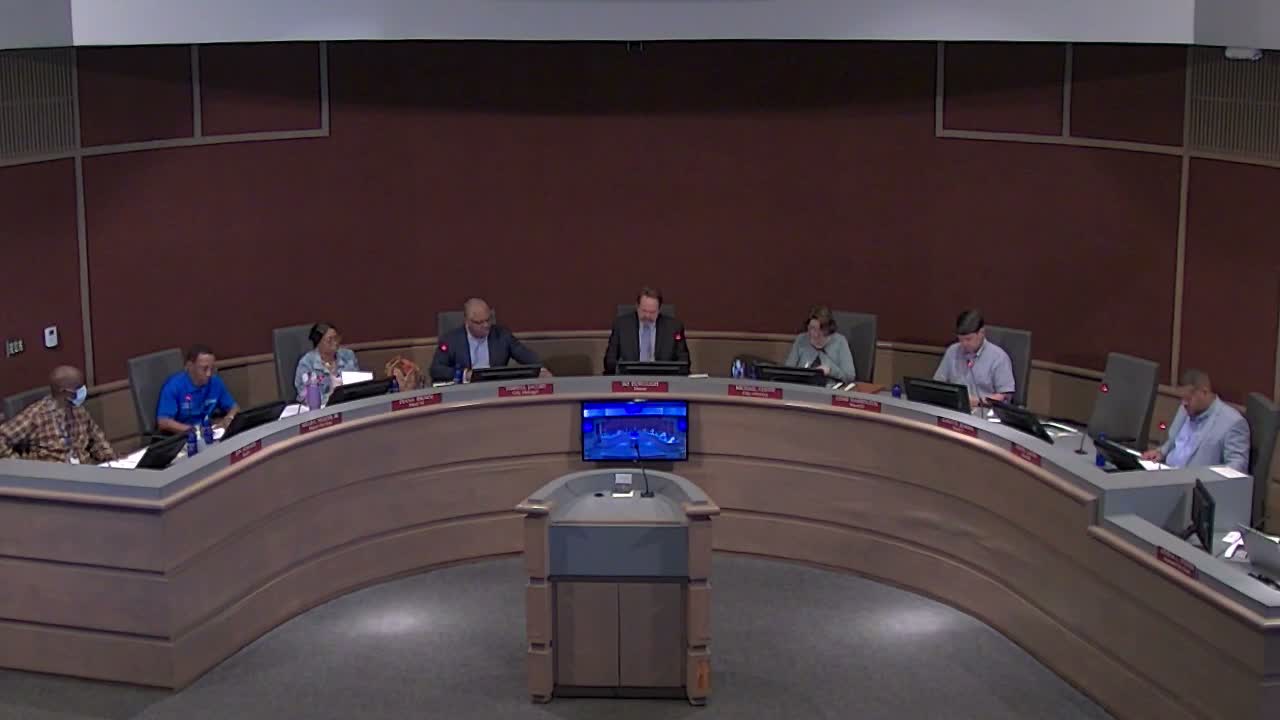
After a heated review of appraisals, related-party concerns and staffing safeguards, the Albany City Commission voted 5–2 on March 10, 2026 to authorize staff to negotiate a term sheet consistent with a $2,000,000 bridge loan to support the downtown "Look Again" redevelopment, with milestones, escrowed payments and personal guarantees pledged by developers.
The Albany City Commission on March 10, 2026 authorized staff to negotiate a term sheet consistent with a $2,000,000 bridge loan to support the downtown "Look Again" redevelopment project, following hours of presentations, legal analysis and questioning about appraisals, related-party transactions and safeguards.
City Manager Terrell Jacobs told commissioners the bridge loan request is aimed at preventing foreclosure and allowing the developers to complete predevelopment work needed to pursue tax-credit financing and permanent lending. "We are here today in regards to specifically to discuss Look Again," Jacobs said, framing the urgency: the developers said they face imminent action by a seller-financier if short-term funding is not secured.
The commission’s legal adviser provided the central warning that shaped debate. Jamie Garner, the attorney working with the city, said the loan involves related-party transfers that require a defensible valuation to avoid a possible gratuities-clause violation of the Georgia Constitution. "We cannot allow an acquisition cost that exceeds what the reasonable value is," Garner said, citing a city appraisal at $655,000 and a borrower appraisal at $890,000 and staff’s proposed compromise valuation of $772,500 for the related parcels.
Why it matters: staff and the developers say the bridge loan—designed to be short term and repaid when permanent financing and tax-credit equity close—would keep three downtown buildings in development hands long enough to complete architectural work, secure new markets and historic tax credits, and finalize a permanent capital stack. Opponents worried the city would effectively subsidize private gain if safeguards are insufficient.
Commissioners repeatedly pressed for documentation and enforceable milestones. Multiple members asked whether commitment letters, bank or county commitments and state approvals for historic tax credits were in hand. DDA chair Devon Ross told the commission the DDA supports the project but warned against advancing funds without strict reporting and draw controls: "To say give them $2,000,000 to walk away from the table without any accountability of what the funds are being used for, I have an issue with that," Ross said.
Developers and consultants said they are actively pursuing the remaining pieces of the capital stack. The developer’s representative said consultants and architects had already been working with the project on a contingent basis and that principals of Look Again agreed to personally guarantee the short-term loan. "All 4 members of Look Again have agreed as one of the conditions to personally guarantee this loan," the representative said. New-markets and historic-tax-credit consultants explained that those credits can provide critical capital but require ownership/control and completed schematic work to apply.
Safeguards staff said would be written into a term sheet include milestone-based disbursements, vendor invoices and closing statements required for draws, benchmarks tied to tax-credit applications and design milestones, an escrowed payment structure for loan servicing, and events of default tied to unmet milestones. Garner said the proposed bridge loan would be interest-only at a low rate (about 3 percent) with a maximum two-year maturity and that many disbursements would be supported by invoices or closing documentation.
The specific legal and valuation dispute animated much of the debate: Garner warned that using public funds to finance an acquisition price that exceeds defensible market value for related-party transactions could trigger constitutional scrutiny. Sherman Golden, counsel for the developer, disputed that reading and urged commissioners to consider the broader public benefits, saying the city’s role is to reduce risk to attract private capital in a distressed downtown area: "I think given the whole picture that this thing doesn't represent a violation of the gratuities clause," Golden said.
Vote and next steps: Commissioner (Speaker 15) moved and Speaker 14 seconded a motion authorizing staff to approve a term sheet consistent with a $2,000,000 bridge loan and to return a completed term sheet and accompanying resolution for formal commission action. The motion passed by roll call, 5–2 (Ward 1 yes; Ward 2 yes; Ward 3 yes; Ward 4 no; Ward 5 yes; Ward 6 no; mayor yes). Staff said it would return with the full term sheet and loan documents at a subsequent meeting (staff indicated the intent to bring back the finalized documents on the commission agenda in mid-March).