Get Full Government Meeting Transcripts, Videos, & Alerts Forever!
Get email alerts on the Stormwater Master Plan topic
No spam. Unsubscribe anytime.
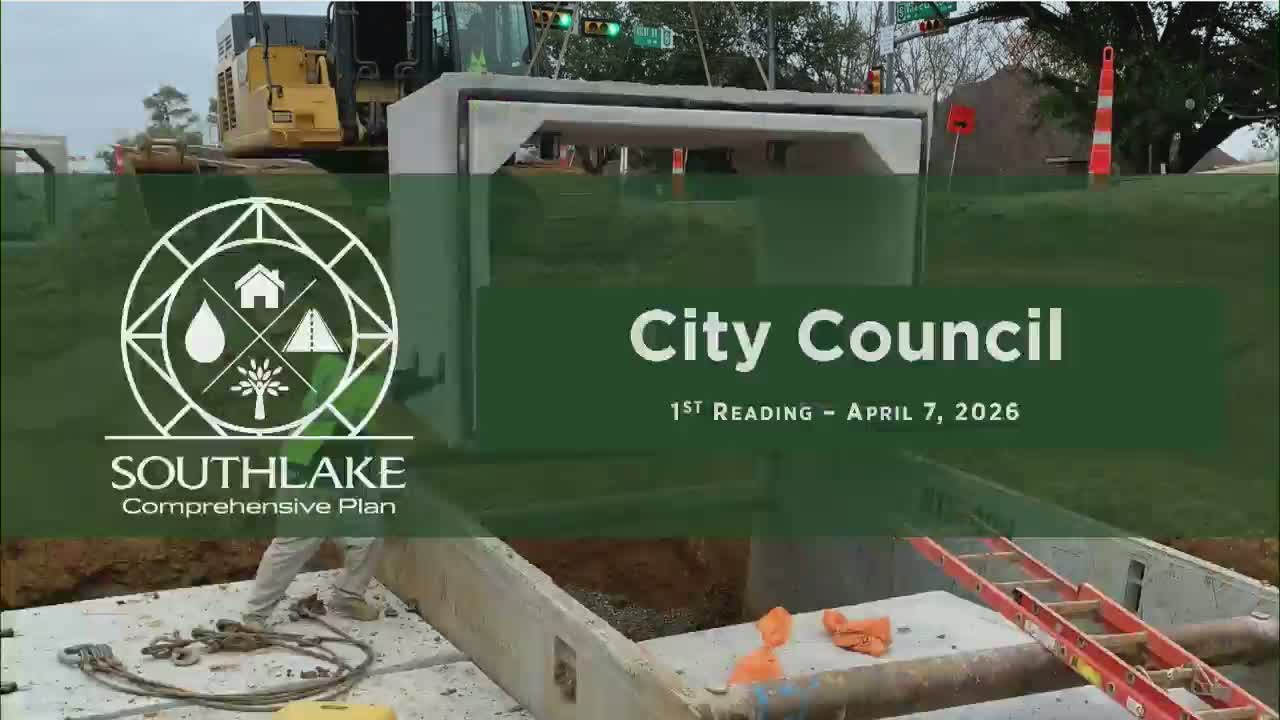
Southlake council approves master plans on first reading after hours of public concern about Big Bear Creek flooding
Summary
After extended public comment from a resident coalition, the Southlake City Council approved first readings of new water, wastewater and stormwater master plans 7–0, and staff said implementation and ordinance updates will follow if council adopts the plans on second reading.
Southlake — The City Council voted 7–0 on April 7 to approve on first reading three new utility master plans — stormwater, water and wastewater — that staff said will guide how the city prioritizes maintenance, capital investment and communications about drainage and flood risk.
Daniel Cortez, director leading the presentation, said the plans are policy and implementation frameworks, not immediate construction programs. “This plan is not the solution itself. It is the foundation,” he told the council, saying the documents set levels of service, asset‑management priorities and a schedule for basin‑level studies and implementation steps.
The meeting drew a large turnout from residents along Big Bear Creek. A delegation calling itself the Big Bear Creek Corridor Coalition documented repeated erosion, trail and bank damage, and rising flood fringes in downstream neighborhoods. “The flood levels that used to be FEMA 100 designation are getting crossed multiple times every year,” said Vamsi Yala, a coalition delegate, warning of accelerating property damage and asking the city to pursue regional coordination, modeling tools and more funding for mitigation.
Coalition speakers described damaged retaining walls, fallen trees, heavy sedimentation and repeated dredging costs in Timberlake and neighboring subdivisions. Resident John Schindler urged the council to treat the problem as a regional watershed issue rather than isolated neighborhood complaints.
Cortez and staff described the technical basis of the plan — layering FEMA maps with local LiDAR, updated Atlas‑14 rainfall inputs and private development studies — and said the stormwater fee is dedicated to stormwater work only. He emphasized that the plan formalizes policy statements that will inform future CIP programming, ordinance updates and how staff responds to resident service requests.
Council members pressed staff for clarifications about timelines, rate reviews and potential implementation steps. Mayor Pro Tem Williamson moved approval; the council approved the stormwater, water and wastewater plans on separate motions, each by a 7–0 roll call.
What happens next: staff said adoption on second reading would trigger an implementation plan, ordinance and funding discussions and that some items (for example basin studies and updated technical tools) could move forward quickly. The council scheduled second readings for two weeks. Residents were told the staff reports and the meeting video are available on the city website.
Speakers quoted (selected): - “This plan is not the solution itself. It is the foundation,” — Daniel Cortez, Director of Public Works. - “The Big Bear Creek has become a raging river during heavy rains,” — Vamsi Yala, Big Bear Creek Corridor Coalition.
Actions: The council approved on first reading the Stormwater Master Plan (CP‑26‑0001), the Water Master Plan (CP‑26‑0002) and the Wastewater Master Plan (CP‑26‑0003). Each motion passed 7–0. The council will hold second readings in two weeks.
Context: The plan responds to residents' concerns about recurring floods and infrastructure aging as Southlake approaches build‑out. Staff said many of the coalition’s priorities are reflected in the policy statements and that implementation and funding decisions will follow a documented timeline.