Get Full Government Meeting Transcripts, Videos, & Alerts Forever!
Get email alerts on the Utilities topic
No spam. Unsubscribe anytime.
Huntsville Utilities explains winter billing spike, audits underway
Summary
Huntsville Utilities told the City Council that prolonged cold, heat-pump auxiliary heating and TVA pass-through charges largely drove unusually high winter bills; the utility has initiated multiple audits and invited affected customers to meet staff in the lobby for one-on-one help.
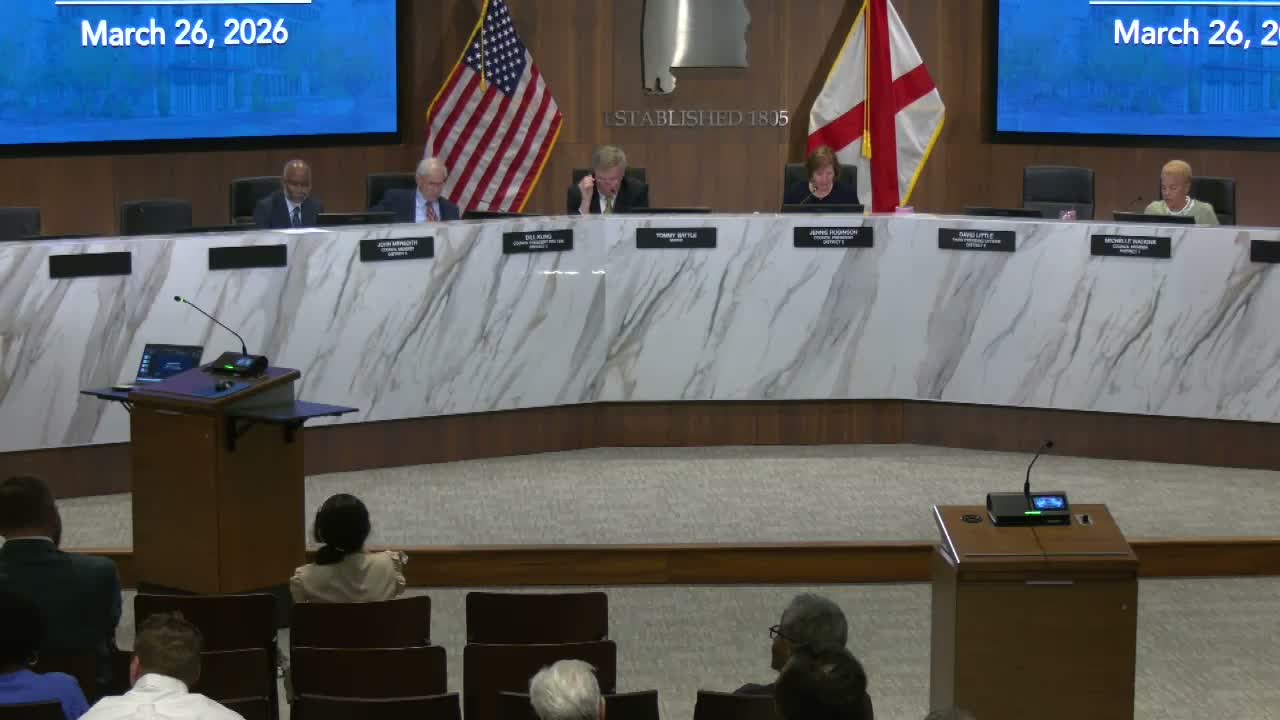
Huntsville City Council heard a detailed explanation on March 26 from Huntsville Utilities about unusually large winter 2026 customer bills and the steps the utility is taking to address them. CEO Wes Kelly said a combination of prolonged sub-40-degree weather, auxiliary heat on residential heat pumps, TVA demand-metering and a TVA fuel-cost adjustment were the main drivers of higher usage and charges.
"When auxiliary heat kicks in, you're gonna use 2 to 3 times the amount of energy you were using before," Kelly told the council, explaining why homes with electric heat pumps saw bills spike during the cold snap. He also described the fuel cost adjustment as a TVA pass-through that varies monthly and can materially change a customer's bill.
Kelly provided system-level figures: Huntsville Utilities serves about 235,000 electric accounts and about 63,000 gas accounts. He said the TVA fuel-cost adjustment can represent roughly a third of some residential bills and that the utility displays an availability (fixed) charge on the new bill format — $17.23 for services at or below 200 amps; he cited a larger figure for over-200-amp services as it appears in their rate spreadsheet. Kelly described the shift to the new billing format and a mid-year change of billing systems as complicating factors.
Council members pressed for detail and suggested expanded public outreach on weatherization and conservation. Kelly said the utility has hired outside firms to review billing and metering accuracy: MaloneJenkins is completing a financial audit for the utility board; Baker Tilly completed an initial billing review and (per Kelly) found no systemic discrepancies but the utility asked them to re-run the review using a larger sample; and a metering specialist, eSource, is beginning a metering-system review to verify that smart-meter data flows correctly into billing.
Several residents used the meeting's agenda-related public-comment period to describe personal billing disputes. Michael Francis told the council he received a single bill showing roughly 113,000 gallons of water for a month, that two plumbers and a specialized leak detector found no leak, and that the bill eventually grew to a $2,676 balance that he felt compelled to pay to avoid disconnection. Kelly and customer-service staff encouraged residents with specific account disputes to use the utility's lobby team and resolution process; Takisha Cowen, the utility's director of customer service, was present to help customers after the meeting.
Kelly also reviewed customer-assistance programs and partnerships. He said community organizations and charitable funds had provided about $850,000 to help low-income customers during the winter period and that the utility's Project Share and other programs provided additional financial assistance. Kelly proposed longer-term mitigation ideas, including voluntary round-up contributions and continued advocacy for federal programs such as LIHEAP.
Kelly concluded by saying the utility wants to be transparent and accurate: "I want it to be right. If there's a problem, I want to fix it," and committed to returning audit findings to the utility board and reporting follow-up to the council.
Next steps: the utility will present the Baker Tilly expanded review to its board in April, continue the eSource metering verification, and hold one-on-one meetings with customers who have unresolved disputes.