Lifetime Citizen Portal Access — AI Briefings, Alerts & Unlimited Follows
AFN‑funded study and providers urge culturally rooted programs, probation reform and more tribal court support to curb Alaska Native incarceration
Loading...
Summary
Presenters from AFN, UAF, Southcentral Foundation, Cook Inlet Tribal Council and the Alaska Native Women's Resource Center told the House Tribal Affairs Committee the AFN report documents deep racial disproportionality (Alaska Native people represent roughly 19% of the population but about 44% of those incarcerated) and recommended early interventions, achievable parole/probation conditions, expanded culturally rooted reentry programs and increased state support for tribal courts and diversion programs.
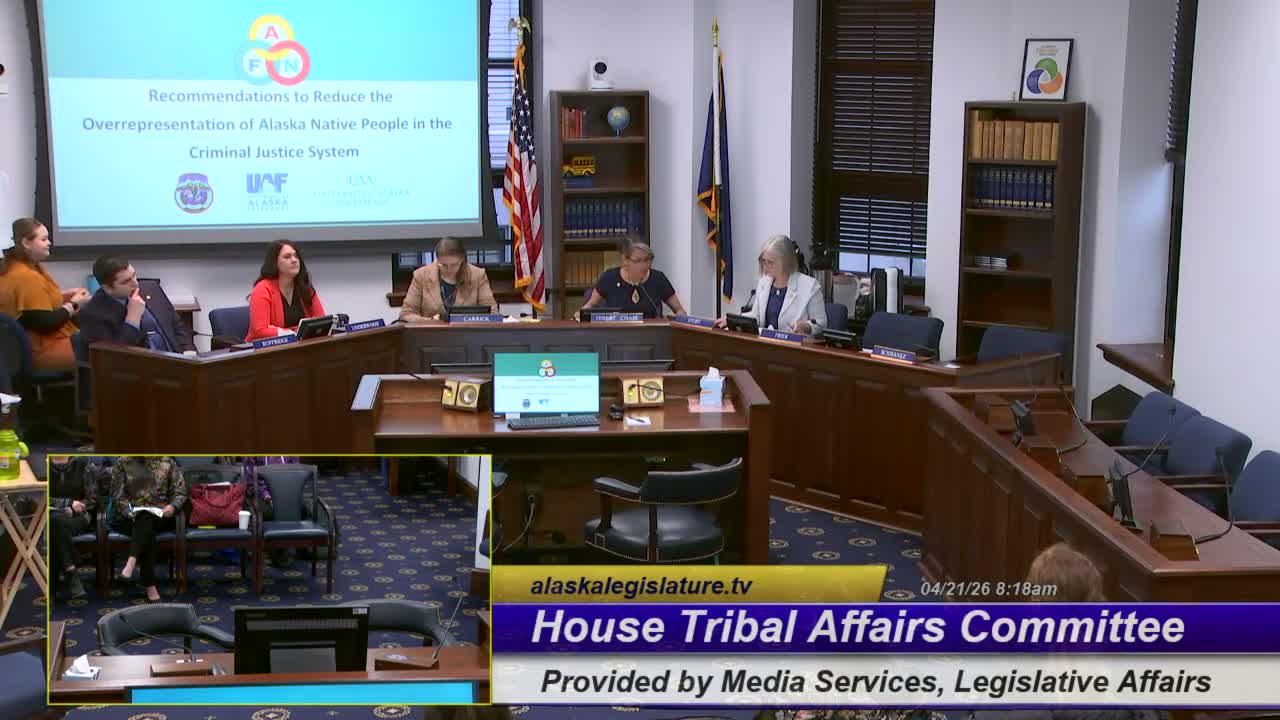
A report commissioned by the Alaska Federation of Natives and presented to the House Tribal Affairs Committee on April 21, 2026, documents persistent and deep overrepresentation of Alaska Native people across the state’s criminal justice system and recommends a package of prevention, treatment and justice‑system reforms.
Dr. Katie Cueva of the University of Alaska Fairbanks, who led the research component, said the study used key‑informant interviews, surveys and literature review. She summarized the scale of the problem: depending on how race is counted, Alaska Native people make up roughly 14–19% of the state’s population in different measures but account for about 44% of people incarcerated according to Department of Corrections data; Alaska Native recidivism was described as the highest among monitored groups (cited at about 60%). Cueva and other presenters emphasized structural and historical drivers — including trauma, poverty, housing instability and limited culturally relevant services — and singled out probation and parole violations (roughly 62% of re‑incarceration in the study) as a critical area for policy change.
Representatives of Southcentral Foundation described Nuweju Healing Place, culturally rooted therapeutic communities inside Palmer and Highland Mountain correctional facilities and a restricted‑activity two‑week program. Bobbie Outen, Southcentral’s service‑line clinical director, reported program recidivism in their cohort between roughly 28% and 33% — less than half the state rate — and offered a back‑of‑the‑envelope estimate that the program has produced multi‑million‑dollar annual savings for the state in avoided incarceration costs. Polly Andrews described evaluation outcomes showing statistically significant improvements in protective factors and reductions in trauma symptoms and emergency‑room use among participants.
Cook Inlet Tribal Council presenters described early engagement, culturally infused curricula and robust wrap‑around services — housing referrals, transportation, peer mentorship and employment partnerships — as essential elements for successful reentry. Caitlin Hickey, a youth advocate with CITC, explained how using culture as a learning framework helps sustain in‑facility programming and improves continuity into the community.
Rick Haskins Garcia of the Alaska Native Women’s Resource Center outlined tribal justice developments and limits on tribal criminal jurisdiction. He reviewed the effect of the 1978 Oliphant decision, which curtailed tribes’ criminal authority over non‑Indians, and noted that subsequent reauthorizations of the Violence Against Women Act restored limited tribal jurisdiction for certain domestic violence offenses; he said some Alaska tribes are moving toward formal criminal jurisdiction but none are yet exercising full criminal authority over non‑natives.
Committee members asked about operational barriers and scaling: wait lists for programs (Outen said the women's facility has a higher demand and some wait lists, while men's programming is rebuilding), volunteer access models for tribal elders and culture‑bearers (presenters requested a volunteer access process similar to the DOC chaplaincy), and logistical barriers to bringing culturally rooted programs into small communities (presenters cited funding, staff capacity and infrastructure). Several members suggested follow‑up actions, including a committee letter to DOC and potential site visits during the Elders and Youth Conference.
The presentations emphasized a combination of upstream investments (early childhood, prenatal care, culturally relevant mental‑health services), pragmatic changes to probation and parole conditions so they are achievable in rural communities, and ongoing state support for tribal courts, diversion and restorative justice practices. The committee took no vote; staff indicated follow‑up hearings and meetings will continue.