Lifetime Citizen Portal Access — AI Briefings, Alerts & Unlimited Follows
House committee hears bill to extend victim‑counselor confidentiality to tribal programs
Loading...
Summary
Rep. Gray introduced HB 384 on April 21, 2026, to add the words “or tribal” to AS 18.66.250 so tribal victim‑counseling programs receive the same statutory confidentiality protections as nonprofits and military‑affiliated providers; staff counsel said the change closes a statutory gap that can make tribal advocate communications discoverable in later proceedings.
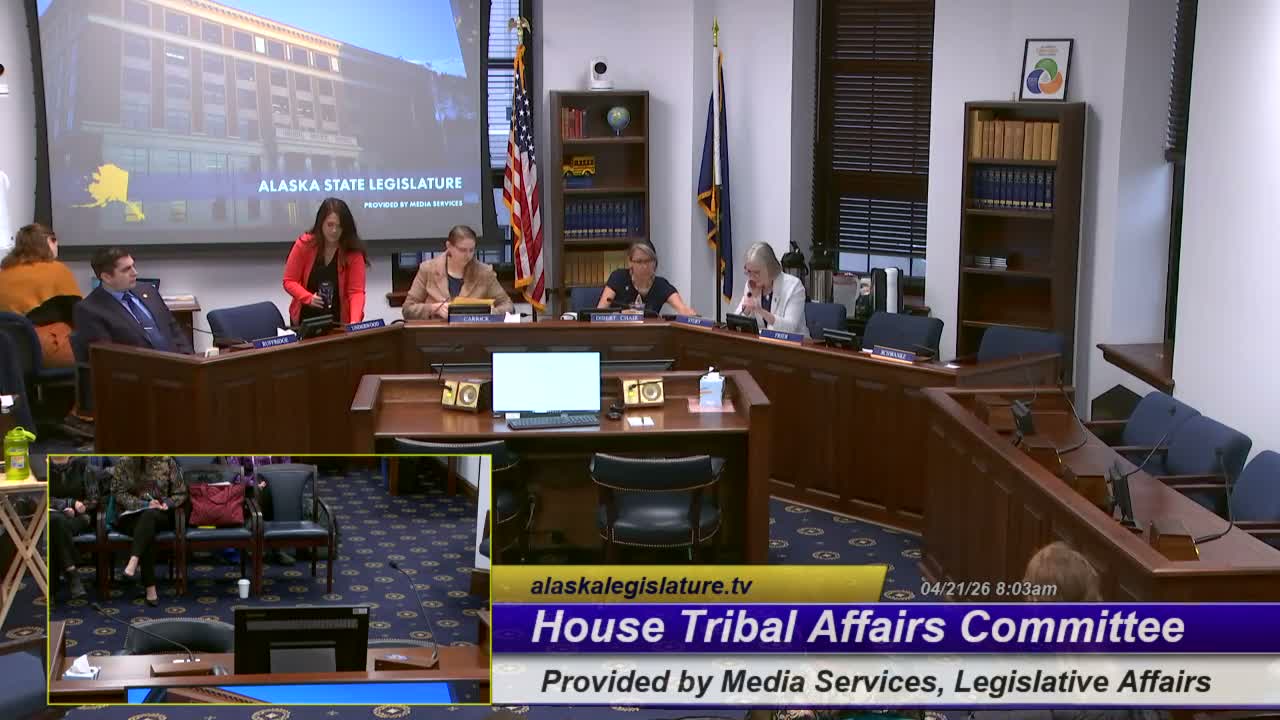
Representative Gray introduced House Bill 384 to the House Tribal Affairs Committee on April 21, 2026, asking the legislature to add the words “or tribal” to AS 18.66.250 so tribal governments that provide victim counseling and advocacy would receive the same statutory confidentiality protections now available to nonprofits and certain military‑affiliated providers. The committee took a brief initial presentation and set a schedule for additional testimony.
Gray told the committee that Alaska law provides strong confidentiality protections for communications between victims and counselors, protections that encourage survivors to seek services without fear those communications will be disclosed in court. “As the landscape of service providers has expanded, it has become necessary to update that statute accordingly,” Gray said. The bill’s text is narrow: Section 1 inserts two words and Section 2 states applicability, according to Dylan Hitchcock Lopez, staff to Representative Gray and counsel on the bill.
Hitchcock Lopez explained why a general constitutional right to privacy does not substitute for the statutory privilege. He told members that the Alaska Constitution’s privacy guarantee and the statutory confidentiality scheme serve different legal functions: statutes governing privileged victim‑counselor communications are tailored to limit discovery obligations in criminal and civil cases and to avoid conflicts with defendants’ constitutional rights to discovery and confrontation. Under current Alaska statutes, Hitchcock Lopez said, tribal‑run counseling programs fall into an anomaly in which communications with tribal advocates may be discoverable, while the same services provided by a nonprofit would usually be privileged.
Rick Haskins Garcia of the Alaska Native Women’s Resource Center, who participated in the earlier portion of the hearing, told the committee tribal advocates’ notes and safety plans can be subject to subpoena in the absence of statutory privilege, which can chill survivors’ willingness to seek care through tribal programs. Committee members noted the bill carries no fiscal note and that the committee will take fuller testimony on Thursday with invited and public testimony.
The committee set an amendment deadline for Friday, April 24 at 5 p.m. and will return to HB 384 at the next scheduled Tribal Affairs hearing. The hearing record includes the brief sectional explanation from staff counsel and initial committee questioning; the bill did not receive a committee vote at the April 21 session.