Get Full Government Meeting Transcripts, Videos, & Alerts Forever!
Get email alerts on the Consent Agenda Infrastructure topic
No spam. Unsubscribe anytime.
Columbia County commissioners move multiple infrastructure contracts and emergency repair to consent agenda
Summary
County staff presented and recommended approval of a multi-item consent agenda that included an emergency pump repair estimate of $71,395, utility and construction contracts (including a $95,659 stormwater lining award and an $88,413.95 striping contract), several GDOT/GDOP indemnifications and an agreement to use Jefferson Electric infrastructure at 50¢ per customer.
Columbia County staff presented a multi-item consent agenda during the commission meeting, asking the board to approve routine maintenance contracts, an emergency pump repair and several road- and utility-related agreements.
A staff member told commissioners the annual contract to maintain the county's hydraulic distribution-model costs $18,000 and is performed by Goodwin Mills and Kaywood; staff recommended continuing that work and paying from the distribution department line item. The same staff member described an emergency repair for a failed vertical turbine backwash pump that left the plant without a backup to clean filters and estimated the repair at $71,395 to be paid from the treatment-plant line item.
County staff also presented an encroachment agreement with Atlanta Gas and Light needed to cross an existing gas line for the Gucci Creek'Harlem interceptor sewer project and said legal staff had reviewed the agreement. On metering, staff described a follow-up agreement with Jefferson Electric to use the company's infrastructure for automatic meter reading at remote locations at a cost of 50 cents per customer; with about 170 customers currently served, staff estimated a roughly $1,020 charge paid from the water utility administrative line.
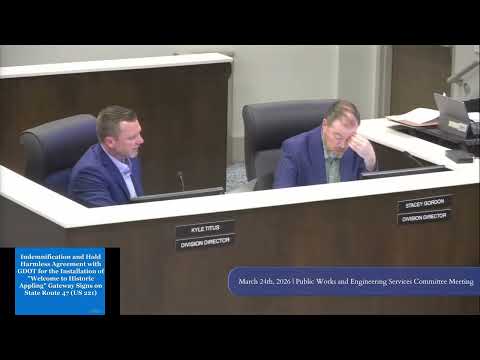
On transportation items, the board was asked to authorize an $88,413.95 contract with Mid State Construction and Striping for safety striping on county-maintained sections of several roads, and to execute multiple indemnification or hold-harmless agreements required by state agencies to advance right-turn-lane and intersection improvements. An agency official said one such GDOT-required agreement would allow the county to extend a Washington Road right-turn lane from about 175 feet to 775 feet to improve corridor flow.
For stormwater, an agency official said Cajun Construction and Rehabilitation Services was the lowest responsive bidder for two UV lining projects at 308 Timber Ridge Drive and 108 Moorhead Drive, with a contract of $95,659 and a 120-calendar-day completion requirement. A commissioner asked whether the county prioritizes corrugated metal pipe repairs by need; an official replied that UV lining works only when the pipe remains structurally intact and that the county packages nearby sites regionally to control costs.
The board also heard a request from the local utility coordinating committee to proclaim April 2026 as Safe Digging Month to promote dialing 811 before excavating; staff recommended placing the proclamation on the consent agenda. Staff presented a 2026 amendment to the Columbia County radar permit for the sheriff's office that includes 16 updates tied to construction zones, speed-limit adjustments and sight-distance issues and asked that the engineering services division director be authorized to sign the application and future revisions requested by the Georgia Department of Public Safety.
An agency official recommended accepting two permanent utility easements and associated water infrastructure shown on a Swift and Associates plat dated 01/16/2026 for Lehi Space of Evans LLC, contingent on staff approval and with a one-year warranty on materials and workmanship. A staff member later offered the year-to-date budget report and water and sewer construction-projects report; commissioners had no questions.
During public comment a resident said the project has been completed for over a year and that the plants are operating well and open for commissioners to visit. Procedural motions were made to move the collection of items to the consent agenda and were seconded during the meeting; the transcript shows staff recommended approval of the items and commissioners proceeded with routine business and staff reports before moving into executive session.
What happens next: items on the consent agenda were presented for approval and were moved to consent during the meeting; the transcript records the motions and seconds and staff recommendations for approval. If the board finalizes the consent vote in the minutes, each listed contract, indemnification and the emergency repair would be authorized according to the line-item funding described by staff.