Get Full Government Meeting Transcripts, Videos, & Alerts Forever!
Get email alerts on the Homelessness topic
No spam. Unsubscribe anytime.
San Marino council introduces ordinance to regulate encampments, bar vehicle habitation
Summary
The City Council voted to introduce Ordinance O-26-1425 to clarify enforcement of encampments in public spaces, add outreach and notice requirements, and prohibit habitation in vehicles while preserving nonpunitive outreach and a 60-day period for reclaiming belongings.
The San Marino City Council moved to introduce Ordinance O-26-1425, updating the municipal code to set clearer standards for responding to encampments and to prohibit habitation of vehicles on public streets and parking lots. Staff recommended the change as a health-and-safety measure that aligns the city’s code with recent Ninth Circuit rulings, and the council approved the measure as amended by roll call vote.
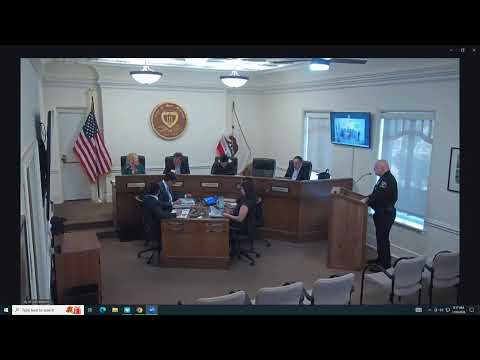
Chief Encanto, who presented the ordinance, said the changes “are about health and safety concerns” and described two new code sections: 14.05.0.05 (enforcement procedures) and 14.05.0.06 (prohibition of habitation in vehicles). The presentation said the ordinance defines habitation, identifies sensitive areas where camping is prohibited, establishes advance-notice and outreach procedures prior to enforcement, and creates penalties aimed at addressing safety, sanitation and nuisance concerns while providing outreach to connect people with shelter and services.
City staff framed the proposal as a response to recent court decisions (cited in the presentation) that limit punitive approaches to homelessness but allow regulation when grounded in legitimate health and safety interests. The ordinance includes an exception for exigent circumstances and a requirement that staff make reasonable outreach and shelter offers before enforcement actions when feasible.
Council members pressed for details on several operational points. One council member asked whether the term “intoxicated” in the ordinance covers drugs as well as alcohol; Chief Encanto replied, “Intoxication means alcohol, drugs.” The city attorney explained why the ordinance sets a 60‑day minimum for storing personal property seized from cleared encampments, saying, “You need about 60 days in your ordinance … After that, we’re free to dispose of them.”
Members also questioned wording in the ordinance’s recitals about hazards and suggested explicitly naming human waste; the city attorney said the broader terms “hazardous materials and unsanitary conditions” cover those concerns but that the council could add language if it preferred.
On enforcement, the attorney described a range of remedies: ticketing and misdemeanor citations, towing, and, if necessary, nuisance actions and court orders that could bar individuals from occupying public streets. Staff and the city manager said Proposition A funding might be a potential, limited source for replacing a problematic bus shelter near a sensitive area, but noted that Proposition A revenues are modest and largely committed to school-related transit work.
A council member voiced caution about towing or vehicle removal and urged multiple warnings and outreach before severe enforcement actions are taken; police staff said officers typically offer resources and referrals during contacts.
The motion to introduce the ordinance (to waive full reading and introduce by title only) passed on a roll call after the city attorney’s recommended language change making the recital refer to the “public” rather than only “residents.” The ordinance was introduced for first reading; staff will return with next steps and implementation details.
The council moved on to other business and approved consent items before adjourning.