Lifetime Citizen Portal Access — AI Briefings, Alerts & Unlimited Follows
Hanford council prioritizes Hidden Valley expansion, agrees to TPL‑funded polling to test funding options
Loading...
Summary
After a staff presentation and a council prioritization exercise, Hanford council instructed staff to pursue public-opinion polling (paid by Trust for Public Land) to test voter support for financing options to fund park projects, with Hidden Valley expansion emerging as the top council priority.
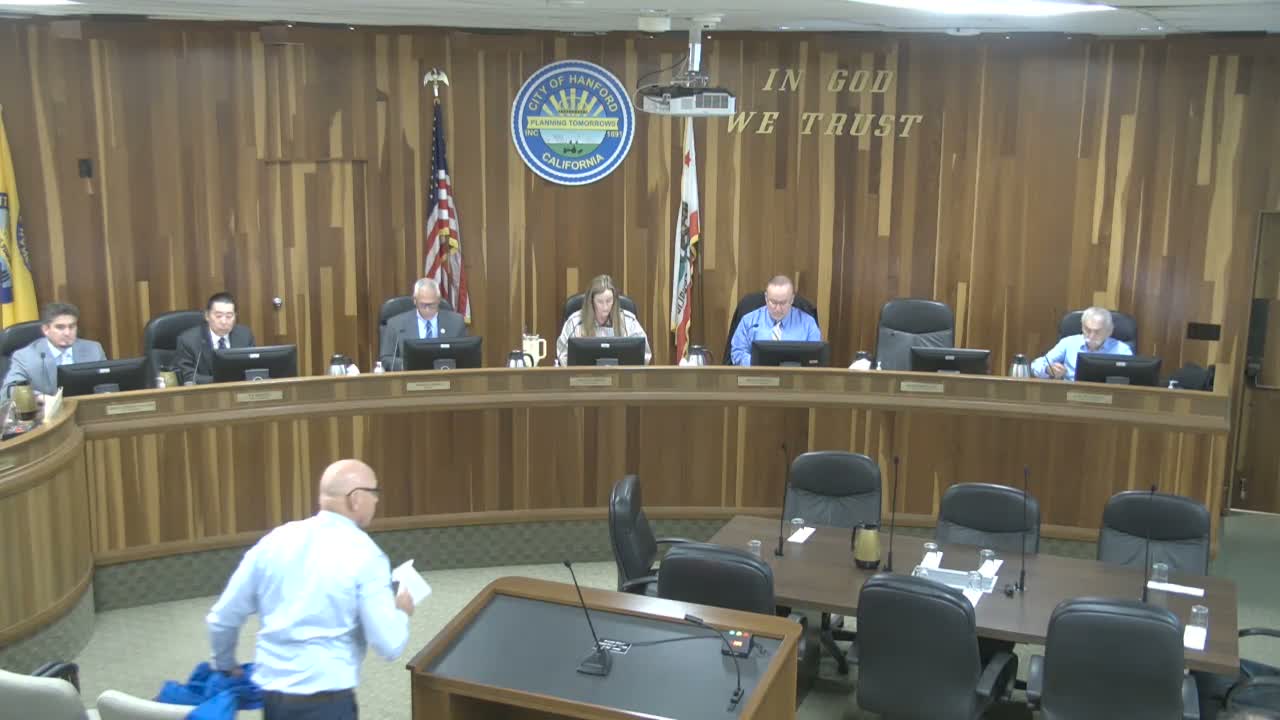
The Hanford City Council on April 21 directed staff to move forward with public‑opinion polling, funded by the nonprofit Trust for Public Land (TPL), to test community support for ballot financing options for parks projects after a study‑session presentation laid out three major capital priorities.
Brad Albert, the city parks official, told the council the parks and recreation master plan identifies persistent deficiencies and that three projects had been selected for prioritization: expansion of Hidden Valley Park (phased; phase one—perimeter path, ~50‑space lot and basic amenities—estimated at about $5.2 million), a multigenerational community center (a planning estimate of roughly $30–40 million, use of $36 million for planning), and completing Heroes Park (an additional $16 million beyond $12 million already reserved, bringing its full build‑out near $28 million). Albert summarized the combined planning estimate at about $70.7 million and said a pending environmental impact report will affect final costs and scope.
Nathan Henry, Western Conservation Finance Director at Trust for Public Land, outlined three typical financing approaches: bonds (raise a large upfront capital sum but restricted to capital uses), parcel taxes (a fixed charge raising revenue over time, requiring two‑thirds for a special tax), and sales tax increases (varied rates with differing revenue and voter thresholds). Henry said TPL has supported hundreds of measures and offered to fund polling to help the city calibrate ballot language and revenue scenarios.
Council members then used an anonymous electronic exercise to rank the three projects; the results showed Hidden Valley with 14 points, the multigenerational center with 13, and Heroes Park with 3. After questions about timing, mechanics and budget impacts—including a report from Finance Director Destiny Borba that the city’s cannabis fund balance was roughly $688,000 (fiscal‑year fund balance)—council moved to "receive the presentation, prioritize the capital projects as discussed, and move forward with polling services with FM3," with TPL to pay polling costs.
Public comment before the council was mixed. Several speakers urged caution about asking voters for more taxes while residents still feel taxed or fatigued by recent measures; others urged the council to convert the 18 undeveloped acres adjacent to Hidden Valley to parkland and to prioritize simpler, quicker improvements first. City staff and the city attorney said the environmental review and traffic studies (anticipated in May) will be required before final project designs and rezoning are completed.
Next steps: staff will execute the polling engagement with FM3 (paid for by TPL), return environmental review findings on Hidden Valley to council when available, and report back with refined cost estimates and options for ballot timing and language.